
Article
Methylene blue during pregnancy and breastfeeding
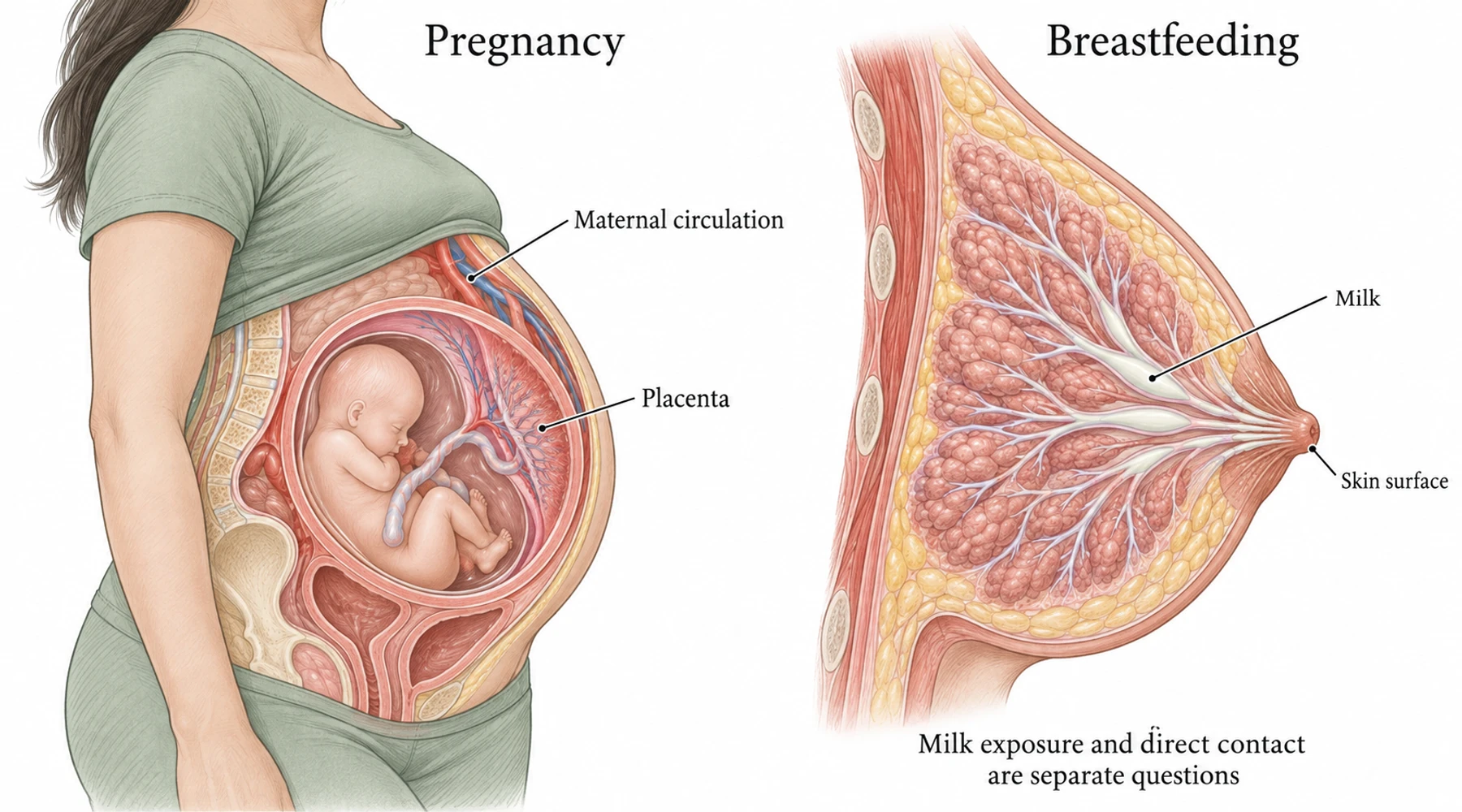
Do not start methylene blue for wellness, a mouth ulcer, or weaning during pregnancy or breastfeeding without a treatment decision from your healthcare team. There is no established safe home regimen for these situations. A hospital decision to use an intravenous antidote addresses a different problem from choosing oral drops or applying a dye to the breast.
The useful question is specific: which product, by which route, for which condition, and who could be exposed? Maternal absorption, fetal exposure, transfer into milk, and an infant swallowing material from the nipple are separate questions.
Pregnancy: what the warning is based on
The US prescribing information for PROVAYBLUE injection warns of potential fetal harm. It describes adverse developmental findings in rats and rabbits given methylene blue orally during organ formation. Those animal experiments establish a hazard signal; they do not identify a safe human oral dose.
Some of the strongest human evidence concerns intra-amniotic injection, meaning injection into the fluid-filled sac surrounding a fetus. Historically, clinicians used dye during amniocentesis to distinguish twin sacs. That route places the dye in the fetal environment and must not be confused with injection into the mother's vein.
In van der Pol and colleagues' 1992 retrospective study, 89 twin pregnancies underwent amniocentesis, with methylene blue used in 86. Seventeen pregnancies had an infant with jejunal atresia, a blockage caused by an absent or closed segment of small intestine. In the 15 affected pregnancies where dye exposure could be assigned to a particular twin, the affected infant was the exposed one. This was a serious route-specific safety signal, not an estimate of risk after an accidental skin splash or an oral supplement.
Why emergency treatment remains a separate decision
The Proveblue 5 mg/mL injection product information limits use during pregnancy to situations where it is clearly necessary, giving life-threatening methemoglobinemia as an example. In this disorder, altered hemoglobin cannot deliver oxygen normally. The danger of the untreated illness belongs in the decision alongside the medicine's risks.
That clinical exception does not support elective use for energy, cognition, or prevention. If methylene blue is proposed in hospital, tell the team that you are pregnant, your gestational age, and every medicine or supplement you take. Do not delay emergency assessment while trying to select an alternative yourself.
Route-specific evidence table
This table separates evidence that exists from questions it cannot answer. It is an original synthesis of the linked labels, studies, and lactation reference, checked on 12 September 2026.
| Product or exposure route | Evidence and clinical context | Practical interpretation |
|---|---|---|
| Intravenous PROVAYBLUE or Proveblue injection | Prescription antidote products have pregnancy warnings and specific lactation restrictions. Proveblue identifies life-threatening methemoglobinemia as a possible pregnancy indication. | Hospital benefit-risk assessment; the injection label does not validate a retail oral product. |
| Intra-amniotic methylene blue dye | Historical twin-amniocentesis studies associated direct sac exposure with intestinal atresia. | Keep this route explicit when discussing fetal findings; do not transfer its observed event frequency to other exposures. |
| Oral drops, capsules, or solutions | LactMed reports no safety information for oral methylene blue during breastfeeding. The reviewed evidence does not establish a pregnancy wellness regimen. | A smaller advertised amount or a purity claim does not supply missing pregnancy or infant-safety evidence. |
| Local mouth application or a compounded rinse | A randomized cancer-related oral-mucositis trial excluded pregnancy and breastfeeding. This population differs from pregnant people with ordinary mouth ulcers. | Efficacy in another population cannot establish reproductive safety. Record formulation, concentration, contact site, and any swallowing. |
| Nipple or breast-skin application | The reviewed clinical sources do not establish a safe methylene-blue weaning method. Surface residue presents a direct-contact question independent of milk transfer. | Do not apply methylene blue to discourage feeding. An infant can contact the product without maternal absorption occurring first. |
Mouth ulcers during pregnancy
“Only on the ulcer” does not resolve the exposure question. A mouth product contacts mucosa, mixes with saliva, and may be swallowed. Its ingredients also matter: a mixture containing borax, honey, alcohol, or other substances is not interchangeable with methylene blue alone.
The randomized phase 2 study of methylene-blue rinse for cancer-related oral mucositis investigated adults receiving chemotherapy whose pain persisted despite conventional care. Its exclusion of pregnant and breastfeeding people is a concrete reason not to generalize its findings to this question. The study was about a defined treatment setting, not a general pregnancy mouth-ulcer remedy.
Ask a dentist, midwife, or pharmacist to identify a suitable treatment for the actual lesion and check the complete product. The NHS mouth-ulcer guidance advises assessment for an ulcer lasting more than three weeks, one different from previous ulcers, or one becoming more painful, red, or bleeding. An unexplained persistent lesion needs examination rather than repeated staining.
Breastfeeding: what the eight-day label means
For intravenous PROVAYBLUE treatment, the US label instructs patients to discontinue breastfeeding during treatment and for up to eight days afterward. This recommendation addresses potential serious adverse reactions, including genotoxicity. It is product-specific prescribing guidance, not a tested safe interval for every methylene-blue formulation or repeated oral use.
The February 2026 LactMed entry reports no relevant published maternal or infant drug-level information and no safety information for oral use during breastfeeding. It also discusses a 1933 report in which milk did not turn blue after maternal administration, with the route presumed intravenous. An unchanged milk color cannot establish an infant's exposure or prove safety. A visual observation is not a modern concentration measurement with a known detection limit.
If hospital treatment is needed, obtain a written feeding plan covering the last administration time, temporary feeding arrangements, expressing if appropriate, and when to resume. A temporary interruption need not mean a decision to wean permanently. Do not calculate a restart time from urine color or from an online half-life calculator.
Applying it to the breast during weaning
Do not use methylene blue on the nipple or breast to make a child stop nursing. The concern includes product directly entering the child's mouth or contacting skin. Even a hypothetical finding of negligible milk transfer would leave that exposure route unresolved.
For planned weaning, the NHS approach to stopping breastfeeding uses a gradual reduction in feeds, with age-appropriate replacement feeding. This also reduces engorgement and mastitis risk. A breastfeeding specialist can help adapt the transition when discomfort or feeding difficulties are driving the decision.
If exposure has already happened
Do not repeat an unprescribed exposure while arranging advice. Keep the container and record the concentration, ingredients, amount, route, timing, pregnancy stage or infant age, and whether an infant directly contacted the product. These details are more useful than saying only that it was “a little blue dye.”
Contact your maternity team, pharmacist, or poison information service for an exposure-specific assessment. If an infant may have swallowed the product, seek poison-service advice promptly. Breathing difficulty, collapse, a seizure, or marked difficulty waking requires emergency help.
Bring the medication list too. The methylene blue interaction guide explains why serotonergic medicines matter; the broader safety reference covers other contraindications. Do not stop prescribed medicines on your own to make methylene blue seem compatible.