
Article
Methylene blue and the gut microbiome: what the mouse study shows
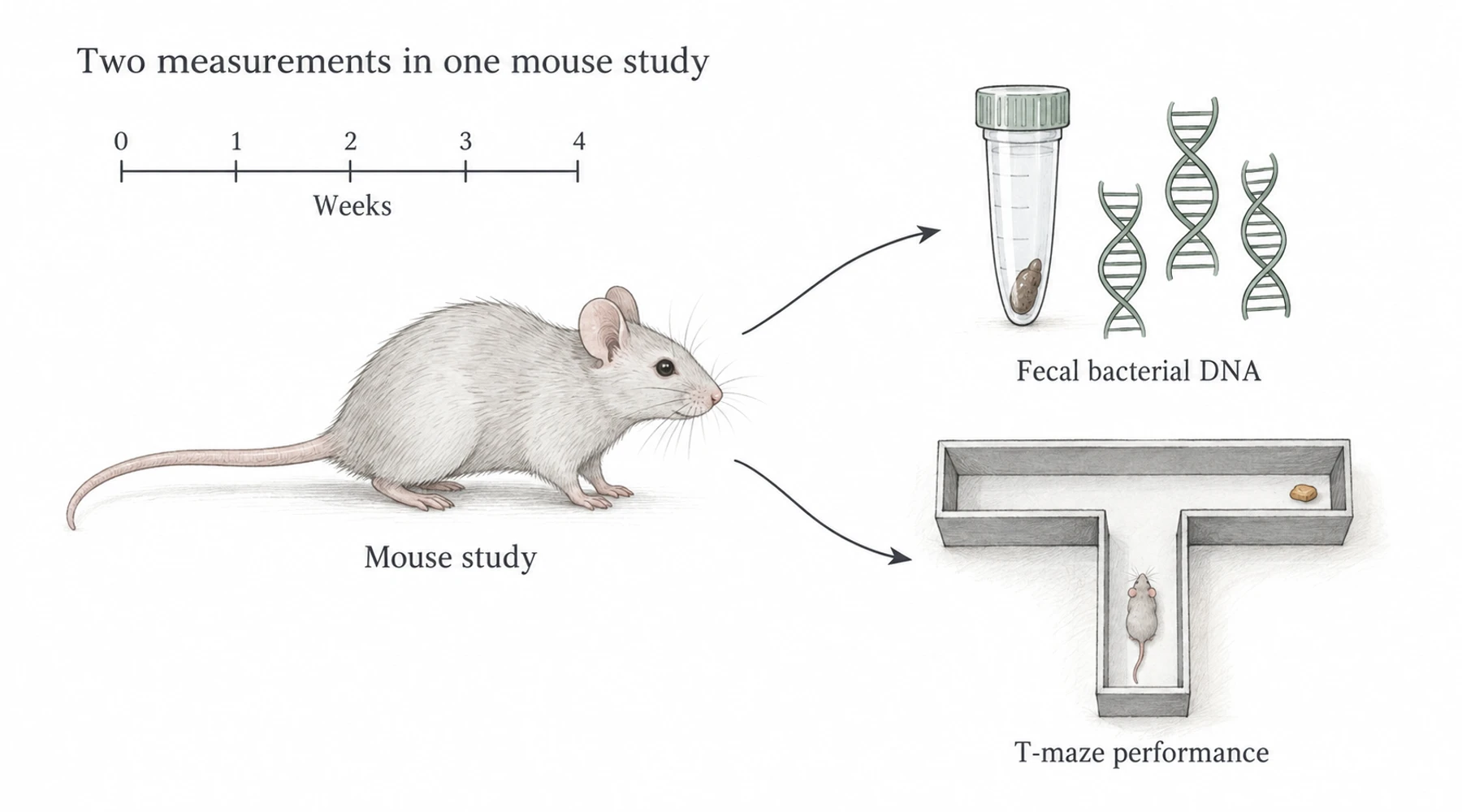
Methylene blue can change the bacterial profile measured in mouse feces. That finding does not establish that it improves human gut health, selectively removes harmful bacteria, or treats dysbiosis. The crucial distinction is between changing a microbial community and improving the health of its host.
The mouse experiment most directly relevant to this question measured bacterial DNA and maze performance. Those measurements can identify patterns worth investigating. They cannot, by themselves, establish that a bacterial change caused a behavioral change or that either predicts relief from digestive symptoms.
What the researchers actually measured
In Gureev and colleagues' 2020 experiment, three-month-old C57Bl/6 mice received four weeks of methylene blue at 15 mg/kg/day (nine mice), 50 mg/kg/day (eight), or control water (13). The experimental-design section does not clearly specify the drug's delivery route or the animals' sex.
Feces were sampled before treatment and weekly. The investigators used bacterial-group qPCR and additional 16S DNA amplicon sequencing. During the final five days, mice completed two habituation days followed by three days of rewarded T-maze testing, with ten scored choices daily.
These are experimental mouse exposures, not human dose recommendations. Route matters when interpreting how much drug reaches the gut, and an unspecified route should remain unspecified. A body-weight conversion would not establish a safe or effective human regimen.
Microbiome-study evidence table
This original table separates the reported observations from the further claims a reader might encounter. Bacterial group names follow the paper's terminology.
| Evidence layer | Observation or measurement | Interpretation boundary |
|---|---|---|
| Lower-exposure bacterial profile | At 15 mg/kg/day, selected groups changed; Delta/Gammaproteobacteria rose early and were undetected at week four. | An endpoint sample can miss earlier changes. Undetected is assay-dependent. |
| Higher-exposure bacterial profile | At 50 mg/kg/day, week-four median Proteobacteria were 7.49%, versus 1.61% in controls. | A percentage increase does not establish an absolute increase in living cells. |
| Taxonomic detail | Sequencing identified changes within broad bacterial groups. | A stable phylum total can conceal changes among its members. |
| Host behavior | Lower exposure improved pooled T-maze scores; higher exposure did not. | This is performance on a particular task, not a comprehensive cognition assessment. |
| Association | Deferribacteres correlated negatively with day-two scores. | Correlation does not identify a causal organism or mechanism. |
| Gut function | No direct intestinal barrier or metabolite endpoint. | The study cannot establish repaired permeability or improved microbial function. |
| Causal testing | No microbiota-transfer or depletion experiment. | Whether microbes mediated the behavioral effect remains unresolved. |
The table is deliberately divided by what was measured. A favorable answer in one row cannot fill an empty answer in another. For example, better maze performance does not supply missing evidence about intestinal inflammation.
Why bacterial percentages do not show what was killed
The term relative abundance describes a group's share of the measured community. It is different from the number of bacterial cells per gram of stool. In their quantitative microbiome-profiling study, Vandeputte and colleagues showed why microbial load matters when interpreting community differences.
Consider an illustrative sample containing ten units of organism A and 90 of other organisms. A accounts for 10%. If A stays at ten while the others fall to 40, A now accounts for 20%. Its share doubled without any increase in its absolute amount. This arithmetic example is not a result from the methylene blue experiment.
The same distinction limits claims about bacterial killing. A DNA-based proportion is not a direct survival test. To establish loss of viable bacteria, an experiment needs measurements that address viability and account for the total population. To establish a functional change, it needs a relevant functional measurement, such as a measured metabolite rather than a prediction based only on bacterial names.
Broad labels also hide biological variation. Treating an entire phylum as either beneficial or harmful skips over the organisms and activities responsible for a particular outcome. A shift in a ratio is therefore not, on its own, a diagnosis of dysbiosis or evidence that dysbiosis has been cured.
Did the microbiome explain the maze result?
The experiment placed the drug exposure, bacterial profile, and behavior in the same study. That is useful for generating a hypothesis. Our interpretation is that the design does not distinguish several possible explanations: a direct drug effect on behavior, an indirect microbial effect, or separate responses of behavior and bacteria to the same exposure.
A stronger mediation experiment would change the proposed microbial mediator independently of the drug. Researchers might test whether transferring a defined community transfers an effect, or whether removing a proposed microbial pathway prevents it. Such experiments also require controls for what else is transferred or altered.
The behavioral endpoint needs equally careful reading. A rewarded maze asks an animal to make choices under specific conditions. As an assessment principle, performance can depend on willingness to explore, movement, reward motivation, and learning. Calling a result “better cognition” compresses these distinctions. The directly measured task remains the more informative description.
Does methylene blue kill gut bacteria?
Methylene blue can participate in antimicrobial activity under defined laboratory conditions. That does not specify what happens to the entire intestinal community after an oral exposure.
For example, a laboratory study of photodynamic bacterial inactivation tested E. coli and S. aureus with photosensitizers and controlled illumination. It assessed colony formation and membrane damage, and included corresponding dark controls. Light or photosensitizer alone had no effect under those tested conditions.
Those controls answer an important causal question within that experiment: what contribution did the combination make? Swallowing a substance does not reproduce illumination of a bacterial suspension. Conversely, a negative dark-control result at one concentration and duration does not prove that every nonilluminated exposure is biologically inactive. The antimicrobial research overview explains these condition-dependent distinctions.
An intestinal-community study also cannot establish treatment of a particular infection. Identifying the organism and demonstrating an appropriate clinical outcome are separate tasks, including when assessing claims about parasite treatment.
What this means for human gut-health claims
The focused literature search for this article did not identify a controlled human intestinal-microbiome trial establishing a gut-health benefit from methylene blue. That is a statement about the evidence located, not proof that no relevant study exists. Human research on local oral photodynamic treatment is a different question: for example, a 45-person halitosis trial sampled tongue coating and measured breath gases, not intestinal health.
To support a human gut-health claim, a study would need a defined population, a reproducible formulation and route, a suitable comparator, and an outcome that matters to that population. A microbial profile could help explain the result, but symptom improvement, disease control, and adverse effects would still need assessment.
Four weeks in one mouse model also cannot establish the consequences of months or years of use. The review of daily and long-term methylene blue exposure separates treatment duration from observation and safety endpoints. For the wider clinical context, consult what human research supports.