
Article
Methylene blue absorption and distribution: what route studies measure
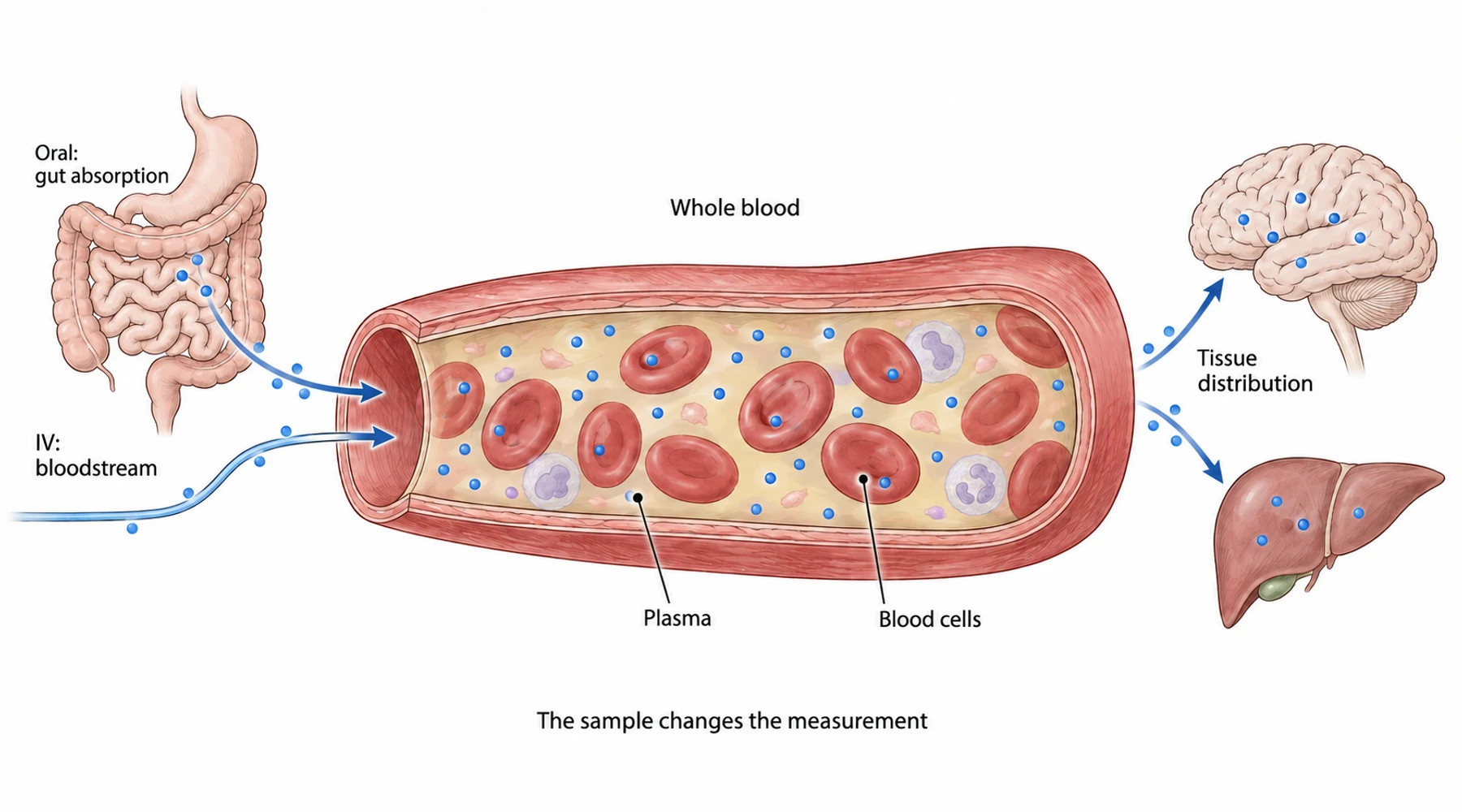
Methylene blue can reach the circulation after oral administration, and animal experiments show distribution into organs, including the brain. Those findings do not establish that every formulation reaches the same concentration, or that a route advertised as faster provides a better clinical result.
The useful question is specific: which formulation, given by which route, produced which measurement in which population? A blood concentration, a brain scan, and a blue patch of skin answer different questions.
Absorption is one step in a longer process
Absorption describes movement from an administration site into the circulation. An intravenous infusion enters the bloodstream directly, bypassing that step. Distribution describes the subsequent movement between blood and tissues.
Absolute bioavailability compares systemic exposure after a non-intravenous dose with exposure after an intravenous dose, adjusting for the different amounts administered. Studies commonly use the area under the concentration-time curve, or AUC. AUC combines measured concentration and time; it is not simply the highest concentration or the moment someone notices an effect.
An absorbed substance can undergo metabolism before reaching the systemic circulation. Consequently, movement out of the intestine and bioavailability of the measured compound need not have the same percentage. In Shin and colleagues’ mouse experiments, the authors estimated nearly complete gastrointestinal absorption despite low measured oral bioavailability, interpreting metabolism as an explanation. That is a finding in mice, not a percentage to assign to a human product.
Route-and-sample comparison
This comparison separates direct concentration measurements from biological responses. Study amounts describe research conditions, not interchangeable doses or instructions for use.
| Route and study | Population and formulation | Sample or endpoint | What the finding establishes |
|---|---|---|---|
| Oral versus IV, Walter-Sack et al. | 16 healthy adults; single 500 mg aqueous oral dose versus 50 mg IV in a crossover study | Plasma concentration-time curves | Mean absolute oral bioavailability was 72.3%, with a standard deviation of 23.9 percentage points. This estimate belongs to the tested formulation and protocol. |
| Oral versus IV, Peter et al. | Seven volunteers; 100 mg by each route; oral formulation details are not specified in the abstract | Whole-blood methylene blue measured by HPLC | Oral whole-blood AUC was substantially lower than IV AUC. This is a different sample and protocol from the aqueous-formulation study. |
| Intraduodenal versus IV, Peter et al. | Rats; methylene blue delivered into the duodenum or a vein | Tissue and whole-blood concentrations | Duodenal delivery produced higher intestinal-wall and liver concentrations, but lower brain and whole-blood concentrations than IV delivery. These were rat tissue measurements. |
| Oral tissue distribution, Shin et al. | Mice; methylene blue dissolved in distilled water, delivered by gastric gavage; separate IV comparison | Plasma and excised tissue homogenates, using liquid chromatography–mass spectrometry | Liver distribution was prominent. Tissue concentration does not establish a treatment benefit in people. |
| Intranasal, Peng et al. | Rats undergoing exhaustive swimming; methylene blue in saline, administered as nasal drops under anesthesia | Behavior, brain tissue markers, and mitochondrial morphology | The experiment reported biological effects. It did not establish human nasal bioavailability or superiority to oral or IV administration. |
| Skin application, 2023 nanoparticle and sonophoresis study | Excised swine-ear skin; aqueous methylene blue versus polymeric nanoparticles, with or without ultrasound pretreatment | Dye in skin layers and receptor fluid after 16 hours | Skin retention was measurable, while receptor-fluid methylene blue was below the method’s quantification limit. Local penetration and through-skin transport were distinct outcomes. |
Plasma and whole blood cannot be treated as equivalent
Whole blood contains plasma and blood cells. Plasma measurements examine the liquid fraction after cells are separated. When a compound partitions into cells, its reported concentration depends on which fraction the laboratory analyzes.
The PROVAYBLUE prescribing information illustrates why a fixed conversion is unreliable. In one clinical IV study, the blood-to-plasma ratio was 5.1 ± 2.8 at five minutes and reached a plateau of 0.6 at four hours. The relationship changed over time.
The same label reports approximately 94% plasma protein binding in vitro. This describes association with proteins under laboratory conditions. It does not mean that 94% failed to absorb, or that a fixed remaining fraction entered the brain. Total plasma concentration includes both bound and unbound compound.
Even a drug-interaction result can depend on the sample. In the aqueous oral study, chloroquine increased methylene blue concentrations in plasma but not whole blood. The practical lesson is to retain the sample type when quoting a result, rather than choosing the largest percentage from different studies.
Brain exposure does not establish brain benefit
Evidence that methylene blue can cross the blood-brain barrier supports investigating central effects. It does not determine the amount reaching a particular brain region in a person, nor whether that exposure helps a disease.
The oral functional-connectivity trial enrolled 28 healthy adults and compared methylene blue with placebo using MRI. Its observations concerned brain activity and connectivity, not direct chemical measurement of methylene blue inside the brain.
A separate IV study in healthy humans and rats found reductions in cerebral blood flow and metabolic measures under its experimental conditions. These results caution against assuming that reaching the brain necessarily increases its energy use. They also cannot rank oral against IV delivery because the studies used different populations, protocols, and endpoints.
Cell entry through reduction, reoxidation, and partitioning concerns another scale of the problem. A compound entering a cultured cell has not thereby demonstrated clinical efficacy. The distinction between models is explained in how to read methylene blue research.
Sublingual, nasal, inhaled, and transdermal claims
Sublingual delivery means absorption across tissue beneath the tongue. Swallowing some of a liquid adds an oral component. The sources located for this article do not establish a reliable human sublingual bioavailability percentage or a demonstrated advantage over swallowing. Staining under the tongue cannot separate mucosal absorption from swallowed exposure.
Intranasal delivery is a separate question. The rat study above used controlled nasal drops under anesthesia. Its behavioral and tissue findings do not establish the fraction absorbed through nasal tissue, a direct nose-to-brain fraction, or the performance of a consumer spray. Those claims require route-specific concentration measurements and suitable comparators.
Inhalation through a nebulizer adds device-dependent aerosol production and airway deposition. A pilot report on post-COVID nebulization concerns lung-function and oxygenation outcomes. Its existence does not provide a conversion from oral or IV exposure to a household nebulizer. An oxygen humidifier is another device again; neither the oral studies nor that pilot validates adding methylene blue to its reservoir. Do not repurpose oral or laboratory solutions for respiratory equipment.
Transdermal delivery means transport through skin toward systemic circulation. A topical formulation can instead retain methylene blue within skin. The swine-skin experiment demonstrates why these must be measured separately. Its companion cancer-cell phototoxicity experiments also do not establish a therapeutic effect from a human patch or cream.
Food effects need their own comparison
A study performed after fasting establishes what happened under fasting conditions. It does not prove fasting improves absorption. A food-effect claim needs a fed-versus-fasted comparison using the same formulation and relevant exposure measurements.
The registered LMTB food-effect study concerns a related formulation that the registry distinguishes from methylthioninium chloride. Its study description is not a food-effect result for ordinary methylene blue solution. The evidence reviewed here does not justify a universal claim that meals reduce absorption or fasting improves it.
Perceived onset, urine color, and tongue staining cannot replace concentration-time measurements. Questions about persistence belong to methylene blue half-life and duration. Clinical route selection also depends on indication and the requirements for injectable formulations, not bioavailability alone.