
Article
Does methylene blue cause cancer? What the toxicology studies show
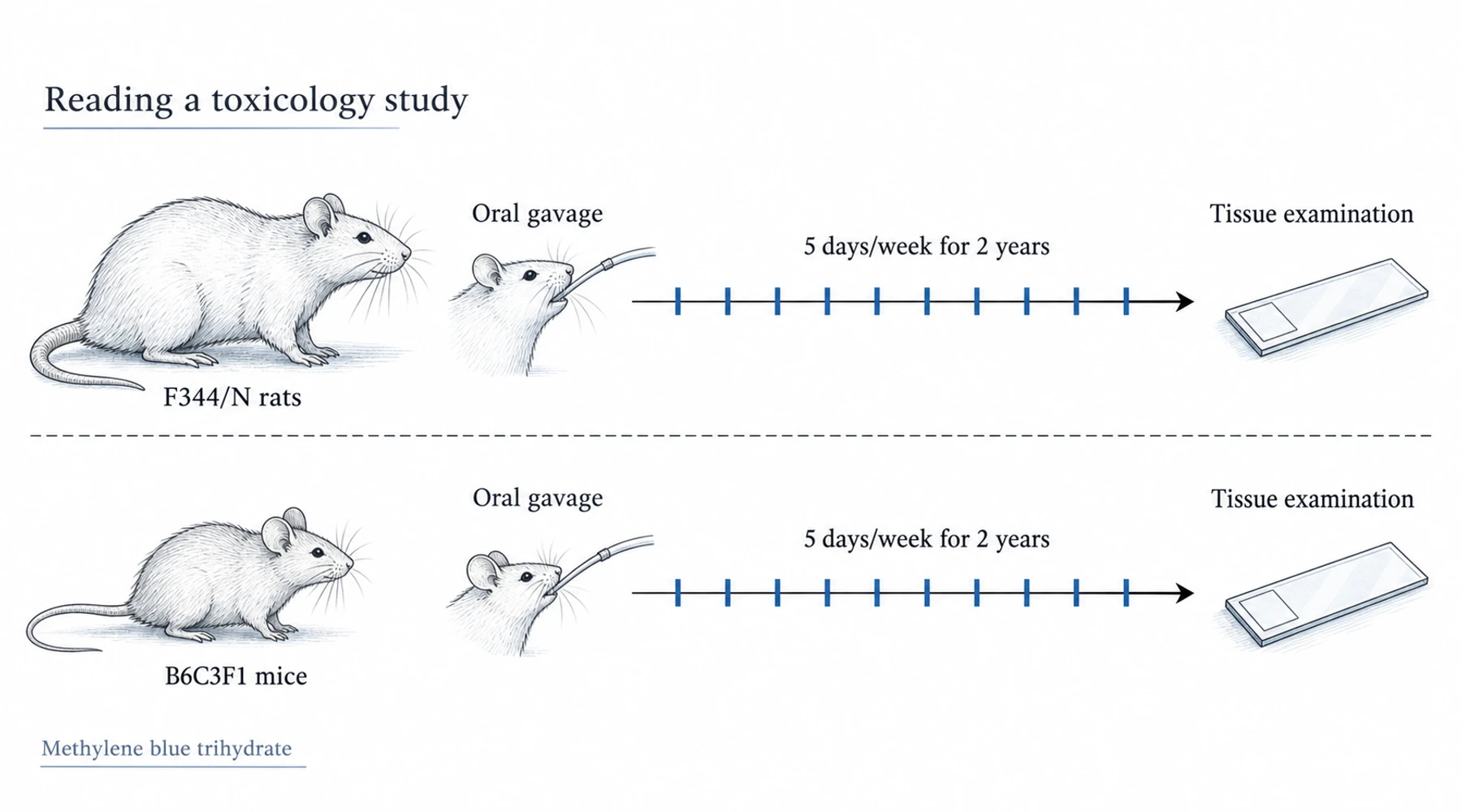
Methylene blue has produced tumour signals in long-term animal experiments and positive results in several laboratory tests of genetic damage. Those findings deserve attention. They do not establish the probability that a person will develop cancer after a particular exposure.
The IARC evaluation published in 2016 placed methylene blue in Group 3, meaning its carcinogenicity in humans could not be classified. The working group had no human cancer data and judged the animal evidence limited. Group 3 does not mean proven harmless. Equally, an animal finding does not make every human exposure a demonstrated cause of cancer.
Three questions that need separate answers
Carcinogenicity concerns the development of tumours. A long-term animal study can detect tumour patterns after a defined exposure. Genotoxicity concerns damage to genetic material or related cellular events. A positive mutation assay supplies a warning signal, but it does not directly count cancers in people. Human risk concerns the likelihood of harm under actual exposure conditions.
These questions require different measurements. Counting bacterial mutants, examining mouse blood cells and diagnosing tumours at necropsy are not interchangeable endpoints. Nor does a treatment experiment showing that a substance injures cancer cells establish whether repeated exposure can initiate tumours in healthy tissue. The separate discussion of methylene blue in cancer research addresses treatment claims.
Study comparison: the actual chronic exposures
The central experiment used methylene blue trihydrate, delivered in 0.5% aqueous methylcellulose by oral gavage, a measured administration through a tube into the stomach. Each chronic-study dose group contained 50 males and 50 females of each species. Administration occurred five days per week for two years, according to Auerbach and colleagues' study report.
The table preserves the NTP's species-specific conclusions. Amounts are milligrams of the tested material per kilogram of animal body weight on dosing days, not human recommendations. Zero-dose animals received the vehicle.
| Model | Dose groups, mg/kg | Route and duration | NTP conclusion and relevant finding |
|---|---|---|---|
| Male F344/N rats | 0, 5, 25, 50 | Oral gavage; five days/week; two years | Some evidence: pancreatic islet-cell adenomas and adenoma/carcinoma combined increased. |
| Female F344/N rats | 0, 5, 25, 50 | Same schedule | No evidence of carcinogenic activity under these conditions. |
| Male B6C3F1 mice | 0, 2.5, 12.5, 25 | Oral gavage; five days/week; two years | Some evidence: small-intestinal carcinoma and adenoma/carcinoma combined increased. Malignant lymphoma may also have been related. |
| Female B6C3F1 mice | 0, 2.5, 12.5, 25 | Same schedule | Equivocal evidence: marginal increases in malignant lymphoma. |
“Some evidence” is an NTP category for a positive experimental finding with less strength than “clear evidence.” “Equivocal” describes an uncertain finding. These categories express the strength of evidence, not a percentage risk or a ranking of how potent a carcinogen is.
The male-rat result was not a steadily rising staircase. Pancreatic islet adenoma or carcinoma occurred in 4/50 controls and 9/50, 14/50 and 8/50 animals at ascending doses. The published paper reports statistical significance for the middle dose only. This makes a simple straight-line story inaccurate; it does not establish that the highest dose was protective. An adenoma is a benign tumour, whereas a carcinoma is malignant. A combined endpoint must not be described as though every counted tumour was cancer.
Why different summaries sound contradictory
The current PROVAYBLUE prescribing information reports the male-rat pancreatic findings but describes no drug-related neoplastic findings in mice. The research paper says that mouse neoplastic increases were not statistically significant, while noting positive trends. NTP nevertheless assigned the mouse categories shown above.
The IARC animal-study analysis clarifies an important statistical distinction: the male-mouse intestinal findings had significant dose trends, but the individual dosed groups were not significant in pairwise comparisons with controls. Testing an overall pattern across doses differs from testing each group separately. Readers should retain the source and its wording rather than compress all these findings into either “mice developed cancer” or “the mouse study was negative.” None supplies a measured human cancer rate.
Study comparison: genetic damage endpoints
The genetic toxicology section of NTP Technical Report 540 describes a different set of experiments. S9 is a laboratory mixture containing liver enzymes used to model metabolic activation. Its presence does not turn a cell assay into a whole-body exposure study.
| Test system | Actual exposure conditions | Measured endpoint and result |
|---|---|---|
| Bacterial mutation assays, second tested lot | Salmonella: 0.25–150 µg/plate; E. coli: 0.25–1,500 µg/plate; with and without rat-liver S9 | Increased mutations in the tested strains. |
| Cultured Chinese hamster ovary cells | Sister-chromatid exchange testing included 0.17–2.5 µg/mL without S9, up to 5 µg/mL with S9; chromosome-aberration testing used 4.7–22 µg/mL | Positive exchange and chromosome-aberration results. |
| Male mice, acute experiment | Single intraperitoneal injection: 25, 50 or 150 mg/kg; samples at 48 hours | No increase in micronucleated erythrocytes in marrow or blood. |
| Male and female mice, repeated experiment | Oral gavage: 25, 50, 100 or 200 mg/kg; five days/week for three months | No increase in peripheral-blood micronucleated erythrocytes. |
A micronucleus is a small additional nuclear body that can reflect chromosome breakage or chromosome loss during cell division. A negative blood-cell assay answers that particular question in those sampled cells. It cannot exclude every kind of DNA damage in every organ. Conversely, a positive cultured-cell assay does not tell us which concentration a person's tissues reached.
The prescribing information also records this overall pattern: positive bacterial and cultured-cell tests, negative mouse micronucleus tests. Calling methylene blue simply “genotoxic” or “non-genotoxic” discards information that matters to interpretation.
What this means for a human exposure
The studies do not provide a validated cancer-safe daily threshold for people. Dividing a rat dose by a body-weight factor would not resolve differences in absorption, metabolism, route, exposure frequency or lifetime duration. It would produce a converted amount, not proof of safety.
A two-year gavage experiment and a brief medically supervised intravenous treatment ask different questions. That distinction prevents direct numerical extrapolation; it does not erase the animal findings. A useful assessment starts with the exact compound and formulation, amount, route, frequency, duration and reason for use. “A few drops” omits both concentration and measured volume.
If methylene blue was administered for a medical reason, the tumour findings alone cannot determine whether that treatment's benefits outweighed its risks. If repeated elective use is being considered, an unmeasured long-term cancer risk should not be described as zero. More immediate issues, including drug interactions and susceptibility to haemolysis, are addressed in side effects and contraindications.
For further reading, use the research library to distinguish human studies from animal and cell experiments. The essential question for each paper is what exposure it tested and what outcome it actually measured.