
Article
Can methylene blue affect pulse oximeters and laboratory tests?
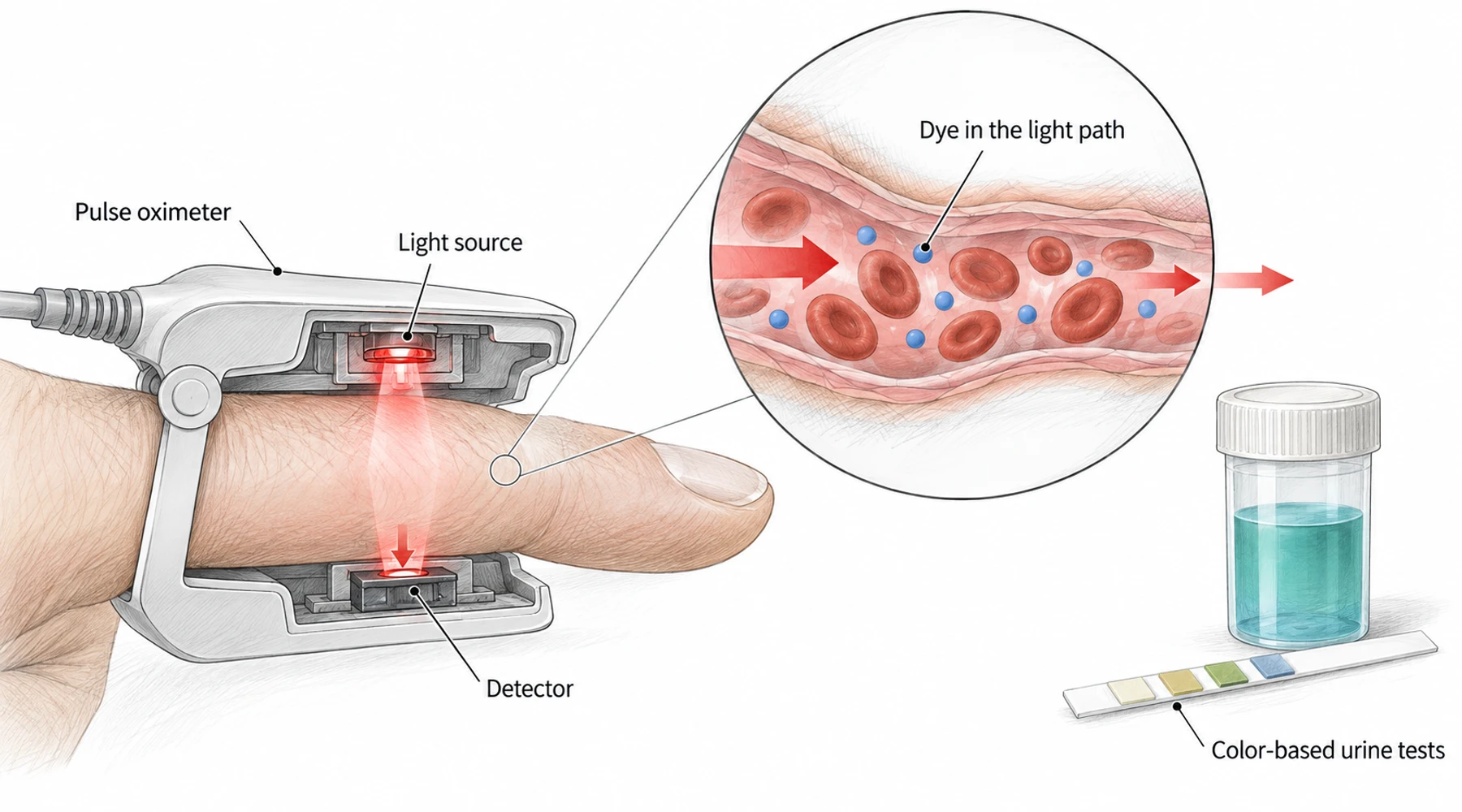
Yes. Methylene blue can interfere with pulse oximeters, urine dipsticks and some laboratory analyzers. The effect depends on the measurement method, dye concentration and timing. It does not mean every abnormal result after exposure is false.
A low oxygen reading still needs attention. Seek emergency care for severe breathlessness, chest pain, confusion, fainting or blue-gray lips. Contact a healthcare professional promptly about an unexpectedly low or persistently falling reading, even if you feel well. The FDA's advice on pulse oximeters emphasizes that symptoms and readings must be considered together, and that low oxygen can occur without obvious symptoms. Tell the treating team about methylene blue exposure; do not wait for the dye to clear before seeking help.
How a dye changes a measurement
An optical test detects light, then translates that signal into a biological result. If another light-absorbing substance enters the sample, the translation can become inaccurate. The instrument may report a biased value, flag an error or fail to calculate a result.
For pulse oximetry, the reported SpO₂ estimates hemoglobin oxygen saturation from light passing through tissue. Gorman and Shnider's study of hemoglobin and dye absorption showed that methylene blue absorbs enough light at 660 nm to produce an apparent desaturation. This explains a falsely low reading after intravenous administration: the additional absorption can be mistaken for a change in hemoglobin oxygenation.
A urine strip presents a different problem. Its reagent pads develop colors that a person or analyzer interprets. Strongly colored urine can obscure or alter that visual signal. Neither mechanism requires the measured biological substance to have changed. Conversely, neither mechanism prevents genuine illness from occurring at the same time.
Test-interference reference table
The table separates labeled warnings, a patient report and experiments that added dye directly to specimens. Concentrations refer to dye in the tested sample, not a dose to take or a blood level predicted from a bottle label.
| Test or instrument | Documented exposure and finding | Mechanism and source-specific limitation |
|---|---|---|
| Pulse oximeter | Intravenous PROVAYBLUE can produce a falsely low saturation reading during or shortly after infusion. | Optical interference. The prescribing information advises an arterial sample tested by an alternative method; it supplies no universal correction factor. |
| Urine dipstick using a blue indicator, including leukocyte esterase | The intravenous product's label warns that dye excreted into urine can interfere with interpretation. | Color interference; no brand, direction of error or concentration threshold is specified. This warning does not establish infection or exclude it. |
| Dipstick albumin versus turbidimetric urine protein | A 2018 patient report found dipstick albumin 3+ (300 mg/dL), but urine protein of 18 mg/dL by turbidimetry, after use of a methenamine/methylthioninium combination medication. | Markedly blue-green urine affected the albumin pad. One case; the abstract does not identify the analyzer or administration route. It does not validate every alternative protein assay. |
| Roche cobas u601 urinalysis | In a 2025 specimen-spiking study, urine methylene blue at ≥5 mg/L affected most parameters. | Colorimetric interference; an in-vitro result for this platform, not all strips or patient exposure routes. |
| Werfen GEM Premier 4000 co-oximetry | In the same study, healthy-donor venous blood spiked to ≥50–70 mg/L produced incalculable results. | Optical measurement failure at tested concentrations; not proof that routine treatment always invalidates co-oximetry. |
| Roche cobas c502 indices and c702 urine amphetamines assay | Spiking biased the hemolysis index downward above 0.1 mg/L, lipemia index upward above 0.01 mg/L, and amphetamines assay upward above 0.08 mg/L. | Method-specific optical interference. An index is not a disease diagnosis; a biased screening signal is not confirmed drug exposure. |
The 2025 authors considered their observed non-urinalysis interferences unlikely to be clinically concerning in their setting. They introduced urine-color comments to flag potentially affected urinalysis. Their assessment should not be converted into a universal claim that blood tests are unaffected or urine tests unusable.
Oxygen measurements answer different questions
An arterial sample is useful only when the team knows which measurement is being performed. Co-oximetry uses multiple wavelengths to distinguish hemoglobin species, including methemoglobin. It is different from the usual two-wavelength finger sensor. A calculated saturation and a directly measured hemoglobin fraction are also different outputs. A two-case laboratory assessment of methemoglobinemia explains that saturation calculated from blood-gas measurements assumes normal hemoglobin behavior. Such a calculation can be misleading when abnormal hemoglobin species are present.
A clinical investigation of discrepant co-oximeter results illustrates why this matters. Its interference came from sulfhemoglobin, not methylene blue. Different instruments returned inconsistent values while the patient also had genuine blood abnormalities. The investigators compared methods and clinical findings instead of declaring either the patient or the entire laboratory result “normal.” That diagnostic principle applies when an administered dye is the suspected interferent too.
Methemoglobinemia is a real impairment of oxygen transport, not merely unusual blood color. In a patient receiving treatment, an apparent monitor deterioration might reflect dye interference, persistent disease or another complication. The treating team must distinguish these possibilities. The methylene blue label also describes true hemolytic anemia and possible rebound methemoglobinemia. Those biological changes must not be dismissed as color artifacts.
Does oral use cause the same problem?
The strongest pulse-oximeter warning cited here concerns intravenous infusion. It does not provide a timetable or expected saturation error for oral consumer use. Oral exposure can still matter for urine testing: a published case involving oral Prosed DS, a combination medicine containing methylene blue, documented blue-green urine and explained how discoloration complicates color-based strips.
Route matters because it affects how and when dye reaches blood and urine. Clinical injection formulations should therefore be distinguished from oral products when describing an exposure. “I used methylene blue” is less useful than the product name, concentration, amount, route and time.
There is no single evidence-based waiting interval in these sources that makes every test reliable again. A sample concentration threshold cannot be translated into hours since use without additional information. Visible urine discoloration also cannot establish whether a particular assay is reliable.
What to tell the clinician or laboratory
Before a planned test, give the ordering clinician or laboratory the following information:
- The exact product or a photograph of its label, including other ingredients.
- The amount used, concentration, route and time of the most recent exposure.
- Any current symptoms and the reason for testing.
- Any unexpected result, including the device name and measurement time if available.
Do not stop prescribed treatment or postpone urgent testing to make a sample look normal. The clinical team can decide whether to add an interpretive comment, use another validated method or repeat a measurement when appropriate. Repeating the same affected method immediately may simply repeat its error.
For researchers, the corresponding question is whether the dye changed biology or only the assay signal. That requires controls for methylene blue interference in experiments. For patients, the practical contribution is accurate exposure information, so the laboratory can investigate the right measurement rather than guess from the color alone.