
Article
Why methylene blue changes urine, tongue, and tooth color
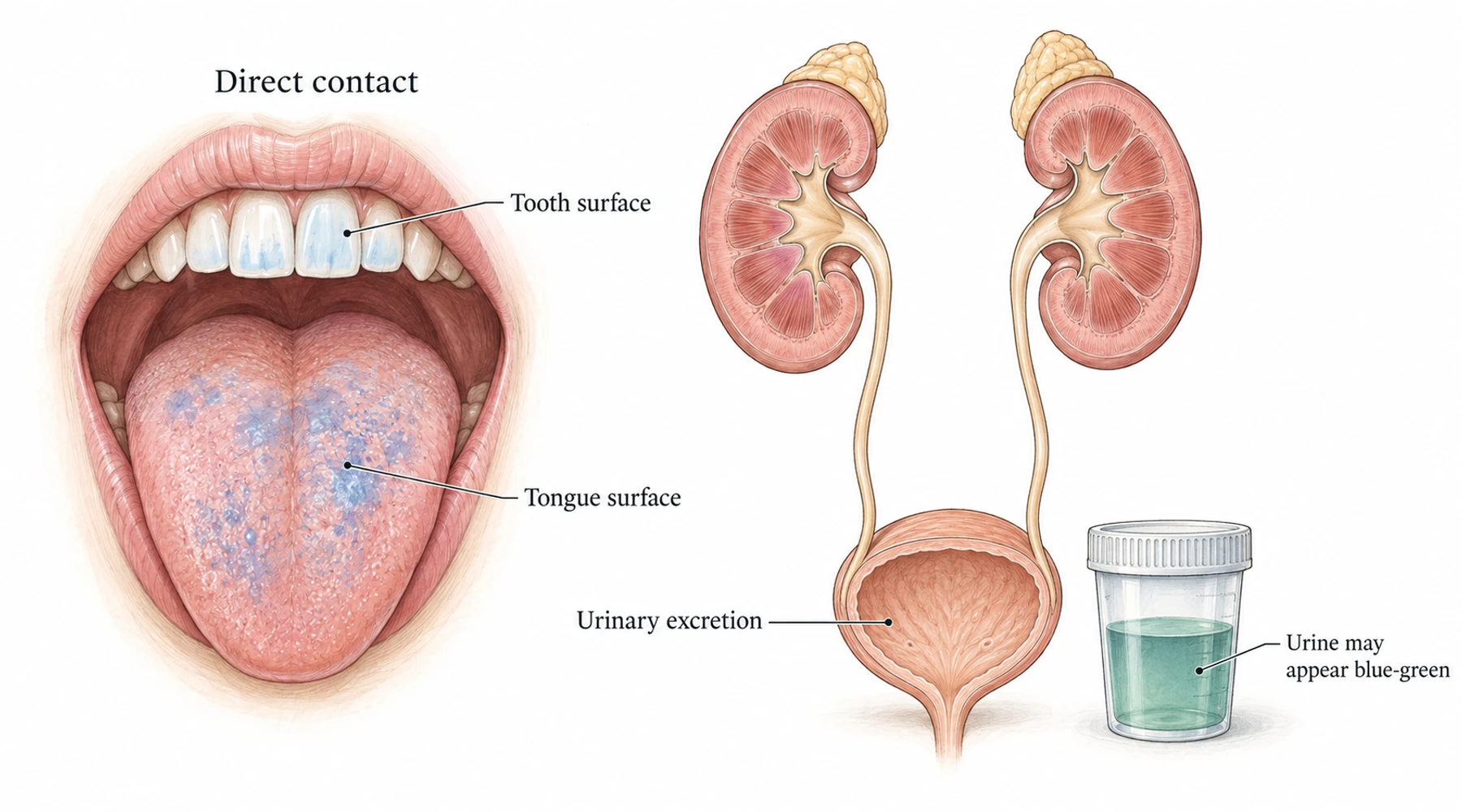
Methylene blue can leave color where it contacts the mouth and can color urine after entering the body. These are different processes. A blue tongue mainly tells you that dye contacted a surface. Blue-green urine can reflect dye leaving through the urinary tract. Neither observation measures a useful dose, absorption, effectiveness, purity, or safety.
Do not take more methylene blue because your urine has not turned blue. There is no validated home urine-color target to reach. Symptoms and the circumstances of exposure matter more than matching a photograph.
Why urine can look green rather than blue
The prescribing information for intravenous PROVAYBLUE states that approximately 40% of methylene blue is excreted unchanged in urine. That figure describes the medicine's pharmacokinetics; it is not a way to calculate an oral dose from a toilet bowl.
Urine already contains yellow pigments. A blue dye against that yellow background can produce a green or blue-green appearance. Dilution and the viewing conditions also affect what you see: fluid in a thin tube, a deep collection container, and toilet water need not look identical.
In Koratala and Leghrouz's postoperative case report, methylene blue was given through a nasogastric tube to check a repaired stomach. The patient's urine became green and faded over five days. This documents one clinical course, not a deadline by which every person's urine must return to its previous color.
What if methylene blue does not turn urine blue?
A visual observation cannot separate several possible explanations: the timing of observation, urine dilution, the amount of colored material present, and its chemical form. Methylene blue can be reduced to colorless leucomethylene blue; human urine assay research identified the reduced form in urine after oral administration. The chemistry of methylene blue and leucomethylene blue helps explain why visible blue color and the presence of the compound are not interchangeable concepts.
Not seeing blue does not establish failed absorption, a fake product, rapid metabolism, or a need for additional exposure. Seeing strong blue does not establish good absorption or an effective treatment. Neither finding reveals whether a product contains unwanted impurities.
For an identity or concentration question, use lot-matched analytical documentation. For a treatment question, use the prescribed clinical monitoring. A person comparing two products by urine color has changed many variables at once, including timing and dilution, without measuring either product.
Why the tongue and teeth can stain
Liquid contacting the mouth can leave dye on the tongue and dental surfaces. Distribution may be uneven because the tongue has a textured surface and retained debris. An oral-lesion staining study specifically describes excess dye accumulating on the tongue's upper surface and in gingival crevices. That study investigated a clinical diagnostic technique. It does not make the pattern of an incidental stain a home test for oral disease.
Ordinary gentle oral hygiene is a reasonable response to a painless surface stain. Do not scour the tongue or use household stain removers, solvents, or bleach in the mouth. A stain that persists despite usual cleaning, or a change accompanied by pain, ulceration, or swelling, warrants dental or medical assessment. There is no evidence-based promise that every stain disappears within a particular number of hours.
Can methylene blue stain veneers, crowns, or fillings?
It can stain dental materials, but “veneers” does not describe one material. A composite veneer, a ceramic restoration, and the bonding material around a restoration are distinct surfaces. Evidence from one cannot establish the behavior of all the others.
In a laboratory study of six composite resins, researchers compared worn and unworn surfaces after exposure to 0.5% methylene blue. Spectrophotometric measurements showed staining, with differences between materials and surface conditions. These were laboratory specimens, not patients drinking a consumer product. The findings support taking restoration staining seriously; they do not predict whether a particular veneer will stain permanently.
If a restoration changes color, give your dentist the product label, exposure time, and material details if known. Do not borrow root-canal cleaning chemicals from a dental experiment for home use. Household cleaning is a separate topic covered in removing methylene blue stains from surfaces and fabrics.
A photographic comparison with an important limitation
These published photographs show the same reported clinical case in two viewing settings. They illustrate why a visible color needs an exposure history and clinical assessment.
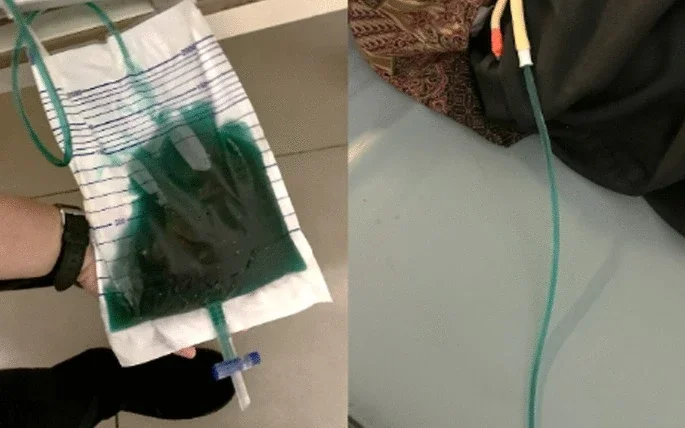
A. Drainage bag and tubing. Blue-green urine observed after catheterization in a patient presenting with urinary retention.
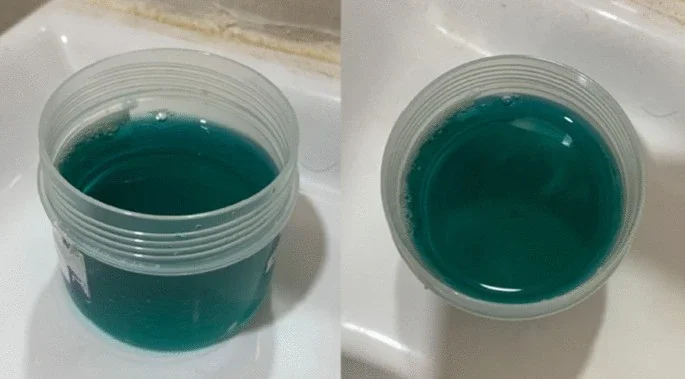
B. Container views. Urine from the reported case in a nonsterile container. The paper does not report standardized illumination, white balance, or identical collection timing.
Photographs: Figures 1 and 2 from Lionardi, Hengky, and Haruman, 2024, reproduced under CC BY 4.0; converted to WebP without recoloring or cropping. The authors report patient consent for publication. Methylene blue was suspected, not chemically confirmed, in the traditional medicine exposure. These are attributed clinical photographs, not a calibrated color standard or proof of methylene blue identity. The cover is an explanatory illustration.
Which changes need assessment?
| Observation | What it does and does not establish | Next action |
|---|---|---|
| Blue-green urine after a known clinical exposure, without new symptoms | Compatible with dye excretion; does not establish normal kidney function or treatment success | Follow the treating team's instructions and mention the exposure before urine testing |
| No obvious blue urine | Does not establish inadequate exposure | Do not increase exposure to produce color |
| Painless tongue or tooth surface staining | Compatible with local dye contact; does not measure systemic exposure | Use gentle usual hygiene; seek dental advice if persistent |
| Urine change with blood, painful urination, fever, or flank pain | A dye history does not exclude another condition | Seek prompt medical assessment |
| Sudden blue-gray lips or tongue with breathing difficulty, chest pain, or confusion | Cannot safely be assumed to be surface staining | Call emergency services |
The NHS guidance on blood in urine advises assessment even when the amount is small or it happens once. Its cyanosis guidance treats sudden blue-gray lips, tongue, or face as an emergency. Do not delay care while trying to wash away the color.
Methylene blue also carries a risk of hemolysis, the destruction of red blood cells, particularly with G6PD deficiency. New marked weakness or yellowing of the eyes after exposure needs urgent assessment, even if a urine change initially looked like dye. These overlap with reported symptoms of G6PD-related red-cell breakdown. The broader methylene blue safety guide explains the relevant contraindications and interactions.
Bring the container or a photograph of its label, the amount and timing of exposure, and your medication list. Tell the laboratory about methylene blue: it can interfere with urine tests that rely on a blue indicator. That history is more useful than an attempt to grade how blue the sample looks.