
Article
Methylene blue and sport: how to check anti-doping rules
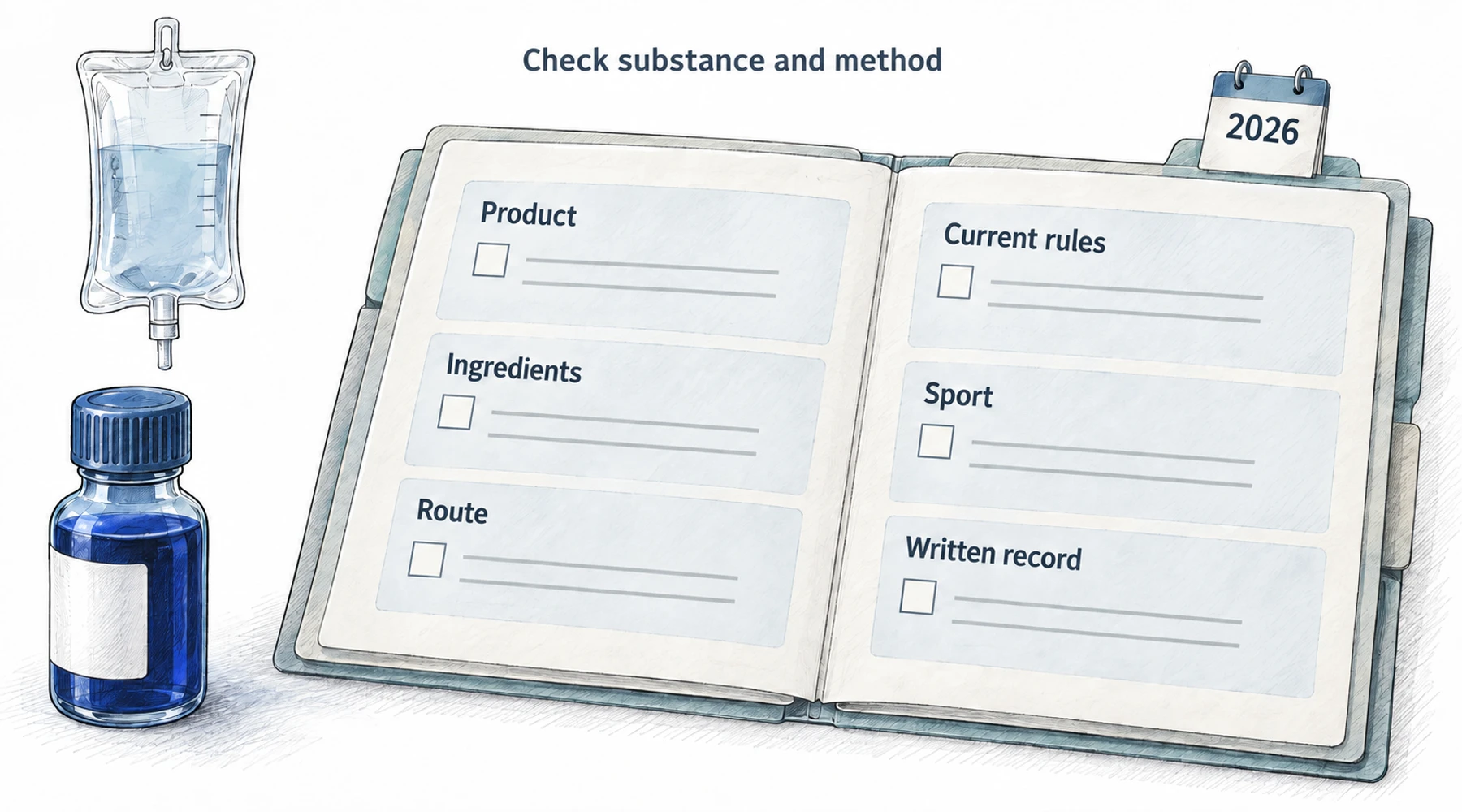
Methylene blue is not individually named in the English 2026 WADA Prohibited List, checked on 12 September 2026. A search for its alternative name, methylthioninium, also returned no match. That finding is not personal clearance to use a particular product or procedure. Eligibility requires checking the full formulation, administration method, applicable categories, and rules governing the athlete.
A useful answer therefore has two parts: what the official resources say today, and what information is still needed about your situation. A retailer’s “WADA compliant” claim cannot supply the second part.
Start with the exact medicine and sport
Global DRO’s medication search requires the sport and country of purchase because a brand can have different ingredients in different markets. Match the full product name, strength, active ingredients, and route. Read the result’s conditions for both in-competition and out-of-competition use. Save the result, including its date and reference number where provided.
The database covers medicines in participating countries. It does not clear supplements, and its own terms explain that separate federation or major-event restrictions may apply. If a medicine is missing, ask the relevant anti-doping organisation instead of treating the blank result as permission. Athletes in more than one sport need to check each sport.
Send a photograph of the label and a specific question. “Can I take methylene blue?” omits information that could change the answer. A more useful enquiry is: “I compete in this sport under this federation. This is the product, ingredient list, country of purchase, intended route, and proposed medical use. Which rules and exemption requirements apply?”
Read categories, not just the alphabetical index
The WADA List contains broad classes and non-exhaustive examples. A name search cannot exclude every category. Equally, advertising about “mitochondria” or “oxygen” does not establish a classification under metabolic modulators or prohibited blood-manipulation methods. Resolve uncertain classification with the responsible anti-doping organisation.
S0 concerns pharmacological substances without current governmental approval for human therapeutic use that are not addressed elsewhere in the List. It is not simply a test of whether a retail bottle has a prescription label. Methylene blue has an approved human medicine, PROVAYBLUE injection for acquired methemoglobinemia. That fact does not validate a different preparation, additional ingredient, or proposed use.
An IV method needs its own check
Under M2.2, intravenous infusions and injections totaling more than 100 mL in a 12-hour period are prohibited at all times, subject to the stated exceptions for legitimate hospital treatment, surgery, or clinical diagnostic investigation. USADA’s current IV explanatory note explains that this applies even to permitted ingredients. The total includes multiple administrations; it is not a separate allowance for each bag or injection. The threshold concerns fluid volume, not milligrams of methylene blue, and it is not a treatment recommendation.
WADA’s IV physician guidelines, version 8.1, distinguish hospital treatment from an ordinary practitioner’s office, hotel room, home, event medical tent, or standalone IV clinic. A clinician administering an infusion does not automatically create an exception. If an infused substance itself is prohibited, the hospital exception for the method does not remove the substance’s TUE requirement.
For planned treatment, give the anti-doping organisation the full procedure details. The clinician should document the diagnosis, ingredients, total fluid volume, timing, setting, and clinical rationale. Our explanation of methylene blue injections and IV formulations covers why injectable suitability is also a separate medical question.
In an emergency, receive necessary medical treatment first. Notify the responsible organisation afterward and retain the records. A retroactive therapeutic use exemption, or TUE, may be available in qualifying circumstances; it is not automatically granted. USADA’s TUE guidance describes assessment of the diagnosis, treatment need, permitted alternatives, and applicable eligibility requirements.
The bottle can introduce a different problem
A product containing methylene blue may also contain other active ingredients. A supplement may have undeclared contamination. UK Anti-Doping’s supplement guidance explains strict liability: athletes are responsible for prohibited substances in their system, including unintended exposure. It also states that anti-doping organisations do not approve or endorse supplement products.
Batch testing can reduce contamination risk, but it cannot guarantee eligibility. A chemical purity report is not automatically an anti-doping screen. Check what was actually tested and whether the tested lot matches the purchased bottle. The guide to reading a methylene blue certificate of analysis explains those document checks.
Dated verification checklist
Official resources checked: 12 September 2026. The 2026 List took effect on 1 January 2026. Repeat the check when rules, product, route, sport, or event change. Copy this table into your own record and replace each blank with the result and evidence.
| Check | Official resource and action | Your record |
|---|---|---|
| 1. Governing rules | Open the current WADA List; confirm the effective edition and your federation’s or event’s additional rules. | Sport, federation, event, edition, date: ___ |
| 2. Exact product | Follow Global DRO’s search instructions; match country, full product, ingredients, and route. Refer missing or ambiguous results to the responsible organisation. | Product, lot, label copy, result/reference: ___ |
| 3. Method | Use the official IV explanation to check the complete procedure with the treating team. | Route, volume, timing, setting, written assessment: ___ |
| 4. Exemption | Follow the relevant authority’s process; UKAD’s Search Check Apply guide illustrates checking whether, when, and how to apply with medical evidence. | Responsible authority, requirement, decision, conditions: ___ |
| 5. Saved evidence | Retain the label, search result, medical records, and correspondence. Check event recognition of an existing TUE with your authority. | File location, recognition, expiry/recheck date: ___ |
An unresolved row is a question to take to the responsible organisation. The table records a verification process; completing it is not an exemption or official approval.
Eligibility, performance, and test interference are different questions
An anti-doping result does not establish that methylene blue improves endurance, strength, or recovery. Those claims require relevant human performance outcomes, rather than inference from a biochemical mechanism. The exercise and recovery evidence guide addresses that separate question.
Clinical measurement interference is different again. The PROVAYBLUE label documents underestimated pulse-oximeter readings and interference with urine tests using blue indicators, including leukocyte esterase dipsticks. These observations do not establish what happens in a specific anti-doping assay and do not provide a doping-control exemption. Tell clinical staff about exposure so they can interpret measurements; see methylene blue and laboratory-test interference.
Medical suitability remains a separate decision, including interactions and G6PD-related risks described in the methylene blue safety guide. Bring the same accurate product and exposure information to both the treating clinician and the responsible anti-doping organisation.