
Article
Methylene blue for fish eggs and hatchery use
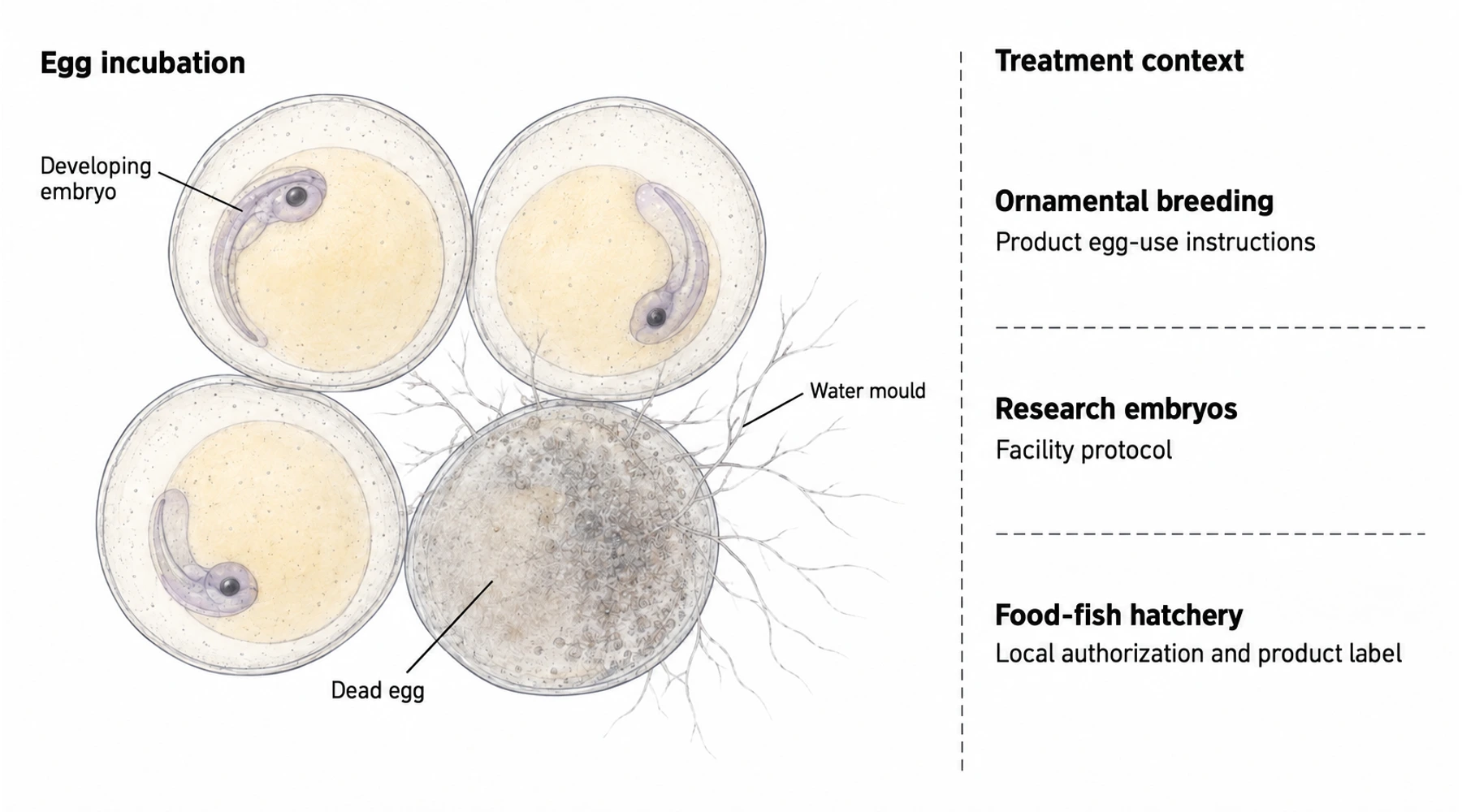
Methylene blue has a defined role in some ornamental fish-egg care: controlling fungal growth during incubation. That does not make every blue solution suitable for every spawn. A discus breeding tank, a zebrafish research dish, and a trout hatchery differ in their animals, water systems, objectives, and treatment requirements.
Start by identifying which of those situations you have. Then check the actual product and the egg-care protocol. The useful question is whether the proposed exposure fits this batch of eggs, not whether methylene blue is generally used by fish breeders.
What egg treatment can accomplish
The Kordon Methylene Blue product instructions identify prevention or treatment of fungus on fish eggs as an intended use. They describe a specific 2.303% aqueous formulation. That is a manufacturer instruction for that product, not an approval for food-fish production or a promise of equal results in every species.
Fungal control addresses one part of incubation. It cannot fertilize an unfertilized egg or restore an embryo that has died. Consequently, the number of eggs laid and the number of living embryos are different starting points when assessing a treatment.
The problem can also spread. Hendrix Genetics' trout incubation guidance describes Saprolegnia growing on dead eggs and extending onto healthy eggs. Its husbandry guidance emphasizes maintaining suitable water flow and removing dead material with minimal disturbance. Adding a chemical while leaving deteriorating eggs in place leaves part of the problem unresolved.
If eggs become opaque or develop cotton-like growth, record which change appeared first. Appearance alone does not establish why the embryos failed. Repeated losses need a review of fertilization, incubation conditions, handling, and possible infection.
Match the species to the setting
This matrix separates a labeled ornamental use from a research practice and a regulated production decision. It is a selection aid, not a cross-species dosing table.
| Species or egg group | Incubation context | What supports a methylene-blue decision | Main limitation to resolve |
|---|---|---|---|
| Ornamental fish eggs | Separate hobby breeding vessel | An aquarium product with an explicit fish-egg fungal-control instruction | Confirm formulation, exposure period, actual water volume, and species suitability. |
| Discus, Symphysodon spp. | Adhesive eggs on a cone or slate, with parents present | General ornamental product instructions, combined with a species-specific breeding plan | Parental egg care and later larval feeding make removal of eggs a separate decision. |
| Zebrafish, Danio rerio | Research embryo medium or shipment | A facility protocol and evidence for its strain and developmental stage | Laboratory use does not establish a universal improvement in hatching. |
| Salmon, trout, or other food-producing finfish | Commercial hatchery incubation | Current jurisdiction-specific authorization and the exact approved product label | An ornamental methylene-blue label does not authorize this use. |
“Hatchery” describes a facility, not a single regulatory category. A business breeding ornamental discus and one producing trout for food can both have incubation rooms. The destination of the animals matters alongside their species. The guide to methylene blue in aquaculture and food fish addresses that distinction in more detail.
Discus eggs require a parental-care decision
Discus eggs adhere to a surface. According to the University of Florida's discus culture guidance, parents guard and fan the eggs, moving oxygenated water across them. After hatching, free-swimming larvae feed on mucus from the parents.
These features change the practical question. Moving a cone to a separate treatment vessel also transfers responsibility for water movement and commits the breeder to a plan for the larvae. A medication choice alone does not supply either.
Before moving a spawn, write down whether the plan is parent rearing or artificial rearing. For parent rearing, consider the adults and the whole breeding system when evaluating a product. For artificial rearing, specify how the eggs will be incubated and how the fry will be fed. Neither plan should be inferred from the instruction to treat eggs.
The sources reviewed here do not establish a discus-specific optimum methylene-blue exposure. A general aquarium label should not be presented as a controlled comparison of discus hatch rates.
Research use is informative, but context-dependent
The Zebrafish International Resource Center FAQ explains that its embryo shipping medium contains methylene blue to limit microbial growth if embryos die in transit. This is a documented facility practice with a specific purpose. It is not evidence that every embryo culture performs better with the dye.
A 2020 study by Peneyra and colleagues tested disinfection combinations in AB and casper zebrafish embryos at 6 and 24 hours after fertilization. The investigators assessed survival, hatching, and malformations five days after fertilization. Methylene blue's effects on survival and hatching varied across the conditions; the best results generally occurred with some treatment combinations followed by maintenance without methylene blue.
This was a study of chemical combinations around sodium-hypochlorite surface disinfection. It does not establish that methylene blue is always harmful, or that the same findings apply to discus eggs. It does establish why a laboratory should evaluate the complete sequence and developmental stage rather than treating the dye as an inconsequential medium ingredient.
Read the egg instructions, not the fish-dip instructions
Kordon's page gives separate procedures for egg treatment and brief fish dips. Those exposures are not interchangeable. It also warns against using its product in recirculating systems with biological filtration because it interferes with nitrifying bacteria; activated carbon removes the dye. Check filter, plant, and tank compatibility before exposing a connected breeding system.
Make four checks against the current bottle instructions:
- Product identity: record the manufacturer, formulation, concentration, and intended use.
- Treatment setting: distinguish an egg incubation vessel from a brief bath or an entire tank. The comparison of fish baths and tank treatments explains why the distinction matters.
- Exposure: identify the instructed amount, measured water volume, duration, and endpoint. Do not dose by the shade of blue.
- Observation: record the starting egg count, evidence of development, losses, hatch count, and subsequent fry survival.
A tank's nominal capacity is not necessarily its water volume. Likewise, instructions expressed as a volume of one stock solution cannot be copied to a bottle with a different concentration. Resolve either uncertainty before treatment.
Food-fish hatcheries need a different starting point
In the United States, the FDA's approved aquaculture-drug list includes named formalin products for finfish eggs and 35% PEROX-AID for mortality associated with saprolegniasis in freshwater-reared finfish eggs. Methylene blue is not listed as an approved aquaculture drug. Kordon also explicitly excludes its product from food-fish medication use.
FDA's letter to aquaculture professionals explains that sharing an active ingredient with an approved product does not make another product approved. Therefore, “use hydrogen peroxide instead” is not a sufficient production instruction either: the product, indication, and labeling must match.
These are US findings, checked in September 2026. For another jurisdiction, the hatchery needs the current local authorization and an aquatic-health professional's assessment before selecting a treatment. Record that decision with the batch protocol. A successful ornamental breeding anecdote cannot establish the legal or biological suitability of a food-fish treatment.