
Article
Methylene blue fish baths versus tank treatment
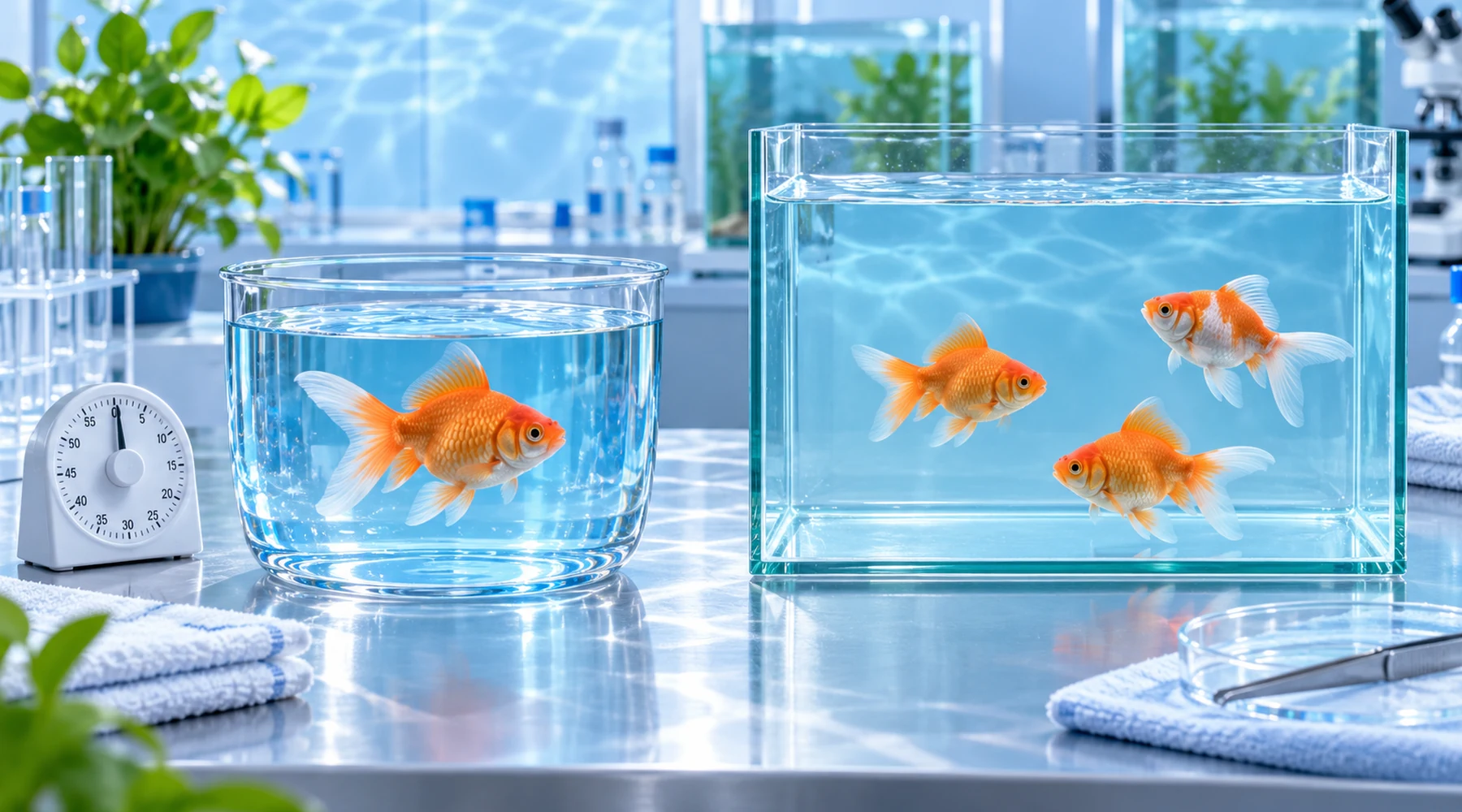
A keeper reads two pieces of advice, both confident. One says dip the fish for seconds. The other says dose the tank for days. Both mention methylene blue, so they look like two sizes of the same treatment. They are not. They are two different concepts that happen to share a chemical.
Think of each treatment as a concentration plus time pair acting on a fish plus its environment. Change any of the four and the meaning changes. A 50 ppm dip for 10 seconds and a 3 ppm tank hold for 5 days differ by more than strength. One exposes the fish briefly and leaves the filter, plants, and invertebrates untouched. The other exposes the whole system for days. Most dosing mistakes come from holding the wrong mental model: concentration alone feels like the dose, while time, water volume, and the biological system drop out of view. This article rebuilds that model using one product label, then shows where species and life stage force further adjustment. For background on what the dye does once dissolved, see how methylene blue acts in aquarium water.
The label defines two treatments, not one
Anchor every number below to a specific product. Concentrations in milligrams per liter mean nothing until you know the stock strength, because teaspoons of a 2.303 percent solution and teaspoons of a weaker retail dilution carry different amounts of dye. The comparison here follows Kordon's official methylene blue directions, which identify the product as a 2.303 percent aqueous solution of zinc free methylene blue chloride. If your bottle states a different strength, recalculate rather than borrowing these teaspoon figures.
| Use on the Kordon label | Concentration | Exposure | Water and filter handling |
|---|---|---|---|
| Fish, fungus and external protozoa, also nitrite and cyanide poisoning aid | 3 ppm, about 3 mg/L (1 teaspoon per 10 gallons) | 3 to 5 days | Remove activated carbon, keep mechanical filtration running, then partial or complete water change plus fresh carbon at the end |
| Eggs and fry, fungus prevention | 3 ppm (1 teaspoon per 10 gallons), single application | Until 3 days after the free swimming stage, or 2 days after birth for livebearers | Remove carbon; Kordon notes about one third teaspoon per 10 gallons adds about 1 ppm if a lower level is wanted |
| Short dip in a separate container | 50 ppm, about 50 mg/L (5 teaspoons per 3 gallons) | No longer than 10 seconds | Nonmetallic container with water similar to the aquarium, then return fish to the tank |
Three details in that table prevent the common errors. First, the dip is roughly seventeen times the tank concentration and lasts seconds, not minutes. Extending a 50 ppm dip to 10 or 30 minutes is a large departure from this label, not a cautious extension of it. Second, the 3 to 5 day protocol includes no daily water change and redose cycle. Kordon calls for one partial or complete change at the end, plus fresh carbon. Third, current Kordon directions give teaspoons and milliliters, not drops. Retail transcriptions sometimes equate 10 drops per gallon with the same 3 ppm, but drop size varies by dropper, so measure with a syringe or calibrated spoon.
The label also constrains where treatment happens. Kordon states the product should not be used in recirculation systems that depend on biological filtration, because it interferes with nitrifying bacteria. It adds that the dye can disturb plant growth, that rock, coral, and wood absorb it, that bare tanks work best, and that silicone sealant may stain permanently. Those sentences point toward the hospital container as the default setting.
Bath or tank: what each concept is good for
A bath or dip isolates the medication from the display system. The fish meets a defined concentration for a defined time then returns to clean water. The filter bacteria, plants, substrate, and invertebrates never meet the dye. Published aquaculture protocols fill out the range beyond Kordon's 10 second dip: an FAO fish seed quarantine protocol uses 20 to 40 ppm for 3 to 5 minutes with immediate return to aerated freshwater in its hatchery quarantine guidance, and an FAO aquaculture review contrasts 1 to 2 ppm prolonged baths with 8 to 10 ppm short baths in its treatment survey. University shipping work used lower still, 2 mg/L for about 11.5 hours in aerated water, in a UF IFAS ornamental fish shipping study. These are different concentration plus time pairs for different animals and purposes, which is exactly why no single cross species bath recipe exists.
Tank treatment, a low concentration held for days in the water the fish lives in, suits problems that need sustained contact: fungus on eggs across a hatch window, or a labeled multi day course for external protozoa. Kordon's 3 ppm for 3 to 5 days is the clearest aquarium example. The cost is that the whole system receives the exposure. Sipos and Urakawa tested methylene blue against ammonia oxidizing microbes from 10 parts per billion to 10 ppm and found wide variation in sensitivity, with strong inhibition in some organisms at very low levels and lethal effects on tested Nitrosomonas marina cells, as reported in their nitrifier inhibition study. The defensible claim is narrower than hobby lore: methylene blue can inhibit or kill nitrifying microbes and destabilize nitrification, but sensitivity differs among organisms, so no single aquarium dose guarantees a crash or guarantees safety.
The decision rule follows from the two concepts. Use a bath or dip when the goal is brief contact with one or a few fish while the display system must stay intact: a new arrival with suspect spots, a single fish with a localized lesion, any tank that contains shrimp, snails, valued plants, or a mature biofilter you cannot afford to disturb. Use a multi day hold in a bare treatment container when the indication needs sustained contact, such as an egg batch through the fungus window. Dosing the decorated, planted, biologically filtered display tank is the option of last resort, not the default. Even then the container should be as bare as practical, with carbon out and ammonia and nitrite tested daily.
Species, eggs, and fry: why no universal dose exists
Label safety for eggs and fry "when used as directed" does not mean all species tolerate all published doses. An ornamental egg study tested 0.5 to 3 mg/L on black tetra, angelfish, and zebrafish eggs and found that 3 mg/L improved hatching in angelfish and black tetra but not in zebrafish, with the authors warning against extrapolation between species, indexed in the FAO AGRIS record of the egg disinfection trial. More recent zebrafish work found that routine husbandry levels around 0.5 to 1 mg/L altered oxidative metabolism during early development, with a recommendation to reconsider routine exposure where metabolic endpoints matter, described in a 2025 zebrafish developmental study. And duration matters independently of species: goldfish held at 2 mg/L continuously for 21 days showed reduced hematological and immune measures with altered growth, a chronic exposure no label recommends, reported in a goldfish chronic exposure trial.
Two hobby myths need the same treatment. The scaleless fish warning for methylene blue appears carried over from malachite green, which has genuine scaleless sensitivity literature, while a recent review treats methylene blue separately as the lower toxicity dye in a 2025 ectoparasite treatment review. That does not make methylene blue harmless to every sensitive fish. It means unsourced tetra, gourami, and scaleless lists should be read as caution flags, not established categories. For invertebrates, robust safe dose data for ornamental shrimp and snails are thin and manufacturer lines vary: one retail brand warns its product may kill shrimp if overdosed, which is not the same as every therapeutic exposure being lethal, while old FAO tables show short term tolerance in a marine penaeid at 75 ppm for one hour with mortality at 100 ppm, data that do not transfer to Neocaridina, Caridina, or aquarium snails in the FAO shrimp toxicity tables. Until species specific data exist, keep invertebrates out of treated water by using the separate container.
Aquarium dose calculator: starter section
This section is the beginning of a calculator, presented as a worked formula you can check by hand. It computes the stock volume for one product strength only. It does not recommend a concentration. Pick the concentration from the label of the bottle in your hand, for your species and purpose, or from veterinary advice.
The formula for Kordon style 2.303 percent stock, which contains about 23.03 mg of dye per mL:
stock mL = target mg/L x water liters / 23.03
Convert gallons first. One US gallon equals 3.785 liters. Measure the water actually present, after subtracting substrate, decor, and the air gap, not the nominal tank size. Measure the stock with a syringe or calibrated spoon, never an uncalibrated dropper.
Worked example one, tank hold at label strength. A bare 10 gallon hospital container holds about 9 gallons of water after displacement, about 34 liters. Target 3 mg/L. Stock equals 3 x 34 / 23.03, about 4.4 mL, just under one US teaspoon at 4.93 mL. So the label figure of one teaspoon per 10 gallons assumes full nominal volume. Adjust down for displacement.
Worked example two, dip at label strength. Three gallons of dip water equals about 11.4 liters. Target 50 mg/L. Stock equals 50 x 11.4 / 23.03, about 24.7 mL, which is the label figure of 5 teaspoons. Prepare this in a nonmetallic vessel, match temperature and pH to the home tank, aerate anything beyond the briefest dip, watch the fish continuously, and end the bath at the first sign of distress such as rolling or labored breathing. That observation rule follows general dip guidance in the veterinary manual's aquarium fish management chapter, which calls for matched pH and temperature, immediate removal on distress, and extra caution with species where a dip has not been validated.
Three calculator warnings belong with the arithmetic. First, 1 ppm equals about 1 mg/L in dilute water, so the label's ppm and the literature's mg/L are interchangeable here. Second, never scale a dip by time instead of arithmetic: doubling minutes at 50 ppm is not equivalent to halving concentration. Third, record what you actually dosed: product name and strength, measured water volume, stock milliliters, start and end times. Without that record the next water change or repeat decision is guesswork.
Running each treatment well
For a bath or dip, set up before the fish leaves its tank. Prepare the container, match temperature and pH, provide aeration for anything longer than seconds, and keep a timer visible. Wear gloves and eye protection, since the dye stains skin, clothing, and benches, and standard hazard summaries list it as harmful if swallowed with eye and skin irritation possible, aggregated in the PubChem methylene blue hazard record. Use a soft net, transfer quickly, observe without interruption, and return the fish to its home water at the labeled second or at the first sign of trouble, whichever comes first. Do not reuse bath water across batches.
For a multi day hold, use a bare container with heater, gentle aeration, and mechanical filtration but no carbon and no porous decor. Dose once per the label, test ammonia and nitrite daily, feed lightly, and change water on test readings rather than color. At the end of the course, do the labeled cleanup: a partial or complete water change with conditioned, temperature matched water, then fresh rinsed carbon for roughly 24 to 48 hours. The full cleanup sequence, including stained silicone and biofilter checks, is covered in post treatment clearing and filter recovery.
Handle concentrate and disposal with the same care as the treatment. Kordon notes its aquarium product is not for human consumption and not a medication for food fish under US rules. Keep the bottle closed and away from children and pets, avoid splashing, and do not pour concentrated stock into drains or ponds.
Choose by asking which system gets exposed and for how long. Brief fish only contact points to the bath. A labeled multi day indication points to the bare treatment container. The display tank with its bacteria, plants, and invertebrates is something the dye visits only when no isolated option exists. That single distinction, concentration plus time plus exposed system, replaces the whole shelf of interchangeable recipes.