
Article
Methylene blue in aquaculture and food fish: uses and restrictions
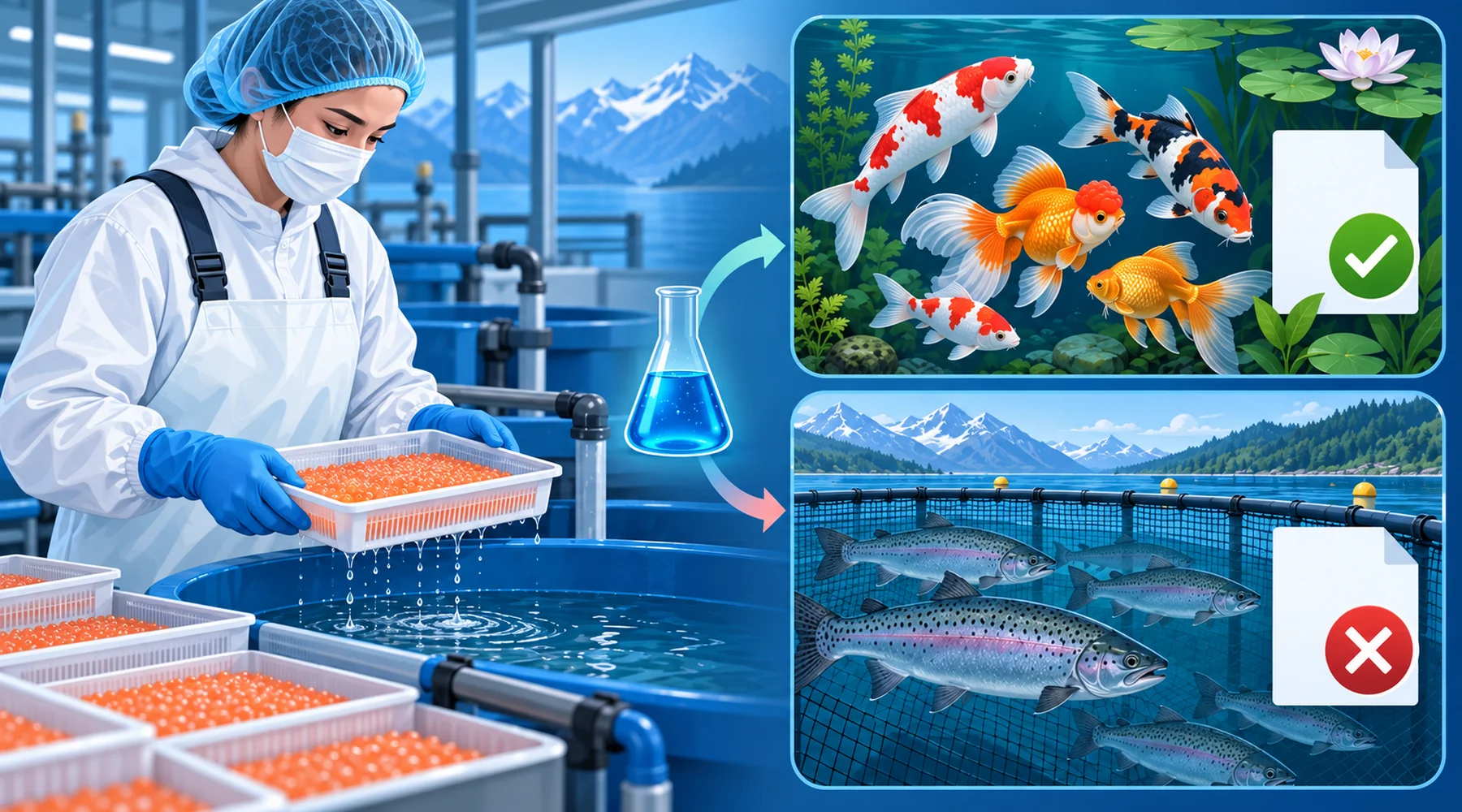
A koi and a carp can be the same species. The difference that matters is not biology. It is destination. One swims in a garden pond and never enters the food chain. The other is raised for human consumption, and every chemical it meets falls under food safety law. Methylene blue sits exactly on this boundary: a familiar hatchery and aquarium treatment on one side, an unapproved substance for food fish on the other.
Confusion arises because the two contexts look alike. A blue bath for eggs in an ornamental hatchery looks identical to a blue bath for eggs in a food fish hatchery. The water is the same color. The procedure looks the same. The rules are completely different.
What methylene blue is used for in hatcheries and aquariums
Methylene blue has been used in fish culture for decades, mainly as an egg treatment. Its principal target is Saprolegnia, a water mold that colonizes dead or unfertilized eggs and then spreads to living ones. Historical hatchery manuals describe such baths for carp in the FAO manual on carp seed production and for sturgeon in the FAO sturgeon hatchery manual. These documents record husbandry practice from their time. They are not modern approvals for food fish, a point the matrix below returns to.
In ornamental fish, current products claim treatment of superficial fungal infections and some external protozoans. The Kordon methylene blue product page lists fungal infections of eggs, superficial fungal infections of fish, and secondary infections by external protozoans including Ichthyophthirius (ich), Chilodonella, and Costia. It also describes the dye as an aid for nitrite and cyanide poisoning response in aquariums. Two limits on that label deserve attention. First, Kordon states the product is not indicated for Oodinium (velvet), so broad internet claims that methylene blue alone cures velvet go beyond what this manufacturer supports. Second, and most important for this article, Kordon states the product is not intended for use on food fish under US FDA and EPA regulation. Aquarium availability is therefore not evidence of food chain approval.
Published bath strengths vary widely, which is itself a warning against copying recipes across contexts. Kordon lists about 3 ppm for several days for aquarium treatment, a single 3 ppm application for eggs, and a 50 ppm dip of at most 10 seconds. Hatchery literature reports values from 0.1 ppm soaks to 50 to 100 mg/L hour long baths in older manuals. Treat these as examples of what has been published, not as interchangeable recommendations. Species, life stage, water chemistry, and regulatory status all change the calculation. Readers working with ornamental fish should follow aquarium dosing practice and readers working with eggs should follow egg and hatchery protocols rather than improvising from this overview.
One more caution comes from laboratory fish. Zebrafish facilities routinely add methylene blue to embryo rearing water at around 0.00005 to 0.0001 percent. A 2025 study found that even these husbandry concentrations altered oxidative metabolism across early development, first raising oxygen consumption and later lowering energy expenditure in post hatch larvae, as reported in the open access record for PMID 39856203. The finding does not translate directly to food fish farming, but it supports a general point: a treatment that looks inert because the fish appear normal can still change physiology, which is why regulators ask for residue and safety data rather than appearances.
The concept that decides everything: food producing animal
Regulators do not classify methylene blue by asking whether it works. They ask what the treated animal is for. A fish raised for human consumption is a food producing animal, and any drug used on it needs authorization under food animal rules, with established residue limits and withdrawal periods. An ornamental fish that will never be eaten sits under a different set of product rules, where food residue limits do not apply but veterinary chemical authorization may still be required.
Three mistakes follow from missing this distinction. A hatchery treats eggs or fry destined for a food production chain as if they were ornamental because they are small and far from harvest. A pet owner releases or sells ornamental stock, such as carp, into a food context without realizing the species name alone does not decide the rule. And a buyer reads an aquarium label and assumes retail availability equals food safety clearance. In each case the error is the same: applying the ornamental concept where the food fish concept governs. Separate compatibility limits for filters, plants, and tanks show the same principle inside the aquarium: the setting decides whether a treatment belongs.
Country and production context reference matrix
This table is the reference asset for this article. It summarizes whether methylene blue is approved for food fish and how ornamental use is positioned in five jurisdictions. Wording is deliberately careful: in most places the accurate statement is "not approved" or "not authorized," which is different from an expressly named statutory ban.
| Jurisdiction | Food fish: approved? | Ornamental and non food context | Authority |
|---|---|---|---|
| United States | No. No FDA approved methylene blue drug for food fish appears on the FDA approved aquaculture drug list. Absent products marketed for food fish are unapproved animal drugs under the FDA letter to aquaculture professionals. Note: this is not a listing under the prohibited extralabel use rule at 21 CFR 530.41; "unapproved" is the precise term. | Aquarium products exist, but retail sale does not establish FDA approval, and residue enforcement described in the FDA aquacultured seafood guidance applies once fish enter the food chain. Veterinarian extralabel use under 21 CFR 530.20 requires food safety safeguards and does not create a general approval. | FDA Center for Veterinary Medicine |
| European Union | No. Allowed substances for food producing animals appear in Table 1 of Regulation (EU) No 37/2010, described in the EMA guidance on maximum residue limits. Methylene blue has no such entry, so the correct term is "not allowed for food producing animals." | Non food ornamentals avoid the residue limit question, but the veterinary product still needs proper authorization under applicable rules. | European Commission, EMA |
| United Kingdom | No under the food animal framework. Northern Ireland follows EU Table 1 rules; Great Britain requires an MRL basis in the GB register or out of scope status before food animal use under the VMD Cascade guidance and VMD maximum residue limit rules. No qualifying basis for methylene blue in food fish was identified. | Ornamental use is a separate product authorization question and must not be extrapolated to fish entering the food chain. | Veterinary Medicines Directorate |
| Canada | No. Methylene blue is absent from Health Canada's list of drugs authorized for food producing aquatic animals, as described in the Health Canada aquaculture drug policy. Veterinarian directed extra label use under the Canadian ELDU policy and emergency release pathways are narrow exceptions, not approvals. | Possible only under the relevant Canadian authorization rules; "non food" alone does not establish a product's legal marketing status. | Health Canada, CFIA |
| Australia | No food fish approval identified. The APVMA requires registration or a permit for veterinary chemical products, per its registration guidance. Ornamental products containing methylene blue are registered, such as the aquarium combination in the APVMA Multi Cure label, while a current dog only methylene blue permit expressly excludes food producing species (APVMA permit PER13488). That exclusion belongs to that permit and should not be quoted as a universal ban. | Registered ornamental aquarium products exist; food fish use would need its own legal basis. | APVMA |
Readers sometimes ask about malachite green as a precedent. The comparison is useful only up to a point. Malachite green has its own explicit residue enforcement history in several jurisdictions, while methylene blue stands in a different position: absent from the allowed lists rather than named in the same prohibitions. Citing the malachite green record as proof of an identical methylene blue classification would be inaccurate.
Why waiting longer is not a withdrawal period
A withdrawal period is a regulator approved interval derived from residue depletion data, showing that edible tissue falls below a legal limit by a defined time. Health Canada and APVMA both tie withdrawal periods to such data. For an unapproved substance with no established limit, no number of waiting days chosen by the user creates an approved withdrawal period out of nothing.
There is one qualified exception. Some jurisdictions let a veterinarian set an extralabel withdrawal interval through a recognized pathway, such as AMDUCA in the US, extra label drug use in Canada, the Cascade in the UK, or veterinarian and minor use provisions in Australia. That is a case specific professional act inside a legal framework with residue safeguards. It is not the same as a manufacturer approved withdrawal claim, and in the EU and Northern Ireland context the missing MRL classification remains a threshold problem that a longer wait cannot fix.
Practical guidance by reader
Hatcheries raising trout, salmon, tilapia, catfish, or carp for consumption should treat methylene blue as unavailable for their production chain unless a veterinarian identifies a lawful pathway in their jurisdiction and takes responsibility for residue compliance. Historical egg bath recipes do not override this. Eggs and fry destined for the food chain count as part of that chain.
Aquarists, koi keepers, and goldfish owners keeping fish that will never be eaten work under the ornamental side of the boundary. Use products labeled for that purpose, follow the label, and do not rehome ornamental stock into food ponds.
Veterinarians should confirm which framework governs the case: approval tables first, then extralabel or cascade rules, then residue documentation. Pet shop availability, hobby forum doses, and old hatchery manuals are husbandry information, not authorizations.
The underlying principle is simple once stated plainly. Methylene blue earned its place in egg trays and aquarium cabinets through decades of visible results against water mold and external parasites. Food production asks a second question that visible results cannot answer: what remains in the flesh, and who has verified that it is safe. Until a jurisdiction answers that question through its own authorization process, the blue bath stays on the ornamental side of the line.