
Article
Methylene blue prices: compare quantity, concentration, and documentation
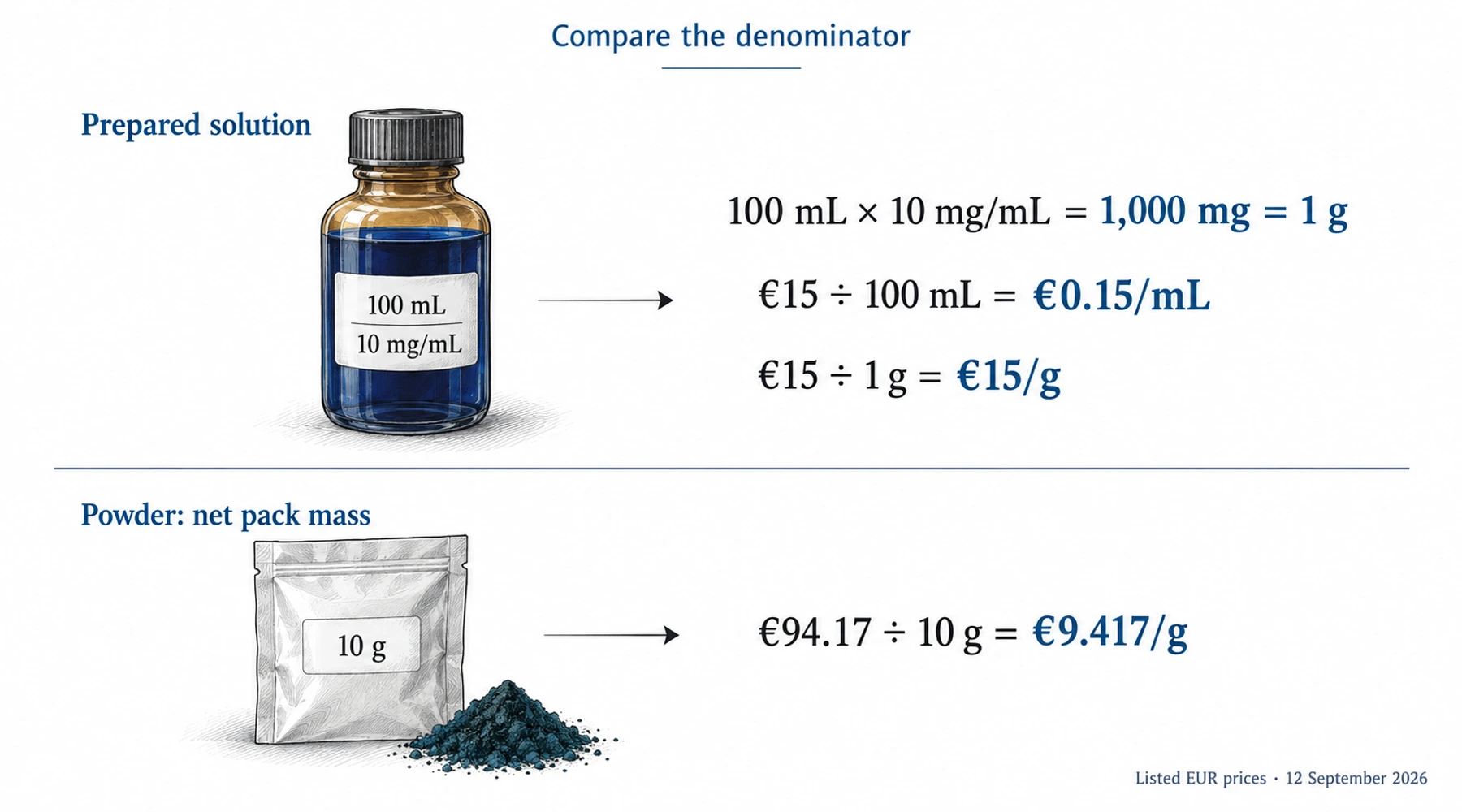
A methylene blue price becomes useful when it is attached to a defined quantity and formulation. A €15 bottle and a €94.17 powder pack do not contain the same amount or provide the same prepared product. Dividing both prices by the number printed most prominently on the label can produce a misleading comparison.
Start with two questions: what exactly is supplied, and what does the denominator measure? For a solution, millilitres measure liquid volume; concentration connects that volume to the stated methylene blue amount. For powder, grams usually describe the net supplied material. Neither calculation establishes purity or suitability for a particular application.
Blupreme sells the products used below. This is a transparent calculation using its public listings, not a competitor ranking or a claim about the best value available.
A dated price snapshot
The Blupreme catalog was checked on 12 September 2026 with EUR displayed. These are single-pack displayed product prices, without a selected delivery destination, coupon, or added delivery charge. The product pages state that taxes and shipping are calculated at checkout. Accordingly, the table uses a displayed-price basis, not a confirmed VAT-inclusive or VAT-exclusive delivered total.
Prepared aqueous solution
The 100 mL solution listing specifies 1% weight per volume, equivalent to 10 mg/mL.
| Formulation | Pack volume | Stated concentration | Calculated stated amount | Displayed price | Price per mL | Price per stated gram |
|---|---|---|---|---|---|---|
| 1% aqueous solution | 100 mL | 10 mg/mL | 1 g | €15.00 | €0.150 | €15.00 |
Powder packs
The following listings describe the same USP-grade powder format. Their denominators are net grams of supplied powder, without an assay or water-content correction.
| Public listing | Net powder | Displayed price | Price per net gram |
|---|---|---|---|
| 5 g pack | 5 g | €55.65 | €11.130 |
| 10 g pack | 10 g | €94.17 | €9.417 |
| 20 g pack | 20 g | €188.34 | €9.417 |
| 50 g pack | 50 g | €419.48 | €8.390 |
Unit prices are rounded to three decimal places where shown. Retain the unrounded value during further calculations. Powder has no supplied liquid volume, so a price per mL would require assumptions about a later preparation and is intentionally omitted.
Calculate the denominator before the price
For a solution with concentration in mg/mL:
Stated grams = volume in mL × concentration in mg/mL ÷ 1,000.
The listed bottle therefore contains a stated 100 × 10 ÷ 1,000 = 1 g. Its €15 price gives €15 ÷ 100 = €0.15 per mL, or €15 ÷ 1 = €15 per stated gram. These answer different questions: the cost of a unit of prepared liquid and the cost relative to its labeled methylene blue content.
When a label explicitly uses percent weight per volume, 1% means 1 g in 100 mL of final solution. Do not apply that interpretation to an unexplained percentage or a weight-per-weight formulation. A bottle saying only “1%” leaves the calculation basis insufficiently specified.
For powder, price per net gram = pack price ÷ net powder mass. The 10 g pack gives €94.17 ÷ 10 = €9.417/g. This is purchasing arithmetic, not an independent measurement of the pack's chemical content.
In particular, a dried-basis assay does not mean the entire as-supplied pack has that same mass fraction on an unchanged basis. The distinction between assay basis, water content, and purity matters before attempting any correction. Do not multiply a pack mass by an assay percentage unless the certificate, moisture information, and intended reporting basis actually support that calculation.
Pack-size effects are not always progressive
In this snapshot, the 20 g powder pack costs exactly twice the 10 g pack. Its unit price is therefore identical. A larger pack does not automatically offer another unit-price reduction.
The 50 g listing has a lower displayed cost per net gram than the smaller powder packs shown, but requires €419.48 upfront. That arithmetic does not establish whether buying 50 g is economical for someone who needs substantially less. Storage conditions, the applicable expiry or retest information, and the amount that can actually be used affect the purchasing decision. The powder pack-size guide explains the format-specific questions.
A prepared solution also includes work and materials that the powder price does not represent. The 100 mL listing includes purified water, a bottle, and a graduated dropper. Comparing solution and powder formats therefore requires more than aligning their euro-per-gram figures. Equal denominators do not establish equivalent finished products.
Add delivery costs on a consistent basis
Keep a displayed-price comparison separate from a delivered-cost comparison. The purchase terms identify EUR as the transaction currency and explain that destination charges may fall outside the checkout total unless expressly included.
For a single-product order, use the confirmed product subtotal after discounts, plus tax added at checkout, shipping, and known destination charges. Divide that total by the order's documented amount. Do not add a tax amount a second time if it is already included in the subtotal. An unknown charge should remain marked unknown rather than silently becoming zero.
For a mixed order, either compare complete baskets or state how shared delivery charges are allocated. Charging all shipping to one item in one comparison and spreading it across several items in another changes the result without changing the products.
Documentation is a separate comparison column
Price cannot reveal what was tested. The quality-testing page describes a chain from the product batch to an ingredient batch and its certificate of analysis. That distinction matters: an ingredient result should not silently become a claim that the finished bottled solution underwent the same test.
Record the tested material, matching batch, report date, methods, and results relevant to the intended application. A document's availability is also different from checking the particular batch being offered. The buyer's comparison checklist provides a structured way to evaluate those details without assigning a quality score from price alone.
Use the worksheet
Download the printable price-per-gram and price-per-mL worksheet. It contains this dated snapshot and a blank comparison sheet for two products. Calculate manually using the printed formulas.
Complete the formulation, currency, tax basis, and quantity fields first. Compare within a matching formulation group, identify every unknown, and update the listing date when checking a new price. The resulting figure is a cost per defined amount. The documentation column determines how much confidence you can place in the amount and product description behind it.