
Article
Methylene blue storage and shelf life: read the product label
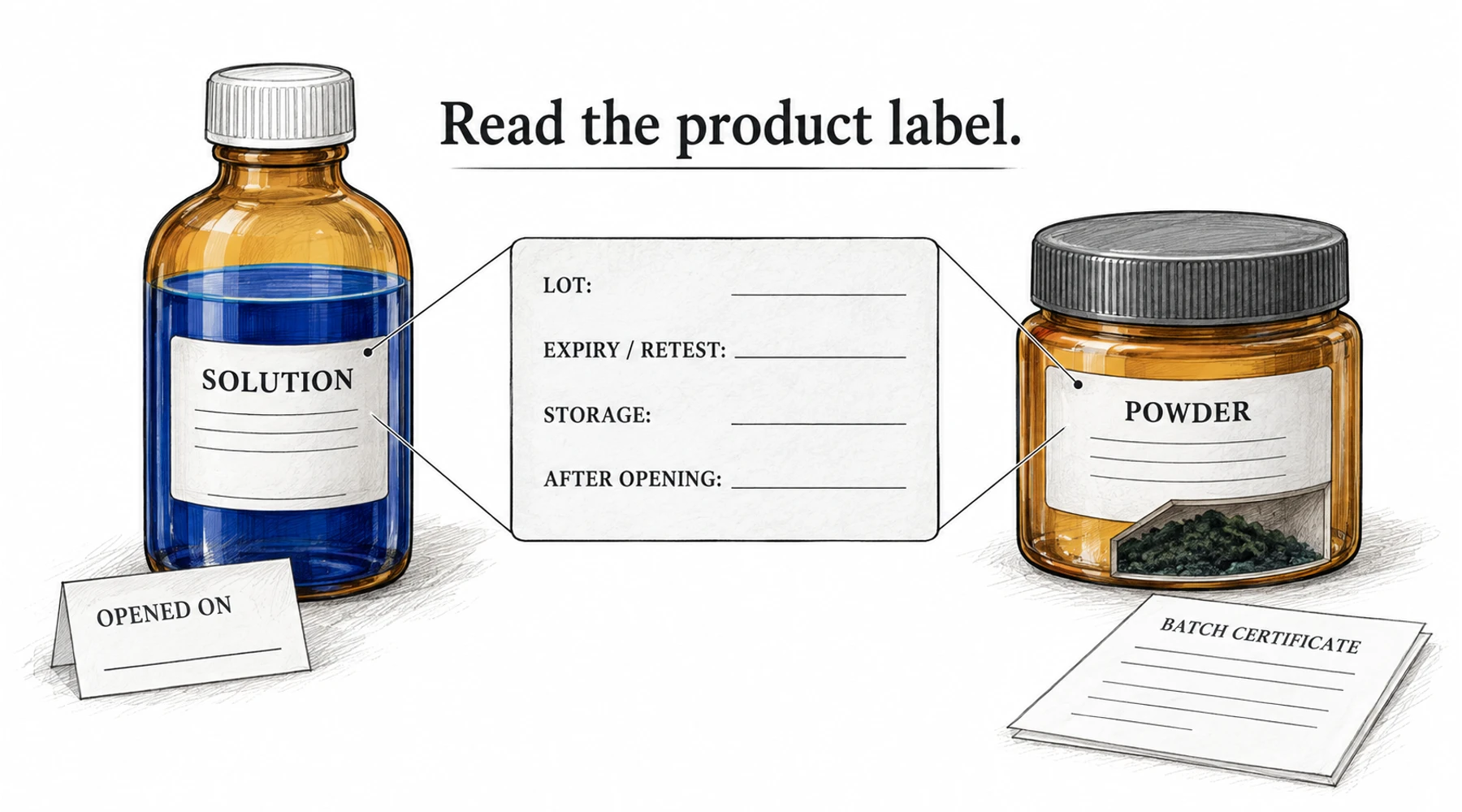
Methylene blue does not have one universal shelf life. A sealed powder, a prepared aqueous solution, and a single-dose injectable medicine are different products. Their dates depend on the material, formulation, packaging, storage conditions, and supporting stability evidence.
Start with your own container. Find its batch number, storage instructions, and expiry or best-before date. Then check whether there is a separate instruction for opening or preparation. An online statement such as “methylene blue lasts for years” cannot establish how long that particular bottle remains suitable.
What the date actually describes
For medicines, the FDA explains that expiration dates reflect demonstrated stability under labeled storage conditions. Stability includes maintaining the required strength, quality, and purity. The date is tied to evidence about a product, not simply to the name of its main ingredient.
Different dates answer different questions:
- Manufacture or release date: when a manufacturing event or batch-release decision occurred. This is not automatically a use-by date.
- Expiry or use-by date: the end of the assigned period for the specified product under its stated conditions.
- Retest date: a point at which material needs appropriate reassessment against its specification. It is not permission to extend use by inspecting the color.
- After-opening or preparation limit: instructions applying once the original package is opened or the formulation is changed. For a dispensed preparation, this may appear as a beyond-use date on the pharmacy label.
Merck's product-dating document separates release, expiry, and retest dates. This distinction matters when reading an ingredient certificate. A retest date on methylene blue powder does not establish the expiry of a solution subsequently made from it. Nor does an unopened product date automatically settle every question about an opened container.
Does methylene blue need refrigeration?
Do not refrigerate it by default. Follow the temperature instruction for the exact product.
Blupreme's solution storage guidance specifies upright storage, protection from light, and a temperature below 25 °C. It says refrigeration is unnecessary and the solution should not be frozen. Keep the bottle securely closed and follow the best-before date on its packaging. The FAQ currently specifies no separate after-opening period; that absence does not supply evidence for a newly invented number of months.
A different product provides a useful comparison. The PROVAYBLUE injectable medicine label specifies 20–25 °C, with permitted excursions to 15–30 °C. It explicitly prohibits refrigeration and freezing, requires the original package for light protection, and directs disposal of unused contents from its single-dose containers. These instructions belong to that medicine. They are not storage or reuse instructions for a retail dropper bottle.
“Cooler must be better” is therefore an unreliable rule. If a shipment freezes or a bottle spends hours in a hot vehicle, record what happened and ask the manufacturer whether the product remains acceptable. Returning it to the recommended temperature does not establish that the exposure was harmless.
Powder needs its own instructions
Powder storage is not just solution storage with the water removed. Read the packaging and safety data sheet for the supplied material. Blupreme's powder product instructions call for a tightly closed package, dry conditions, and protection from light.
As another product-specific example, Merck's Certistain methylene blue instructions specify 5–30 °C for that dry microscopy reagent. They allow the supplied contents to be used until the stated expiry after first opening if those conditions are maintained and the bottle stays tightly closed. This does not assign the same date to a laboratory staining solution prepared from the powder.
Before buying a large pack, check whether you can use it within its documented period and maintain its closure between uses. The powder buying guide covers grade, pack size, and documentation questions.
Label-based storage checklist
Use this table with the container and matching batch document in front of you. Copy the actual instructions into the final column. A blank field identifies a question to resolve, not a condition to guess.
| Check | Prepared solution | Supplied powder | Record for this product |
|---|---|---|---|
| Identity | Exact product, concentration, intended use | Exact product, grade, supplied form | Product: ______ |
| Batch | Match bottle to documentation | Match pack to certificate | Lot: ______ |
| Date type | Expiry/best-before and any dispensing date | Expiry or retest, not merely release date | Type/date: ______ |
| Temperature | Copy range and freezing/refrigeration instruction | Copy the powder-specific range | Conditions: ______ |
| Light and moisture | Copy light-protection requirements | Copy light and dry-storage requirements | Location: ______ |
| Closure | Original bottle, cap, and any required carton | Original pack and effective resealing | Closure checked: ______ |
| After opening | Record opening date and stated in-use limit | Check whether opening changes the stated period | Opened/limit: ______ |
| Diluted or prepared | Obtain instructions for the changed formulation | Do not transfer powder dating to a new solution | Applicable document: ______ |
| Storage incident | Note heat, freezing, leakage, or contamination concern | Note moisture, damaged packaging, or storage excursion | Event/action: ______ |
Why the container and light protection matter
Keep the original label and packaging unless the product instructions require otherwise. A replacement bottle may differ in light protection, closure, and material compatibility. The FDA's stability-testing discussion identifies formulation and container-closure differences as factors in product dating.
An amber bottle does not make direct sunlight acceptable. Put the product in a location that meets its instructions and avoids predictable heat exposure. For an opened dropper bottle, avoid touching the dropper to hands, the mouth, or work surfaces; close it promptly. Do not assume the dye's color establishes microbiological quality. The technical discussion of light, pH, solvents, and methylene blue stability explains why experiments and formulations need their own conditions.
Missing dates or a changed appearance
If you cannot find a date, ask the supplier to identify the applicable batch document and explain whether the product has an expiry, retest date, or another documented use limit. Ask separately about use after opening. Sigma-Aldrich's product support explanation explicitly notes that a missing expiry or retest date can reflect insufficient suitable stability data to assign a shelf life. Missing information is not proof of indefinite stability.
Unexpected cloudiness, particles, leakage, or a damaged seal warrant stopping use and following the product's instructions. A normal-looking bottle does not pass an expiry test. Conversely, darkness alone may reflect how strongly a concentrated solution absorbs light. Read about green, cloudy, or almost black solutions and precipitates and crystals before attributing an appearance change to one cause. Do not heat, filter, or remix a questionable product to make it look acceptable again.