
Article
Why does methylene blue look green, cloudy, or almost black?
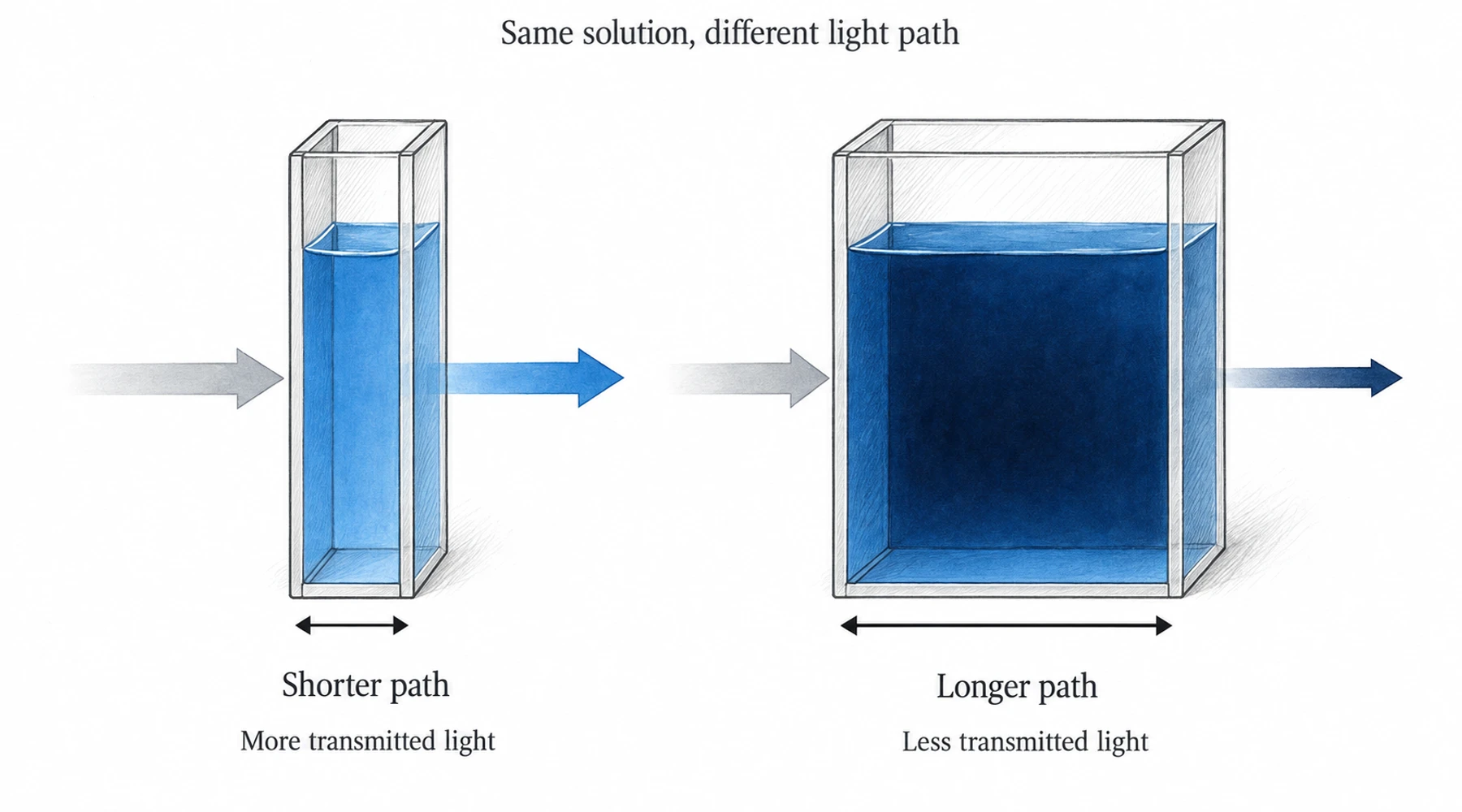
A methylene blue solution can look nearly black because very little light passes through it. A green cast can reflect viewing conditions or formulation differences. Cloudiness raises a separate question: is light being scattered by something in the liquid? These observations do not identify a cause by themselves, and none establishes purity, safety, or remaining shelf life.
Start with the exact product label. A laboratory stain, an aqueous retail solution, and a prescription injection can contain the same named dye while having different compositions, specifications, and intended uses. The useful question is whether this bottle matches its own documented appearance and storage requirements.
Why blue can look almost black
The distance light travels through liquid is its optical path length. Looking through the wide center of a bottle gives light a longer path than looking through a narrow edge. More light can be absorbed along that longer path, making the center look much darker even though the liquid has the same composition throughout.
Concentration also matters. Within appropriate measurement conditions, the Beer–Lambert relationship connects absorbance with concentration and path length. An aqueous methylene blue spectroscopy study expresses that relationship while accounting for different absorbing species. A darker view therefore cannot tell you whether there is more dye, more liquid in the light path, or both.
There is a second complication: dissolved methylene blue molecules can associate into dimers and larger aggregates. These are molecular associations, not automatically visible flakes. A 2020 study of aggregation in water examined absorption across dye concentration, salt concentration, and temperature. The associated forms had different optical spectra, making color an unreliable concentration ruler. Our explanation of concentration-dependent absorption develops that distinction.
Darkness and clarity are different properties. A liquid can be intensely colored without being cloudy. For example, the Hikma prescription injection label describes its specific 5 mg/mL formulation as clear and dark blue. That description does not establish the condition or suitability of another product.
Why a solution may appear green
What you see includes the light source, liquid, container, background, and viewing angle. NIST's discussion of color and appearance explains why illumination and viewing conditions matter to color measurement. A tinted bottle or yellowish background can alter the apparent hue. A photograph adds another layer of interpretation rather than supplying a chemical measurement.
A green cast that changes when the background or lighting changes is consistent with an optical contribution. That observation does not prove that the formulation is correct. A persistent difference from the manufacturer's specification needs a different investigation: the ingredient list, concentration, solvent system, lot records, and any relevant analytical results.
Avoid the shortcut “green means oxidized” or “green means contaminated.” Neither is a diagnosis. A product may contain additional colored ingredients; a laboratory stain may deliberately be a mixture. Chemical changes can also affect absorption, but assigning a particular chemical species requires evidence beyond the hue. Absorption spectra and measurement conditions explain what a controlled measurement adds.
Cloudiness is a separate observation
Cloudiness, haze, floating material, and settled sediment should be recorded separately from color. The USGS explanation of turbidity measurement describes light scattering and its interferences, including bubbles and colored constituents. This is an optical principle, not a test of bottled methylene blue safety.
Possible explanations for haze include suspended particles, precipitation, or bubbles. The formulation and handling history determine which possibilities deserve investigation. “It is just the concentration” is not enough to explain new visible material. Equally, a cloudy appearance does not identify a microorganism or tell you what a particle contains.
If unexpected haze, sediment, or particles are present, set the bottle aside and ask the manufacturer for product-specific instructions before using it. Do not filter, heat, dilute, or add chemicals to make it look acceptable. Altering the contents can conceal the original observation and makes an investigation harder.
Appearance troubleshooting chart
Read each row from observation to evidence needed. These are investigation routes, not pass or fail grades.
| Observable appearance | Possible explanation to investigate | What appearance cannot establish | Useful next evidence |
|---|---|---|---|
| Very dark center with a more visibly blue edge | Longer optical path through the center; concentration also affects absorption | Exact strength or freedom from impurities | Labeled concentration and an appropriate validated assay |
| Green cast that varies with lighting or background | Illumination, tinted packaging, and viewing conditions | Chemical identity or acceptable quality | Manufacturer appearance specification and consistent photographs |
| Persistent hue difference from the stated appearance | Formulation difference or chemical change | Which ingredient or reaction caused it | Ingredient list, lot records, and suitable analytical testing |
| Haze, floating material, or sediment | Bubbles, suspended particles, or precipitation, depending on formulation | Particle identity or microbial condition | Manufacturer investigation; particulate or microbiological testing where relevant |
| Fading or another change during storage | Redox chemistry or degradation among the possibilities | Potency, expiry extension, or successful restoration | Storage history and product-specific stability evidence |
Download the troubleshooting chart to record observations alongside the bottle's lot number.
What redox changes can explain
Methylene blue can be reduced to leucomethylene blue, which has much less visible color. In a controlled system, oxygen can restore the blue oxidized form, as illustrated by the University of Wuppertal's photoelectrochemical demonstration.
The surrounding chemistry matters. In Ye and colleagues' 2024 oxygen-indicator research, the reduced dye was incorporated into an engineered hydrogel. That is evidence for a designed sensing system, not a reference standard for an unexplained retail bottle.
Fading therefore does not mean that all dye has disappeared. Nor does a return to blue demonstrate that degradation products, contaminants, or microbial problems have been removed. The guide to color and purity testing explains why a reversible reaction cannot replace comprehensive quality testing.
What to send the manufacturer
Keep the original packaging and contents available for investigation. Provide four things:
- Product name, concentration, lot number, and expiry date as printed.
- Photographs showing the whole container and the appearance of concern under ordinary, consistent lighting.
- When the difference first appeared, including whether it was present before opening.
- Storage and transport history, including known freezing, heat, light exposure, or additions to the bottle.
Ask whether the observation matches the specification for that exact formulation and lot, and what evidence supports the answer. A release certificate can document results at testing; assessing a bottle after an unusual storage event may need additional stability information.
Follow the product's own storage instructions. The injectable example above specifies light protection and prohibits refrigeration or freezing; those directions should not be transferred automatically to every stain or solution. Storage and shelf-life guidance explains how to read the relevant label. An unchanged blue color does not extend an expiry date, and a changed color cannot determine a replacement expiry date.