
Article
Can methylene blue's color tell you its purity?
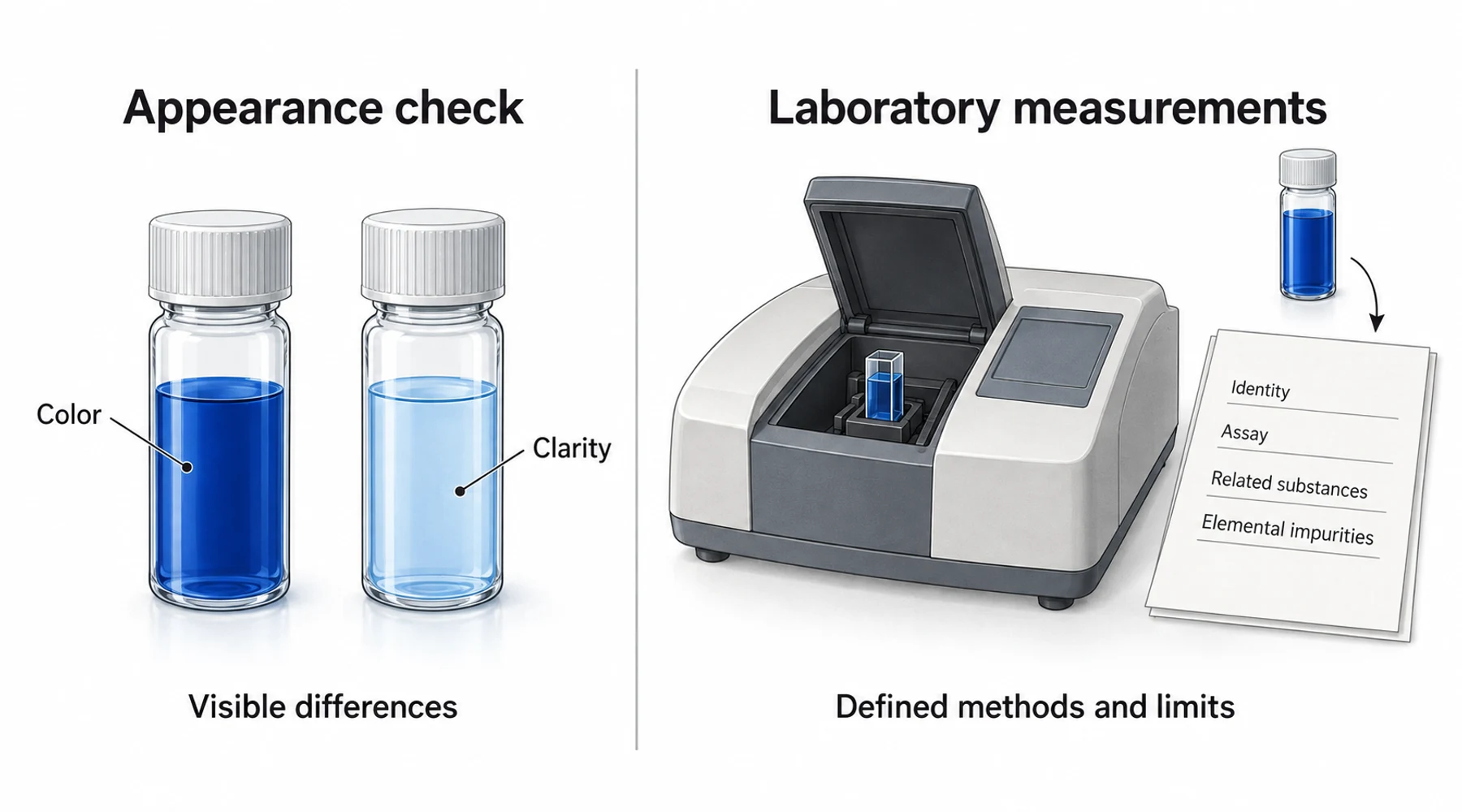
Methylene blue's color cannot tell you its purity. A blue solution may look consistent with the label while containing the wrong concentration or impurities that your eyes cannot detect. A darker bottle is not evidence of a purer product.
Appearance still matters. Unexpected particles, cloudiness, or a change during storage deserve investigation. The mistake is treating an acceptable appearance as proof that all the other quality requirements have been met.
Why two blue samples can look different
Color intensity depends on how much light passes through the liquid and how much the liquid absorbs. Concentration is one factor. The distance light travels through the sample is another: the same solution can look darker through the center of a wide bottle than through its thin edge.
The IUPAC definition of the Beer–Lambert law describes the relationship between absorbance, concentration, and optical path length under specified conditions. A laboratory controls those conditions. Comparing photographs of different bottles does not. Lighting, colored glass, background, and camera settings introduce further differences.
There is also more chemistry involved than a simple dark-to-light scale suggests. Methylene blue molecules can associate into aggregates with different absorption spectra. In a 2020 experimental spectroscopy study, Fernández-Pérez and Marbán measured aqueous solutions across concentrations, salt levels, and temperatures, then modeled the contributions of different aggregated forms. Their work shows why an optical measurement must account for the sample conditions. It does not provide a color chart for judging commercial bottles.
Consequently, a shade difference alone cannot tell you whether the cause is concentration, container geometry, chemical environment, or a product problem.
What dilution can and cannot show
Dilution usually makes an intensely colored solution easier to see through because there is less absorbing material per unit volume. That observation is compatible with methylene blue. It is not unique to methylene blue, and it does not identify everything else present.
Consider a solution containing both the intended dye and a dissolved impurity. Diluting it reduces the concentration of both. A colorless impurity can remain invisible, and the ratio of impurity to dye is unchanged by dilution alone. A prettier shade therefore supplies no evidence that the starting material was purified.
Concentration and purity are different quantities. Concentration describes how much methylene blue is present in a volume of solution. A purity or assay result describes a specified property of the tested material, with a defined calculation basis. For example, the supplied 2023 USP methylene blue monograph preview states its assay definition on a dried basis. That is not a visual shade requirement or the percentage printed on an aqueous solution label.
Does losing and regaining blue color prove authenticity?
Methylene blue can undergo reduction to leucomethylene blue, a form with very different light absorption that can appear colorless. Reoxidation can restore the blue form. Buchholz and colleagues' biochemical experiments examined this reduction and reoxidation with purified enzymes and defined reaction conditions. The experiments establish redox behavior, not a consumer product certification method.
A reversible color change can therefore be consistent with methylene blue chemistry. It does not measure the amount of dye, exclude related dyes, or quantify metals. The impurity you are concerned about may remain present throughout the change.
Nor does every instance of fading demonstrate this reversible reaction. An observation without controlled conditions and analytical measurements does not establish its cause. A bottle that changes unexpectedly should be checked against the supplier's specification and storage instructions. Adding household chemicals to make the color return would change the sample without resolving the quality question.
Appearance checks and laboratory measurements answer different questions
The cover illustrates an appearance comparison beside laboratory measurement and reporting. The report represents several separate tests; the illustrated spectrophotometer does not perform all of them. The following comparison turns that distinction into questions you can ask about a product.
| Question | What appearance can show | Evidence that addresses the question |
|---|---|---|
| Does this match the expected physical description? | Visible color, clarity, or particles under the observation conditions | A documented appearance specification and investigation of unexpected changes |
| Is the substance methylene blue? | A blue appearance is compatible, but insufficient | A specific identity procedure compared with suitable reference material |
| How much methylene blue is present? | Darkness may change with concentration and path length | A quantitative assay, with units, calculation basis, and a method suitable for the formulation |
| Are related organic substances controlled? | Some affect color; others are masked or too dilute to see | A selective impurity method, often chromatography, with named limits and results |
| Are specified elemental impurities controlled? | No dependable visual pass/fail conclusion | Element-specific analysis, such as validated ICP-MS or ICP-OES, with reporting limits |
This separation follows the logic of ICH Q6A specifications, which treats description, identification, assay, and impurities as distinct quality attributes. These principles explain the questions; they do not mean every product has undergone every test listed here.
USP's elemental-impurity procedures describe ICP optical emission and mass spectrometry as analytical approaches. They measure elements using instrumental signals, not the visible blueness of the dye.
Is a spectrophotometer enough?
A spectrophotometer measures how strongly a sample absorbs selected wavelengths. That is much more informative than an eye comparison. With an appropriate method, it can support identity assessment or concentration measurement. However, an instrument reading only answers the question the procedure was designed and validated to answer.
If another substance contributes to the measured signal, it can interfere. ICH Q2(R2) analytical validation guidance requires evidence of specificity or selectivity and recognizes that an additional procedure may be needed when one method cannot distinguish the relevant components adequately. A matching absorption feature is therefore not a universal certificate of purity. A routine dye spectrum also does not establish sterility or exclude every possible contaminant.
What to check at home instead
Use home inspection to identify discrepancies and documentation gaps:
- Match the bottle to its records. Check the product identity, concentration, batch number, and stated storage conditions. A photograph of another batch is weak evidence.
- Record unexpected appearance. Photograph particles, cloudiness, or a change under consistent lighting and contact the supplier. Do not taste the product or chemically alter it to assess quality.
- Read the actual test results. Look for methods, units, acceptance limits, and a certificate tied to the relevant batch. Our guide to reading a methylene blue certificate of analysis explains how to interpret those fields.
- Check what was tested. A raw-material result and a finished-solution result describe different samples. A claim of “not detected” needs a reporting limit and the name of the substance tested.
Blue color is an observation. A defensible quality conclusion connects a specific sample to suitable measurements, their limits, and a documented specification.