
Article
Methylene blue precipitates and crystals: a formulation troubleshooting guide
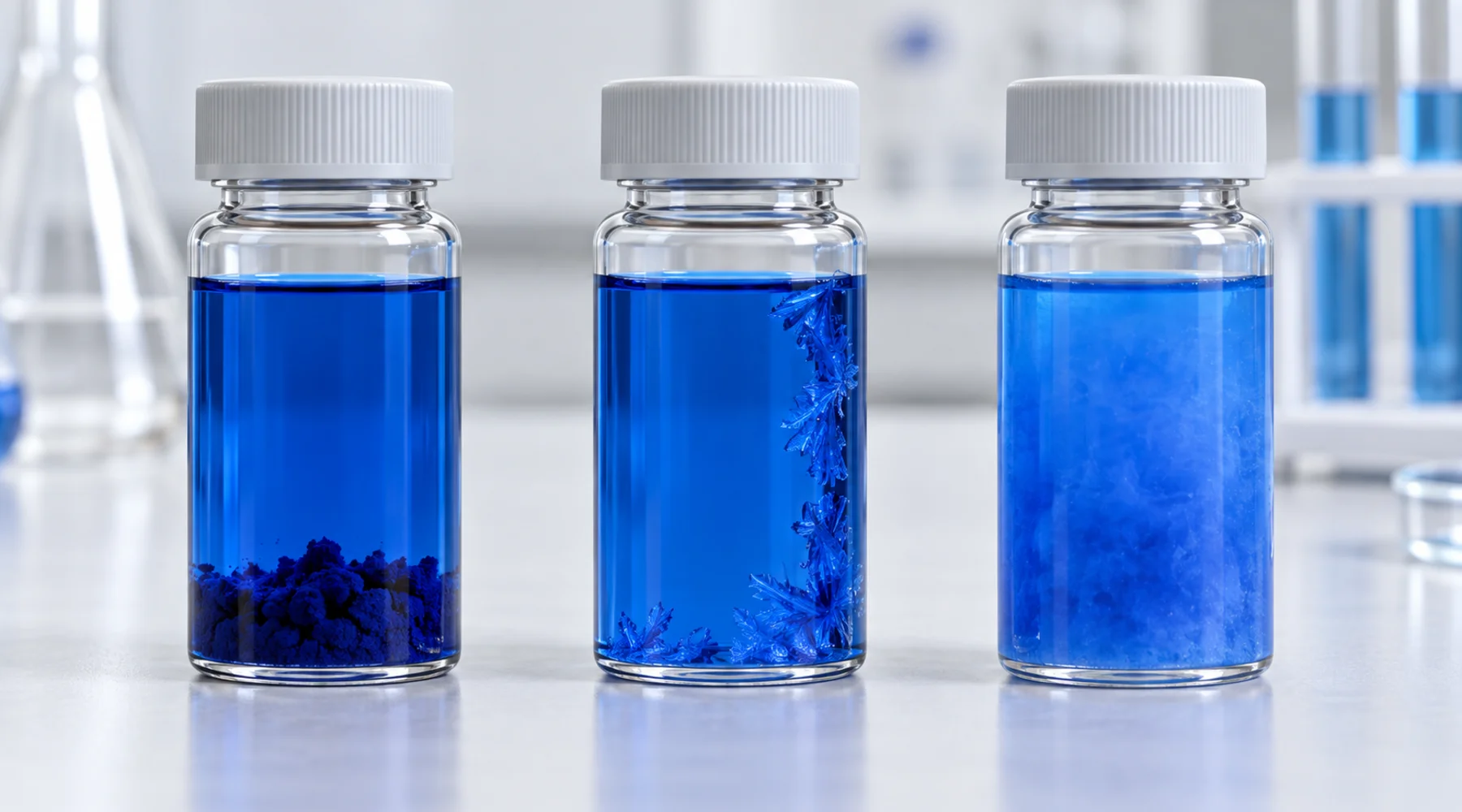
A solution is clear on Monday and has crystals on Friday. Or a powder never fully dissolves despite vigorous stirring. Or two clear liquids turn cloudy the moment they meet. Each of these is called a methylene blue precipitate, but they are different failures with different causes and different fixes.
The mistake is treating appearance as a diagnosis. Visible solids answer one question only: a separate solid phase is present. Everything else, which solid, why it formed, and what to do about it, has to come from timing, formulation, solvent, and the labeled handling requirements of the product in front of you.
Solubility sets the ceiling
Every troubleshooting session should start with the same check: how close is this preparation to the solubility limit in this solvent at this temperature.
For the chloride salt in pure water, the PubChem entry for methylene blue compiles a solubility of about 43.6 mg/mL at 25 C. A separate experimental dataset measured 43.2 g/L at the same temperature and a strongly positive dissolution enthalpy, which means solubility rises steeply with warming and falls steeply with cooling. In that dataset, saturated concentrations ran roughly 19 g/L at 5 C, 43 g/L at 25 C, and 84 g/L at 45 C.
Two qualifications matter before anyone quotes these numbers as a specification. First, the PubChem record for the trihydrate form carries a different compiled figure, at least 100 mg/mL near room temperature, from a different source and a nominally different solid. The two figures should not be merged into one true value. Second, a crystallographic investigation found five distinct methylene blue hydrate phases and no single clean trihydrate phase, even though trihydrate remains the established compendial and product designation. In plain terms, the solid you weigh out may not be exactly the solid named on the label, and its effective solubility follows the actual solid and solvent, not the name alone. The solid forms behind hydrate designations explain why compendial names and crystal structures can diverge.
For perspective, the finished drug product PROVAYBLUE is a 5 mg/mL solution, far below the pure water ceiling. Visible methylene blue crystals in solution at that strength, in correct storage, cannot be explained as simple equilibrium saturation. Something else, temperature history, an added component, or a particulate source outside the dye itself, belongs in the differential.
Timing is the first discriminator
Before reaching for an explanation, record when the solids appeared relative to three events: first contact of powder with solvent, any period of standing or cooling, and introduction of any second component. That single timeline separates most cases.
| Observation and timing | Formulation and solvent context | Likely mechanism | Label or handling check | Next step |
|---|---|---|---|---|
| Solids present from the start; powder never clears | Concentration near or above the effective solubility; wrong solvent for the solid form; insufficient dissolution time | Incomplete dissolution, not storage failure | Confirm the weighed solid form, target concentration, and solvent against the validated procedure | Reduce concentration or change solvent per the validated procedure; confirm the dissolved fraction by assay rather than by eye |
| Clear at first, crystals or haze after standing or cooling | Concentrated aqueous stock; cold room or refrigerator storage | Supersaturation followed by delayed nucleation | Review storage temperature on the label; the labeled storage and handling requirements for the pharmaceutical product specify 20 to 25 C with no refrigeration or freezing | Warm only if the procedure permits; otherwise prepare fresh at lower concentration and keep at the labeled temperature |
| Cloudiness or particles appear when two liquids are combined | Diluent containing chloride, especially 0.9% saline; admixture with another drug product | Incompatibility or salting out | The PROVAYBLUE prescribing information directs dilution in 5% dextrose where dilution is used and warns that chloride reduces solubility; inspect for particulate matter | Stop and segregate the mixture; do not filter and use an injectable that shows particles; review the addition sequence in dilution and compatibility practice |
| Blue color fades with no sediment | Reducing agent present, such as ascorbic acid; oxygen excluded then readmitted | Redox conversion to colorless leuco form, not precipitation | Check the component list for reducing or oxidizing substances | Confirm by spectroscopy (collapse of the visible methylene blue band) instead of particle analysis; treat as a chemistry problem, not a solubility problem |
| Particles in an unopened, correctly stored pharmaceutical vial | Finished 5 mg/mL product within expiry, no dilution performed | Foreign or container particulate, or product defect; not simple saturation | Follow the label instruction to inspect for particulate matter and discoloration before use | Quarantine the unit and follow the product complaint process; appearance alone cannot identify the particle, as discussed in how analytical checks separate identity from appearance |
Preparation errors: solids from the first minute
Powder that never dissolves points at the preparation, not at storage. The usual causes are concentration above the effective solubility in the chosen solvent, a solvent that was assumed equivalent but is not, and impatience.
Ethanol illustrates the solvent trap. Descriptions that call methylene blue soluble in ethanol hide a wide experimental range, and older references describe the trihydrate as only sparingly soluble in alcohol. In the temperature dataset cited above, ethanol at 25 C held roughly 37 g/L against water at 43 g/L, and both shifted strongly with temperature. A protocol moved between solvents or between temperatures without revalidation can cross the ceiling silently.
Association adds a subtler trap. Methylene blue self associates in water into dimers and higher aggregates, with monomer absorption near 665 nm and aggregate contribution near 605 to 612 nm. A concentrated solution can therefore change color or spectrum while remaining physically clear. Dimers are not methylene blue precipitation. Treating every spectral shift as impending crystallization leads to fixes, such as aggressive filtration, that address the wrong problem.
Storage changes: clear first, crystals later
A solution that was clear and later deposits crystals is the signature of supersaturation. Warm liquid holds more dissolved dye than cold liquid. A concentrated stock prepared warm, then moved to a cold room or refrigerator, can sit in a metastable clear state for hours before nucleation starts. Once the first nucleus forms, crystallization can proceed quickly, which is why the change looks sudden.
This is where labeled handling earns its place. The pharmaceutical product is labeled for 20 to 25 C, with excursions permitted between 15 and 30 C, protection from light, and explicit instructions against refrigeration and freezing. A particle investigation on such a product should therefore ask about temperature history before any chemistry. Cold storage of a product that forbids it is a handling deviation, and the remedy is procedural, not a rescue step applied to the vial.
Hydrate behavior can add a slow storage component. Because the solid can exist in multiple hydrate phases, a suspension or a marginally dissolved preparation can transform between solid forms on standing, changing how much stays dissolved. This matters most for laboratory stocks prepared near saturation and stored for weeks, not for dilute finished products.
Incompatibilities: solids that follow mixing
When cloudiness follows the meeting of two components, suspect the combination, not the dye alone. The best documented case is chloride. The prescribing information avoids sodium chloride solutions as diluents because chloride reduces solubility, and Australian product information reports precipitation with 0.9% saline. Mechanistic work supports a chloride dependent aggregation and salting out picture: added salt shifts association equilibria toward larger aggregates, and at high chloride the aggregates leave solution. Saline is therefore not water with a spectator ion. It is a different solvent with a lower ceiling.
Other incompatibilities are documented in product information rather than in bench lore: caustic alkalis, iodides, dichromates, and oxidizing and reducing substances, with double salt formation noted for many inorganic salts. Strongly alkaline conditions do more than precipitate; in 0.1 M alkali the dye converts chemically, largely toward methylene violet. That is degradation, and no solubility maneuver restores the original compound.
The ascorbic acid trap: fading is not precipitation
One case deserves isolation because it produces the most confident wrong diagnoses. Ascorbic acid reduces blue methylene blue to the essentially colorless leuco form, and oxygen can reverse the change. Analytical methods exploit exactly this fading to quantify ascorbate at micromolar levels. A blue solution that goes pale around a reducing agent, with no sediment, has undergone redox conversion. Calling it methylene blue crystals in solution sends the investigation toward filters and solvents when the right instruments are a spectrophotometer and a review of the component list.
The converse also holds. Genuine particles with retained blue color are a physical phase problem unless analysis proves otherwise. Color behavior narrows the field; it does not close the case.
What appearance cannot tell you
Two boundaries keep this guide honest. First, visible particles in a pharmaceutical product cannot be identified as dye crystals by looking. Container derived material and foreign particulate remain in the differential, which is why the label instructs inspection and rejection rather than identification at the bedside. Second, this guide gives no injectable compounding instructions. Diluents, addition sequences, and beyond use questions belong to the product labeling, pharmacy procedures, and applicable compounding standards, not to a troubleshooting article.
The working model, stated once: solubility sets the ceiling, concentration and temperature set supersaturation risk, chloride and ionic strength push association toward salting out, dimers form without precipitating, and reducing agents can remove the blue without forming any solid. Match the observation to the timeline in the table, check the formulation and the label, and most methylene blue precipitation stops being mysterious.