
Article
Methylene blue stability: light, pH, solvents, and degradation
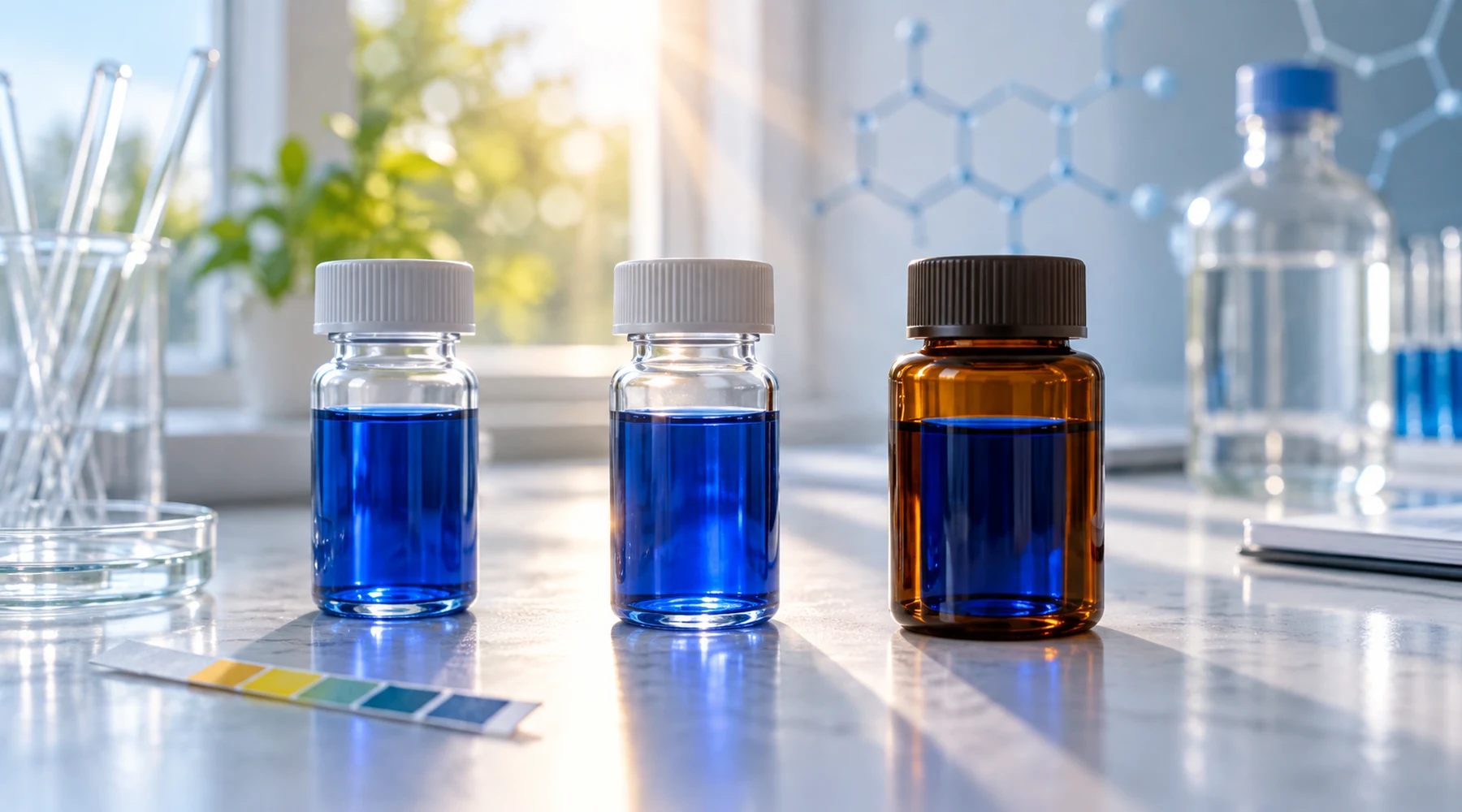
A dilute methylene blue standard reads 0.842 at 664 nm on Monday. On Friday the same bottle reads 0.791, and nobody changed the concentration. The first question is whether dye was lost. The second, harder question is what "lost" means.
Methylene blue stability is not one property. It is several processes that all reduce absorbance at the same wavelength. Reversible reduction, aggregation shifts, and irreversible breakdown look alike on a single-wavelength readout. This page separates them so an experiment can be interpreted correctly.
The scope here is formulation and experiment stability. For bottle storage, opened-bottle handling, and expiry questions, see the consumer shelf life guidance. No expiry date is assigned here, because solution lifetime has to be validated for a specific concentration, container, and storage condition.
Start with the object being described
Dry methylene blue and dissolved methylene blue behave differently. The PubChem record for methylene blue describes the chloride salt, formula mass about 319.9 g/mol for the anhydrous form, with dark green crystals and deep blue solutions in water and alcohol. Compiled historical references describe the trihydrate as stable in air, and current safety sheets ask for a tightly closed container kept dry, cool, ventilated, and protected from light.
That makes the solid comparatively robust under ordinary laboratory storage. It does not transfer to solutions. The current USP preview language says solutions containing methylene blue should be prepared fresh before analysis, with packaging kept well closed, protected from light, and stored below 30 C. That instruction is conservative analytical practice, not proof that every solution fades in days. It means methylene blue solution stability has to be demonstrated, not assumed. The USP methylene blue monograph preview states the assay basis used for that judgment.
Light: the main avoidable loss
Methylene blue absorbs where ordinary light emits. Monomer absorbs strongly near 658 to 665 nm, with a dimer shoulder near 605 to 610 nm and ultraviolet bands near 292 nm and below. Red bench light therefore overlaps the dye directly. Fluorescent light, white LEDs, and UV-A can also bleach dilute solutions under experimental conditions. There is no single safe color of light, only less exposure.
The photochemistry starts with the triplet state. Absorbed light moves the dye to an excited state, and the resulting triplet can transfer energy or electrons to dissolved oxygen. Dilute monomer is an efficient singlet oxygen sensitizer, with reported quantum yields near 0.5 in water. A standard reference for this system is a methylene blue triplet and singlet oxygen study.
Singlet oxygen should not be named as the sole cause of every faded bottle. Irradiated solutions contain reduced leuco species plus demethylated dyes, and the authors of a visible-light irradiation study of methylene blue explicitly leave the branching mechanism open. Reversible photoreduction, oxidative N-demethylation, secondary reactive oxygen chemistry, and later fragmentation can run in parallel.
In one materials study, 10 mg/L aqueous dye at 20 C lost about 37 percent of absorbance after 120 minutes under laboratory visible light and 53 percent under sunlight, while a dark control showed no detectable loss even at 80 C. Those numbers come from a temperature and illumination study of aqueous methylene blue and describe that apparatus only. They show that light dominates, not a half-life for another bottle.
Oxygen plays two roles, which is why "air exposure" is ambiguous. Oxygen enables reactive oxygen formation from excited dye, but it also reoxidizes colorless leucomethylene blue back to the blue form. Air can therefore bleach one solution and restore the color of another. The distinction between leuco formation and destruction is developed in the redox chemistry of methylene blue and leucomethylene blue.
Aggregation changes light sensitivity per molecule. Face-to-face H-dimers relax rapidly and generate far less triplet and singlet oxygen than monomer, as measured in a dimer photophysics study of methylene blue.
pH: stable in the middle, chemical change at the edges
Across the acidic to neutral range, the oxidized blue cation resists spontaneous alkaline chemistry better than it does at high pH. An environmental fate summary compiled in PubChem does not expect hydrolysis to matter much around pH 5 to 9, but that is an environmental estimate, not pharmaceutical validation.
A classic study found dilute dye near 25 C essentially stable below about pH 9.5, with dealkylation appearing around pH 9.5 to 9.8 and rapid change at pH 12 over days. The result appears in an early stability study of methylene blue in alkaline solution and should be read as mechanistic evidence, not a specification.
Strong alkali can also redirect the chemistry. In 0.1 M aqueous alkali, the major isolated product was Bernthsen methylene violet, an alkaline hydrolysis product, as identified in an alkaline degradation study of phenothiazine dyes. That is decomposition, not a pH indicator shift.
Reduction gives leucomethylene blue, essentially colorless and readily reoxidized by air, faster at higher pH and slower in acid. The oxygen dependence was characterized in a photoreduction and reoxidation study of methylene blue. Loss of blue color therefore proves only that the oxidized population fell, not whether reduction, aggregation, or destruction caused it.
Solvents and aggregation: the spectrum can move without loss
Water dissolves the chloride salt readily. PubChem compiles about 43.6 g/L in water at 25 C plus qualitative solubility in ethanol and chloroform, while pharmacopeial language uses terms such as slightly or sparingly soluble for specified materials. Hydrate form, purity, ionic strength, and terminology explain part of the spread. The methylene blue solubility and solution preparation guide covers how to report the material basis behind a number.
Solvent choice changes speciation, not just solubility. In water and methanol mixtures, spectroscopy resolves aqueous monomer, dimer, and trimer alongside methanolic monomer, as shown in an aggregation study of methylene blue in mixed solvents. Alcohol does not remove aggregation: dimers and higher aggregates persist in methanol, ethanol, propanol, and butanol, per a solvent-dependent aggregation study.
For practical work, solvent, ionic strength, temperature, and concentration can move peak position and absorptivity without destroying dye. Keep sample and standard in the same solvent system and verify linearity. The IUPAC definition of the Beer-Lambert law states the conditions for absorbance to track concentration.
Reversible fading versus irreversible degradation
Progressive N-demethylation gives Azure B and then less methylated Azure species and thionine. Aerating the bottle does not reverse that step, and the exact branching varies, so it should not be drawn as one strict chain. The network is mapped in a product study of methylene blue demethylation.
Leucomethylene blue sits on the other side. It is the two-electron reduced form, essentially colorless, and oxygen or another oxidant can regenerate the blue dye. Pharmacopeial control reflects the irreversible side: the current USP monograph controls Azure B as a specified impurity, which is consistent with demethylation being the impurity pathway to watch.
Later oxidation gives ring-opened and fragmented products. Those are destruction. A laboratory does not need to identify every fragment. It needs to avoid calling every absorbance drop by the same name.
Condition-by-stability evidence table
This is the reference asset for the page. Each row names a condition, the best-supported behavior, and the control that prevents a wrong conclusion.
| Condition | Observed behavior | Reversible or permanent | Laboratory control |
|---|---|---|---|
| Dry powder, closed, dark, cool | Comparatively stable; treated as light-sensitive solid | Neither; starting material preserved | Keep tightly closed, dry, protected from light below 30 C |
| Dilute aqueous solution in room light | Progressive methylene blue photodegradation plus possible photoreduction; 664 nm falls | Mixed; leuco part recovers, demethylated part does not | Amber or brown glass, dark storage, minimize illumination time |
| Same solution kept dark | Far slower change; published dark controls show little loss over hours even warm | Mainly preserved if pH and oxygen are controlled | Use a dark control beside every light-exposed series |
| Dissolved oxygen present | Enables reactive oxygen chemistry from excited dye; also restores leuco dye to blue | Both, depending on which path dominates | State aeration; do not equate air exposure with damage alone |
| Acidic to neutral pH | Oxidized cation relatively resistant to alkaline attack | Preserved under otherwise protective conditions | Match pH, buffer, and ionic strength between sample and standard |
| Alkaline pH, around 9.5 and above | Detectable dealkylation, faster with rising pH; hydrolysis products at strong alkali | Permanent chemical change | Avoid alkaline storage of standards; validate any alkaline method separately |
| Water versus alcohol or mixed solvent | Peak position, absorptivity, and monomer to aggregate ratio shift | Spectral redistribution, not proof of loss | Same solvent system for samples and calibration; check full spectrum |
| Concentrated versus dilute | More dimer and higher aggregates; lower photosensitization per molecule | Speciation shift, reversible on dilution if no chemistry occurred | Verify Beer-Lambert linearity over the working range |
| Warm solution, dark versus illuminated | Heat alone causes modest change in published controls; heat plus light accelerates loss | Mostly light-driven under tested conditions | Control temperature in kinetic and calibration work |
| Single-wavelength drop at 664 nm | Compatible with bleaching, reduction, aggregation, adsorption, or demethylated chromophores | Cannot be assigned from one wavelength | Scan the full spectrum and use dark and light controls |
Controls for quantitative work
Prepare analytical standards fresh and keep exposure time short. Match temperature, pH, solvent, ionic strength, and concentration range between standards and samples. Include a dark control when degradation is being studied and a light-exposed no-catalyst control in photochemical experiments. When the spectrum matters, record the full visible spectrum rather than one wavelength, because demethylated dyes and aggregates absorb nearby but not identically. The concentration-dependent spectra behind that advice are documented in a concentration and aggregation spectroscopy study.
Do not convert any result on this page into a shelf life. A validated lifetime belongs to a defined formulation, container, concentration, headspace, microbial control, and storage condition. That validation is owned by the consumer shelf life guidance, which this page supports but does not replace.