
Article
Methylene blue in the environment: fate, aquatic toxicity, and wastewater in context
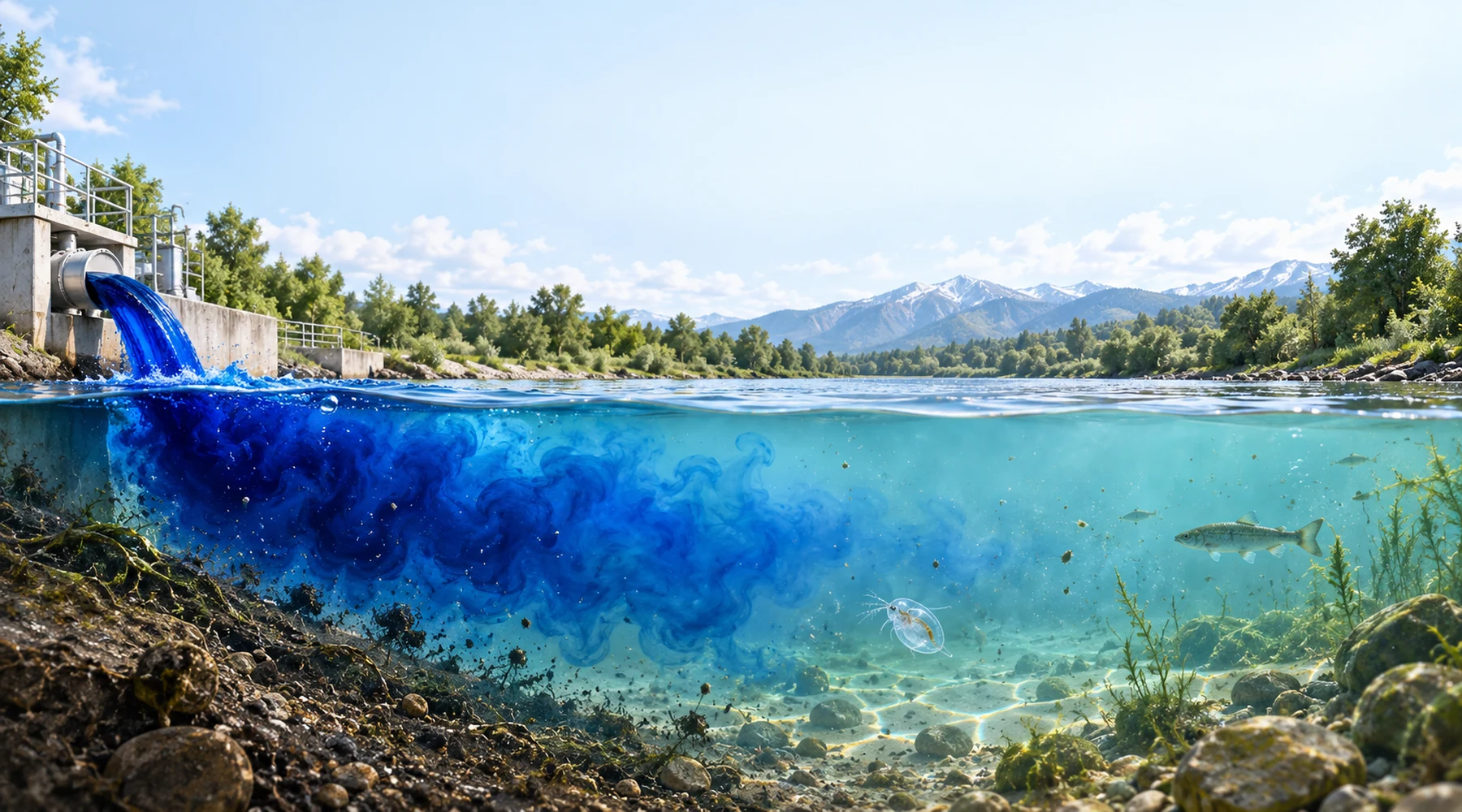
Two different literatures share the name methylene blue. One is the environmental measurement literature: sparse, quantitative, and full of qualifiers. The other is the treatment literature: enormous, confident, and almost entirely built on synthetic solutions mixed in the lab. Confusing the second for the first is the central error in this topic. A paper that removes 95 percent of dye from a spiked flask has demonstrated a material property, not an environmental concentration.
This article keeps the two apart. First the fate of the molecule in water, then the measured toxicity endpoints, then what wastewater numbers actually describe.
Fate: a soluble cation that sticks to solids
Methylene blue dissolves readily and stays positively charged across ordinary environmental pH. Reference compilations list solubility near 43,600 mg/L at 25 C, and a 2025 critical review of its photophysics confirms the dye exists predominantly as the MB cation over roughly pH 3.5 to 11.5. Volatilization from water is therefore negligible. Sorption is the process that matters.
Because it is cationic, the dye binds strongly to negatively charged surfaces: clays, sediments, sludge, and biomass. Older soil work cited in the reference record found strong uptake to organic matter, montmorillonite, and kaolinite with only a small extractable fraction, and clay exchange studies show the mechanism directly as cation exchange that depends on pH, competing ions, and dye concentration. A commonly quoted estimated Koc near 8,000 predicts the same outcome, but treat it as an estimate for an ionic dye rather than a measured constant. Conventional Koc relationships were built for neutral organics and fit ions poorly.
Activated sludge acts as a sink by the same route, even without biodegradation. Batch studies on dried sludge reported Langmuir capacities near 256 mg of dye per gram of sludge at pH 7, and later work with extracellular polymeric substances reached about 366 mg/g with equilibrium in minutes. Those are laboratory capacities, not plant removal rates, but they explain why dye color can vanish into solids while the molecule itself survives.
Sunlight alone is an unreliable sink. A review of methylene blue treatment studies reports one experiment with only about 8 percent removal after 10 hours of catalyst-free photolysis, plus several visible-light controls with negligible loss. Do not assign the dye a universal sunlight half-life. Irradiance, pH, oxygen, suspended solids, and self-sensitization all change the result.
The biodegradation record has a gap at its center. No transparent OECD 301 ready-biodegradability result for pure methylene blue could be located for this article. Primary treatment papers routinely call the dye representative of biodegradation-resistant dyes, and some safety sheets label it not readily biodegradable, but neither is a substitute for a standard test dataset. Selected bacterial cultures and biofilms can decolorize or transform the dye under optimized conditions, so the defensible statement is narrow: commonly described as recalcitrant, with no verified standard pass or fail value found. Transformation chemistry is better established. Oxidative N-demethylation runs approximately from the parent dye through Azure B, Azure A, Azure C, and thionine, while reducing conditions convert the dye to colorless leucomethylene blue. Clear water after reduction is therefore not proof of destruction. The phenothiazine core can remain intact after the color is gone.

Aquatic toxicity: measured endpoints, with conditions attached
Standardized ecotoxicity coverage for methylene blue is thin, and recent results disagree with some legacy database values by orders of magnitude. Every number below needs its species, duration, and endpoint, because stripping those details is how the confusion spreads.
The most sensitive modern result is for the water flea. A 2023 study of toxic effects on Daphnia magna reported a 48-hour immobilization EC50 of 61.5 micrograms per liter (0.062 mg/L) and a 24-hour LC50 of 0.149 mg/L, with physiological and reproductive effects above 4.7 micrograms per liter. That last concentration is an observed-effect level under the authors' statistics, not a regulatory no-effect concentration, but the overall signal is clear: cladocerans respond at concentrations far below typical lab spike levels.
Fish data tell a conditional story. Larval fathead minnows exposed in acute and subchronic tests gave 96-hour LC50 values of 45 mg/L at 20 C and 15 mg/L at 25 C, with seven-day chronic values near 2.1 mg/L for survival and 0.6 mg/L for growth under laboratory light. Temperature and light changed the outcome, which matters because dye color itself alters light penetration.
Primary producers fall in the low single-digit range in one OECD-style series. Exposures of 24 to 96 hours gave EC50 values declining from about 62 to 5.4 mg/L for Chlorella vulgaris and from about 5.8 to 1.1 mg/L for Spirulina platensis, the latter being a cyanobacterium rather than a eukaryotic alga. A short marine bacterial assay with Vibrio harveyi measured a 15-minute bioluminescence EC50 near 18 mg/L for undegraded dye, which describes acute bacterial response, not sludge inhibition.
One finding deserves special attention from treatment engineers. Ammonia-oxidizing microbes showed strikingly uneven sensitivity: the archaeon Nitrosopumilus maritimus lost about 65 percent of ammonia oxidation activity at 0.010 mg/L, while the bacterial Nitrosococcus oceani needed about 10 mg/L for a comparable effect in comparative inhibition tests. Those are percent-inhibition observations rather than IC50 values, but they flag nitrification as a process worth protecting in any discharge containing the dye.
Regulatory context is modest. No verified EU harmonized aquatic classification or public ECHA PNEC specific to methylene blue could be confirmed; the substance appears in ECHA records without that single number attached, so do not copy a PNEC from a mixed-solvent safety sheet. As a national example, New Zealand classifies the dye as Aquatic Chronic 3, H412, harmful to aquatic life with long lasting effects. Useful context, not a European classification.
Why the model pollutant literature is not exposure data
Methylene blue dominates adsorption and photocatalysis journals for practical reasons. It is cheap, intensely colored, easy to track with the spectrophotometric methods used for dilute aqueous work, strongly adsorptive, and it even has a formal test history through ISO 10678 for photocatalytic surfaces. The ISO-test literature itself warns that adsorption, dye purity, pH, light source, and diffusion introduce large errors, with inter-laboratory reproducibility error near 30 percent. Convenience is not representativeness.
Generic dye effluent numbers make the confusion worse. A widely cited review of dyehouse effluents reported total dye concentrations of roughly 10 to 250 mg/L, but that covers many dye chemistries and must never be quoted as a methylene blue concentration. Actual measurements of this specific dye run much lower. A South African textile wastewater study found about 2.3 mg/L in influent and 3.2 mg/L in effluent before the authors spiked samples to 30 mg/L for experiments, and a batik rinse-water sample in Phuket contained about 3.6 mg/L with spectrophotometric and HPLC confirmation. Those single-digit values sit an order of magnitude below the 30 to 50 mg/L starting points typical of removal papers.
The rule for reading this literature: a reported removal percentage describes performance against a laboratory probe at the stated starting concentration. Exposure requires sampling data with speciation. Related analytical method references cover how to keep that distinction visible in reported results.
Treatment: name the endpoint before claiming removal
Three families of treatment remove the dye, and each has a characteristic way of overstating its success.
Adsorption and biosorption move the dye from water to a solid: carbon, clay, biomass, or sludge. The limitation is phase transfer, not chemistry. Unless the spent sorbent is destroyed or securely disposed, the dye still exists. Reversibility is documented; one ultrafiltration study achieved near-complete initial rejection through adsorption and then recovered the dye by lowering pH to desorb it. A separate membrane test showed retention collapsing from about 20 percent to near 2 percent once adsorption sites saturated. Early samples measured the sorbent, not the membrane.
Oxidation destroys the chromophore, but color loss is not mineralization. Fenton oxidation of 10 to 30 mg/L solutions gave over 98 percent dye removal in one hour at pH 2 to 3 while chemical oxygen demand fell only about 81 percent. Ozonation achieved complete visible degradation in 12 minutes at pH 12 with COD reduction near 65 percent. The gap between those two numbers is where Azure intermediates and partial oxidation products live. Decolorization, degradation, COD removal, and mineralization are four different endpoints and should never be used interchangeably.
Membranes can reject the dye at high rates under controlled feeds, including one laboratory nanofiltration case near 99.8 percent removal from a 100 mg/L feed, but they produce a concentrate stream that still requires handling and may rely partly on adsorption in early operation. Full-scale validation is a separate claim from a controlled-feed result.
For bench and pilot work, the practical consequences are concrete. Keep dye waste segregated and labeled rather than pouring dilute blue solutions to drain on the assumption that a treatment plant will biodegrade them; sorption to sludge is likely while destruction is not assured. Practical container, segregation, and disposal steps are covered in the laboratory waste handling guide. Discharge color rules such as India's 150 PCU limit for textile effluent regulate observable color, not methylene blue concentration, so there is no universal conversion from color units to mg/L in mixed wastewater.
The honest summary fits in one paragraph. Methylene blue sorbs strongly, photolyzes slowly without help, has no located standard biodegradability verdict, breaks into Azure species or a colorless reduced form rather than vanishing, harms some aquatic organisms below 0.1 mg/L while others tolerate tens of mg/L, appears in the few measured effluents at single-digit mg/L, and is removed by sorption or oxidation only when the endpoint is defined precisely. Everything else is a spiked flask waiting for a field sample.