
Article
The methylene blue method for sulfide measurement
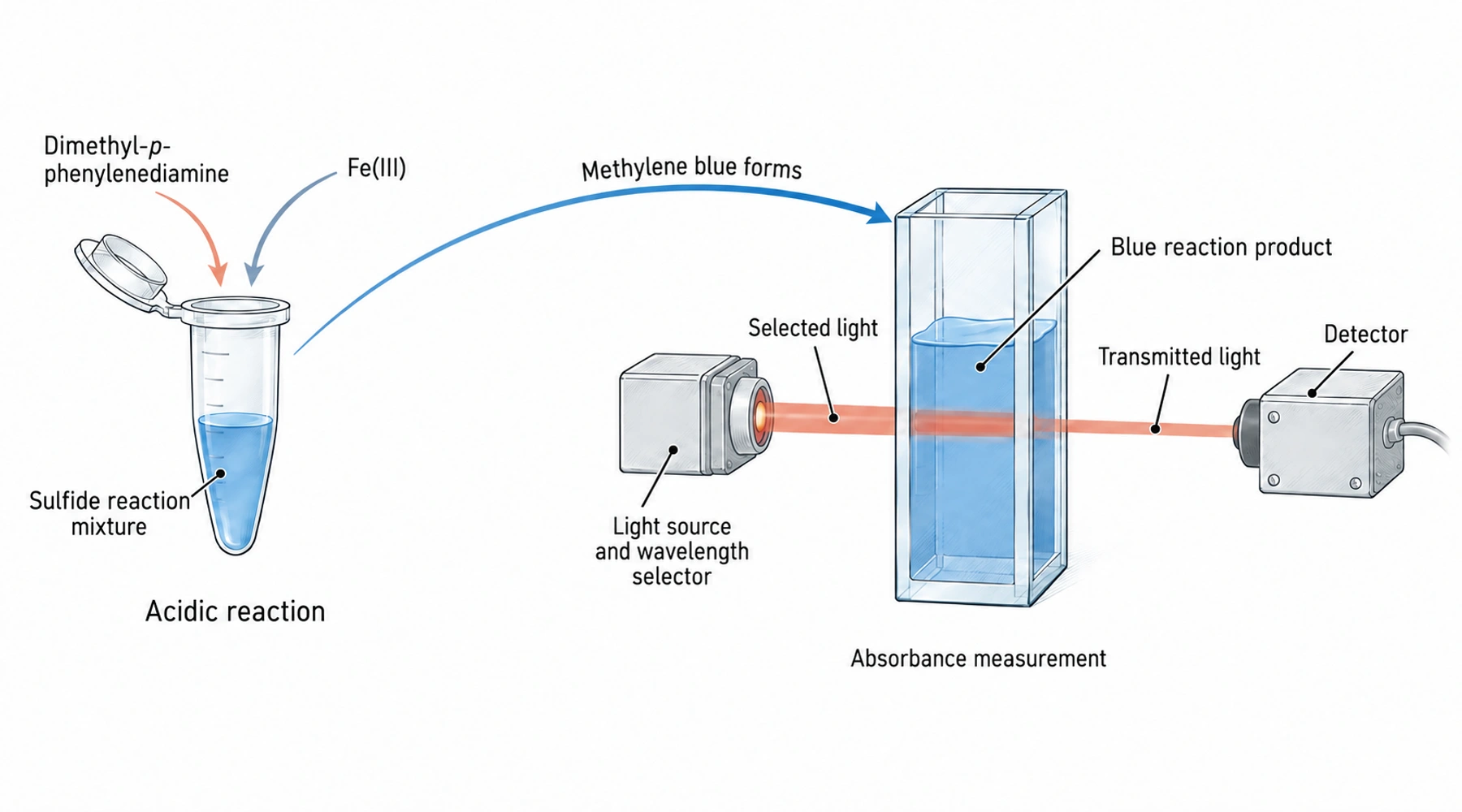
The methylene blue sulfide method measures sulfide by converting it into a blue dye and measuring the resulting absorbance. Methylene blue is the reaction product that carries the analytical signal. Adding a bottle of methylene blue to water is not this test.
The difficult part is often keeping the sample representative until that reaction occurs. A precise absorbance reading cannot recover sulfide that escaped or oxidized during collection. Nor can it distinguish free hydrogen sulfide from other sulfur pools released by sample preparation.
What produces the blue color?
In EPA Method 376.2, sulfide reacts with dimethyl-p-phenylenediamine in the presence of ferric chloride to form methylene blue. The acidic reagents create the conditions for dye formation. The instrument then measures light absorption by the resulting solution.
The conceptual reaction is:
Sulfide + N,N-dimethyl-p-phenylenediamine + Fe(III), under acidic conditions → methylene blue → absorbance measurement.
This is an analytical schematic, not a balanced reaction equation. Reagent formulation and concentration, development time, wavelength, and optical path must come from the selected method.
Those details are not interchangeable. EPA 376.2 specifies measurement at 625 nm. The Hach 8131 procedure documented for its DR/5000 instrument uses 665 nm. A literature value for methylene blue absorbance does not replace the settings and calibration belonging to a particular assay.
Define the sulfide fraction before collecting it
“Hydrogen sulfide concentration” can conceal different measurement targets. In water, dissolved H₂S and HS⁻ are related by acid-base chemistry. Their proportions depend on conditions, including pH. Acidifying a sample changes that distribution; it does not preserve the original distribution for later observation.
EPA 376.2 covers total and dissolved sulfides in specified water and waste samples, but excludes acid-insoluble sulfides. Therefore, “total” in a report using this method must not be read as every sulfur-containing compound in the bottle. Sulfate is a different analyte, and an acid-insoluble metal sulfide can be missed.
Before comparing results from two laboratories, ask what fraction each procedure recovered. Also check the reporting basis: mg/L as sulfur and mg/L as H₂S are different mass conventions. A matching number without matching units, preparation, and analyte definition is not agreement.
A workflow that protects the measurement
Use the following sequence when reviewing a proposed laboratory workflow. The cover illustration shows the reaction and optical readout; this table identifies the decisions that precede them.
| Stage | Record before proceeding | What the record prevents |
|---|---|---|
| Define | Water, waste, or biological matrix; dissolved or method-defined total fraction | Comparing different analytes under the same “H₂S” label |
| Collect | Collection time, temperature, filtration, container, and exposure to air | Treating a changed sample as the original water |
| Stabilize | Exact preservation procedure and permitted delay | Assuming refrigeration alone preserves every sample |
| React | Method version, reagent lot, volumes, and development time | Combining incompatible parts of different protocols |
| Measure | Wavelength, cell path, blank, standards, and dilution | Converting color to concentration without the right calibration |
| Review | Recovery checks, duplicate agreement, reporting limit, and units | Reporting an instrument number without its analytical limits |
The NEMI summary of Standard Methods 4500-S²⁻ D calls for minimal aeration and either immediate analysis or specified zinc-acetate preservation. Its total-sulfide preservation procedure also uses alkaline conditions and a completely filled bottle. These requirements belong to the sample method, not merely to laboratory housekeeping.
Interferences can make a sample look falsely low
The same Standard Methods summary identifies reducing agents that suppress blue-color formation, metals that form poorly recovered insoluble sulfides, and ferrocyanide that itself produces blue color. Very high sulfide concentrations can also inhibit the reaction.
Consequently, a pale tube has several possible explanations: little sulfide, loss before analysis, incomplete recovery, or suppressed color development. A dark tube can contain interfering color. Color and turbidity require the method's prescribed background correction; subtracting an arbitrary water blank is not necessarily sufficient.
A useful check is to add a known sulfide amount to a representative sample and carry it through the relevant preparation. If the expected increment is not recovered, the matrix or workflow needs investigation. The quality-control provisions in EPA 9030B illustrate why a matrix spike is processed through the entire method, alongside blanks and check standards. A spike added only immediately before reading cannot assess earlier losses.
A field example: hot water defeats a tidy protocol
The USGS Yellowstone study reported in Open-File Report 2010-1192 compared two methylene blue procedures with an ion-selective electrode method on preserved geothermal samples.
Electrode results were consistently higher. The researchers identified oxidation and H₂S degassing as problems with hot samples. Premixing the color reagents before adding sample gave marginally higher colorimetric results, but introduced another problem: the mixed reagent degraded rapidly, making timing a source of imprecision. Seven samples also contained thiosulfate at concentrations the authors associated with likely colorimetric underestimation.
For their geothermal waters, the authors favored immediate alkaline antioxidant stabilization followed by electrode measurement. This is a concrete method-selection finding for hot water, not evidence that every electrode measurement outperforms every colorimetric assay.
Choose the method for the question
| Analytical question | Method to evaluate | Principal qualification |
|---|---|---|
| Recoverable sulfide in an appropriate water matrix | Documented methylene blue colorimetry | Preserve the specified fraction and demonstrate matrix recovery |
| Sulfide in hot geothermal water | Immediate stabilization with a validated electrode workflow | Validate collection and preservation for the temperature and matrix |
| Sulfides in heterogeneous waste or solids | Fraction-specific preparation such as EPA 9030B, with its stated determinative method | Acid-insoluble recovery can remain incomplete; do not assume exhaustive extraction |
| Free sulfide versus acid-labile pools in biological specimens | Selective trapping or derivatization with separation | Establish which sulfur pool generates the measured signal |
The biological distinction is substantial. In Shen and colleagues' 2011 laboratory and mouse-plasma study, methylene blue measurements were limited by background color, sensitivity, and acid-labile sulfur released during preparation. Their monobromobimane/HPLC method separated a sulfide derivative and detected lower concentrations under the tested conditions. This was analytical validation work, not a clinical diagnostic threshold or proof of a treatment effect.
Calibration and similarly named tests
Calibrate against the procedure's defined sulfide standards, using the same reaction and optical conditions as the samples. Review the blank and check-standard results before converting sample absorbance. A clean calibration curve establishes a relationship for those standards; sample recovery establishes whether that relationship survives the matrix.
Finally, MBAS testing for anionic surfactants uses methylene blue differently. In EPA 425.1, existing dye associates with surface-active substances and is extracted into an organic phase. Sulfide colorimetry forms the dye. Neither analytical procedure is a water-treatment instruction. Identify the analyte and reaction before selecting the reagent or interpreting the blue color.