
Article
Methylene blue dye-ingress testing: what a clear vial proves
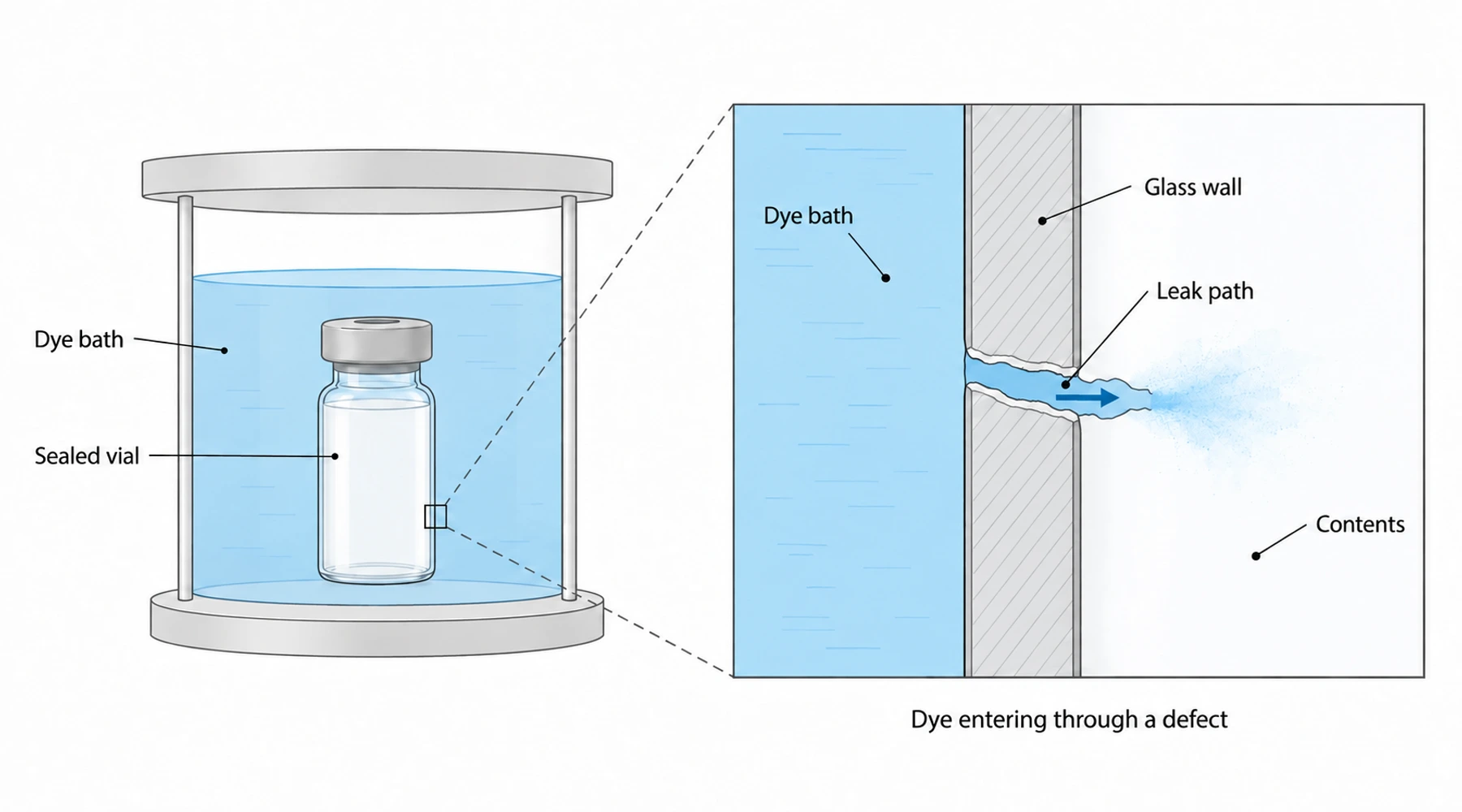
A methylene blue dye-ingress test asks whether an external dye solution can enter a sealed package under defined challenge conditions. Blue dye inside an ampoule or vial can identify a breach. No detectable dye means that the test did not detect ingress under those conditions. It does not, by itself, establish that the product is sterile.
That distinction determines how the test should be designed. A visually convincing demonstration with a broken vial is easy. Showing that a method can reliably identify the defects relevant to a particular product takes considerably more work.
Follow the dye through the package
In a typical immersion test, sealed containers are placed in a dye bath and exposed to a specified pressure sequence. Reducing external pressure can allow gas to leave a leaking container. Restoring pressure while the container remains submerged can drive dye solution inward. The exterior is subsequently cleaned, and the contents are examined visually or analyzed for the tracer.
The complete pathway matters: the challenge must reach a leak, liquid must traverse it, and enough dye must remain detectable inside. A test can fail at any of those stages. A small channel blocked by product or trapped gas need not behave like an open hole with the same nominal diameter.
For a fused glass ampoule, the relevant defect may be a crack or an incomplete seal. For a stoppered vial, the system also includes the glass finish, elastomer, and the way the closure is secured. Testing a punctured stopper's ability to reseal addresses an additional in-use question. These are related packaging problems, but they are not interchangeable test specimens.
Concentration is part of a method, not the method
There is no single answer to “What concentration of methylene blue is used for a leak test?” without identifying the procedure. Dye concentration, formulation, exposure time, pressure, fill volume, and detection method operate together.
An archival USP Pharmacopeial Forum document from 2008 describes a 0.1% solution, expressed as 1 g/L, for a particular elastomeric-closure self-sealing test. That historical example is not a universal recipe for ampoules, prefilled syringes, or every current vial system.
For present method selection, USP chapter 1207 provides the package-integrity framework for sterile products, while chapter 1207.2 addresses leak-test technologies. Its introduction explicitly cautions readers to check the scope and latest versions of referenced standards. USP chapter 382 addresses functional suitability of parenteral packaging systems containing elastomeric components. An old workshop draft cannot replace the applicable official text and a validated procedure.
The practical question is therefore: does this complete method detect the leakage relevant to this product and package? Choosing a darker bath does not answer it. Record the solution composition and concentration unambiguously, including additives and the basis of any percentage.
Controls distinguish a useful result from a failed test
Use this interpretation workflow when reviewing a method or test report. The control identities and acceptance criteria must be established before interpreting the unknown samples.
| Stage | Required evidence | If the evidence is missing | False conclusion to avoid |
|---|---|---|---|
| Define the purpose | Product, package configuration, lifecycle stage, and leakage concern | The test may answer the wrong packaging question | “Any leak test is suitable.” |
| Challenge the pathway | Known-defect packages representing the method's claimed capability | A clear unknown may reflect an ineffective challenge | “The large broken control worked, so small defects are detectable.” |
| Check background | Intact negative controls handled with the samples | Exterior contamination or matrix color may be mistaken for ingress | “Every blue signal came through a leak.” |
| Check the readout | Dye-spiked contents or suitable analytical standards | The contents may conceal a low dye concentration | “A sensitive instrument guarantees a sensitive package test.” |
| Interpret the sample | Valid controls and a predefined decision rule | The result requires investigation | “No dye means sterile and pyrogen-free.” |
A dye-spiked sample and a deliberately defective package answer different questions. The spike asks whether dye already inside can be detected. The defective package asks whether dye can enter and then be detected through the complete workflow. A rigorous study needs to distinguish those capabilities.
Two detection limits are easy to confuse
The analytical detection limit concerns how much dye the readout can distinguish from background. The package-test detection capability concerns which defects the entire method detects, with what consistency. An excellent analytical limit cannot rescue a challenge that fails to transport dye through a relevant leak.
This is why dye-ingress results are probabilistic: an existing defect does not guarantee observable tracer passage on every challenge. Repeated tests and appropriately characterized defects are needed to establish performance, rather than assigning a universal minimum hole size.
Original research illustrates the dependence on the system. In a 2016 study of prefilled syringes, Lu and colleagues reported that methylene blue was unsuitable for reliable detection of small breaches in the drug-product syringes they investigated. They developed an approach using a fluorescent dye and spectroscopic detection. That finding supports evaluating tracer and readout together; it does not establish one replacement method for all packages.
A different dye-ingress study published in 2000 used FD&C Red No. 40, not methylene blue, and compared dye and microbial ingress using breached vials fitted with microtubes. Similar sensitivity in that experimental system does not make every blue-dye protocol equivalent to a microbial challenge.
Keep four quality questions separate
Package leakage: Can material cross the package boundary under the test conditions? Dye ingress supplies evidence about this question.
Microbial integrity: Can the package maintain its microbial barrier through the relevant storage and use conditions? Linking a physical test to this claim requires an appropriate validation rationale. The FDA guidance on integrity testing in stability protocols supports validated approaches to demonstrating continued package integrity. It explicitly excludes replacing initial product sterility testing: an intact package could have been filled with contaminated material.
Pyrogens and endotoxins: A leak test does not measure these contaminants. FDA's production and process controls guidance treats microbial contamination and pyrogen or bacterial-endotoxin testing as distinct quality requirements. A clear dye result cannot supply either measurement.
Glass-surface durability: A container may resist leakage while its inner surface develops particles or delamination. USP chapter 1660 concerns inner-surface durability and glass-particle formation. Surface staining or microscopy used to investigate glass is not the same observation as dye entering a sealed vial.
Finally, clinical dye tests for fistulas and anatomical leaks have a different subject, purpose, and interpretation. A pharmaceutical package test does not provide a clinical protocol. Within analytical uses of methylene blue, the dye is a tracer here: the conclusion depends on the tested pathway and its controls, not simply on the presence or absence of blue.