
Article
Methylene blue in textile and paper dyeing: Basic Blue 9 in the dyehouse
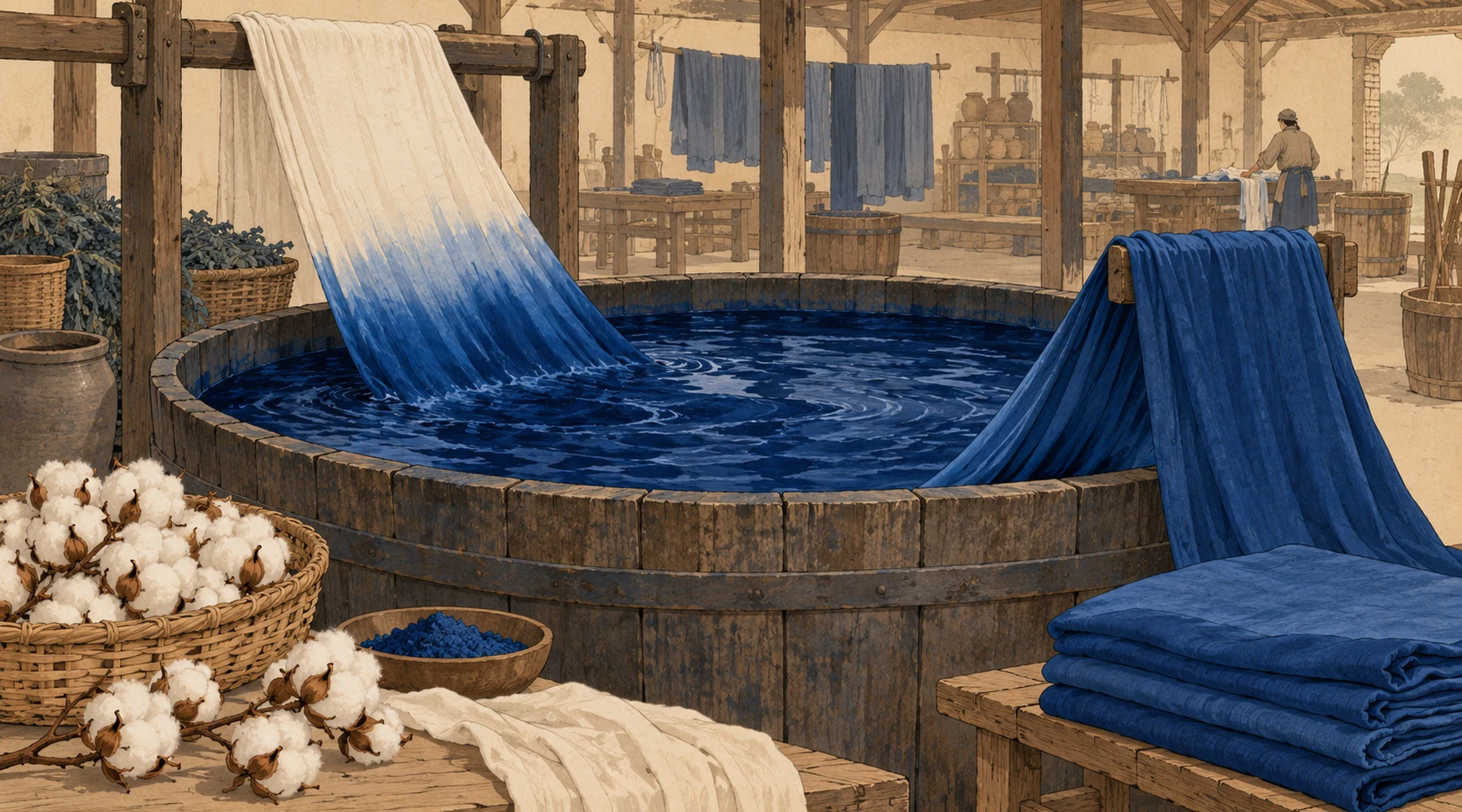
Methylene blue spent fifteen years as a commercial dye before anyone gave it to a patient. Heinrich Caro synthesised it at BASF in 1876 as a textile dyestuff, and both BASF's own history and the American Chemical Society describe it as a dye made for cotton. Koch's medical staining work came around 1880, and the malaria treatments of 1891 later still. Everything else the compound became, stain, indicator, drug, started from a dye catalogue entry.
That entry is still the correct way to read the substance in an industrial setting. In dyehouse language it is not methylthioninium chloride. It is Basic Blue 9.
One compound, two numbering systems
The Colour Index identifies every commercial dye twice. The Generic Name describes application and use; the Constitution Number describes chemical structure. Methylene blue carries the Generic Name C.I. Basic Blue 9 and the Constitution Number C.I. 52015, placing it in the thiazine class that occupies numbers 52000 to 52999, as a recent Colour Index account confirms with methylene blue as its worked example.
The chemistry behind the numbers is the phenothiazine cation paired with chloride: anhydrous formula C16H18ClN3S at about 319.9 g/mol with CAS 61-73-4, and the common commercial trihydrate at about 373.9 g/mol with CAS 7220-79-3. The commercial salt forms dark green crystals with a bronze lustre that dissolve to a deep blue solution, and a 1 percent solution of the trihydrate sits at pH 3 to 4.5 according to PubChem and a recent molecular properties review. Anyone buying by the drum should check which CAS number is on the label, because a kilogram of trihydrate contains roughly 15 percent less chromophore than a kilogram of anhydrous salt. The question of what exactly is being weighed is worth settling before any dyeing calculation.
The binding concept: a cation looking for anions
Basic dyes are cationic dyes. In solution the coloured species carries a positive charge, so it binds most naturally to fibres that offer anionic sites. That single fact predicts nearly the whole application pattern.
Acrylic fibre is the textbook substrate. It conventionally carries carboxylate or sulfonate groups, and ionic attraction between those sites and the dye cation gives strong substantivity, as described in studies of conventional cationic dyeing of acrylic and the chemistry of acrylic fibres. Wool and silk also take up basic dyes directly at negatively charged sites and give brilliant shades, though textile references warn that the older basic dyes on these fibres generally show poor light fastness, a point summarised in an open textile colouration textbook.
Cotton is the important exception. Untreated cellulose has little affinity for traditional basic dyes, which is exactly why Caro's "dye for cotton" needed help. Historical practice mordanted the cotton with tannic acid, commonly fixed with tartar emetic (antimony potassium tartrate), producing an insoluble tannin dye complex on the fibre. A period cotton dyeing handbook lays out the three operations, tanning, fixing, then dyeing, in The Dyeing of Cotton Fabrics. Ordinary nylon needs a similar qualification: it is primarily an acid dye substrate, and only nylon deliberately modified with sulfonate groups, sold as cationic dyeable nylon and described in work such as US6312805B1, takes basic dyes strongly.
So the fibre summary is compact. Cotton with a tannin mordant for historical reasons; wool and silk directly but fugitively; acrylic as the chemically natural modern substrate; ordinary nylon mostly off limits.
Brilliant, and fugitive
The weak point was never getting the colour on. It was keeping it there. A 2019 study that dyed cotton, silk and wool directly with methylene blue trihydrate measured a lightfastness rating of 1, the bottom of the scale, on all three fibres under ISO 105-B02, with retention improving only after smectite post-treatment, as reported in RSC Advances. The older literature says the same thing in period language: many basic colours are fugitive to light, as the 1911 Encyclopaedia Britannica dyeing article records.
Bath chemistry adds a second caution. Basic dyes are normally applied under neutral to mildly acidic conditions, and strong alkali is specifically bad for methylene blue: in 0.1 M aqueous alkali it hydrolyses mainly to Bernthsen's methylene violet, a strongly coloured lipophilic product, rather than surviving unchanged, according to a study on the effect of alkali on methylene blue. An alkaline scour left in the goods, or an alkaline aftertreatment, can therefore shift the shade for chemical reasons that have nothing to do with fixation. The redox cycling behind the colour changes is a separate subject, but the practical rule is simple: keep the bath out of strong alkali.
Paper, ink, and carbon copies
Paper dyeing is documented as a current commercial application. A Basic Blue 9 supplier lists paper alongside silk, hemp, wood and bamboo coloration plus ink and colour lake manufacture, in its product application sheet. Ink has the stronger paper trail: India once maintained a dedicated standard, IS 2230:1962 for methylene blue dye for the ink industry, now withdrawn but recorded in the BIS annual report of 1962 to 1963 and catalogued as withdrawn.
Carbon paper is on record too. A 1933 US patent for carbon paper coatings describes oil and wax inks containing aniline dyes including methylene blue, in US1925235A. And a 2024 heritage science study of historical blue copying pencils found methylene blue among the most common colorants, while documenting exactly the behaviour a dyehouse would predict: severe light sensitivity and a tendency to bleed when wetted, published in npj Heritage Science. The pencil that copied brilliantly and faded in sunlight is the same chemistry as the cotton that dyed brilliantly and faded in the window.
Three grades, three specification regimes
Here is the comparison that matters most, because the same name covers materials made to incompatible specifications. Textile grade, biological stain, and pharmaceutical grade are not steps on one purity ladder. They are answers to different questions.
| Textile / technical grade (Basic Blue 9) | Biological stain (certified) | USP / pharmaceutical grade | |
|---|---|---|---|
| Question answered | Does the lot match the standard shade and strength? | Does it stain correctly? | Is it pure and safe enough for the monograph? |
| Key figures | Relative colour strength vs reference dye (see ISO 105-Z10); shade; water insoluble matter, e.g. max 1.5 percent on one supplier specification; moisture | Dye content, e.g. min 82 percent on a BSC certified product | 97.0 to 103.0 percent on the dried basis per the USP monograph, with dedicated Azure B reference standards |
| Impurity control | Lot to lot consistency; no pharma impurity panel | Stain performance; certification, not a drug assay | Full panel: identity, organic impurities including Azure B, residual solvents, elemental impurities, residue on ignition, microbial limits, endotoxins |
| What 100 percent means | 100 percent standard strength is strength relative to a reference dye, not 100 percent chemical purity | Certified for the bench, not for ingestion | Assay on dried basis with controlled impurities |
Two confusions in the table deserve emphasis. First, a "100 percent" textile dye is not 100 percent pure chromophore; ISO 105-Z10 defines strength as relative to a reference dye. Second, a certified stain at 82 percent dye content is not a failed pharmaceutical; it passed a different test. The pharmaceutical side is illustrated by a process development report that held total metals below 20 ppm, Azure B below 2 percent and other impurities below 0.5 percent, figures that describe that process in the published Proveblue study, not a universal textile specification. And the reason Azure B gets its own reference standard is that it is both the principal demethylation impurity and a pharmacologically active metabolite in its own right, a story taken up in the research on Azure B.
For a dyehouse, the practical incoming checks follow from the left column: shade against standard, relative strength, solubility and insoluble matter, moisture, and consistency between lots. Nothing in that list qualifies the drum for the laboratory, let alone for consumption.
How to read a Basic Blue 9 data sheet
A typical technical data sheet lists four numbers, and each answers a different question. Strength, expressed as a percentage against the supplier's reference lot, tells the dyer how much dye to weigh for a target depth; a lot at 105 percent strength needs about 5 percent less weight than standard. Dye content, when stated, is the chemical fraction of actual chromophore, and it is always lower than the strength figure suggests because commercial powder includes moisture and diluents. Water insoluble matter, capped at levels such as 1.5 percent, predicts specks and filter clogging rather than shade. Moisture completes the picture, and it interacts with the hydrate question: the trihydrate carries three waters of crystallisation, so a kilo of it holds roughly six sevenths the chromophore of a kilo of anhydrous salt. A recipe written for one hydrate and weighed with the other will miss its depth by that fraction before the goods ever enter the bath.
A note on effluent
Methylene blue is intensely coloured and easy to follow spectrophotometrically, with adsorption studies typically tracking its visible absorbance around 663 to 665 nm, as in a biosorption study and a hydrogel adsorption study. That convenience made it the model cationic dye of wastewater research: a major review in the Journal of Hazardous Materials surveys its removal by adsorption on low cost materials, covering textile, paper and printing effluents.
Model status cuts both ways. The volume of adsorption papers does not prove methylene blue itself is a leading modern textile pollutant; it proves the compound is a convenient stand in for cationic dyes generally. Read effluent claims with that distinction in mind.
The name is the warning
Basic Blue 9, C.I. 52015, methylthioninium chloride: three names for one chromophore, sold under at least three specification regimes. The textile material that Caro made for cotton was never asked to be swallowable, and no certificate written for shade and strength can make it so. When the same drum name appears on a laboratory shelf, the specification, not the colour, is what tells you what you hold.