
Article
What is methylene blue? Uses, history, and key distinctions
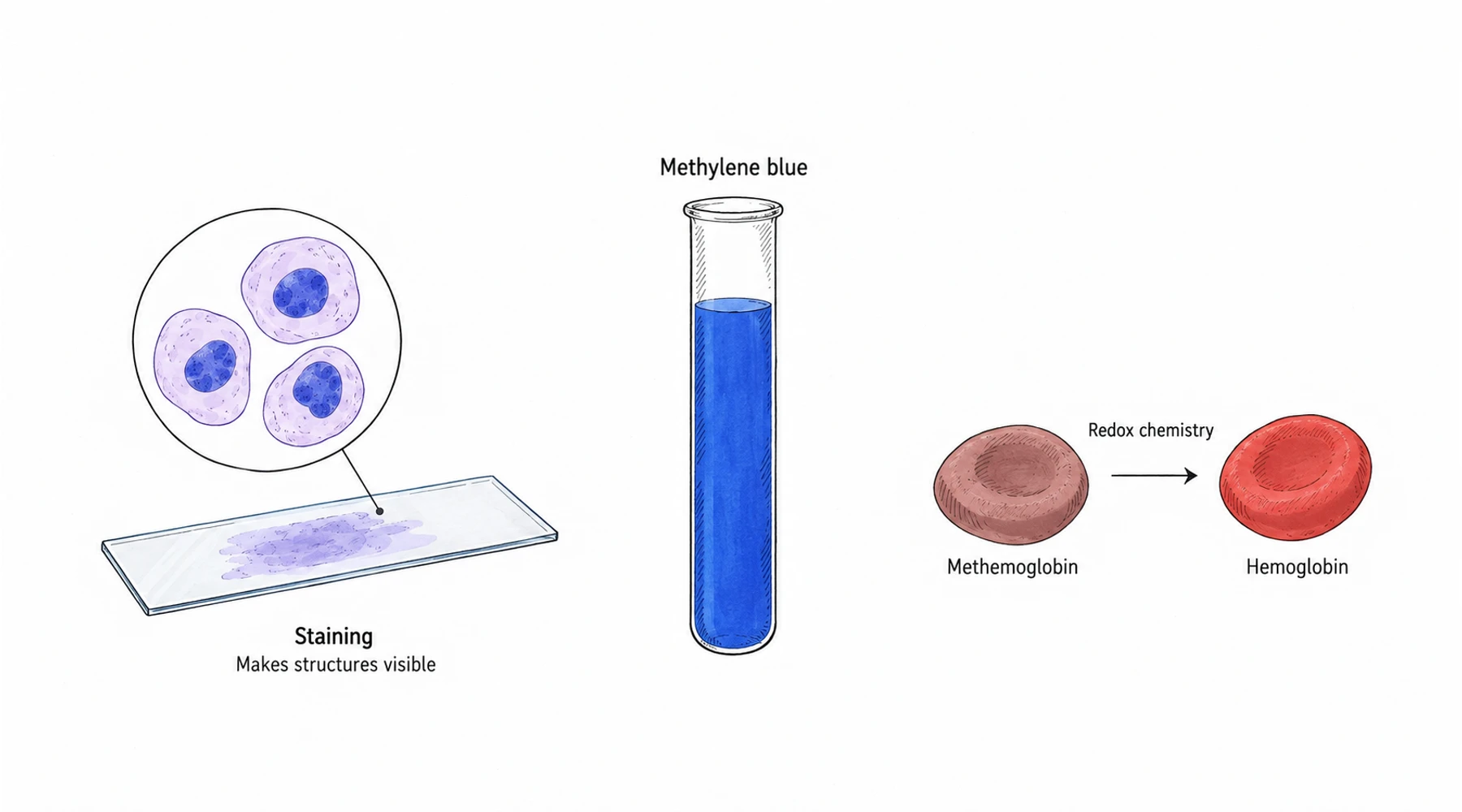
Methylene blue is a synthetic blue dye that also acts as an oxidation-reduction agent. It is used in certain medicines, biological staining, analytical methods, and aquarium products. Researchers also study its effects on the brain and other biological systems. These applications share a chemical name, but they do not share one formulation, purpose, or standard of evidence.
The most useful first question is therefore: methylene blue used for what? A microscope stain helps someone see a specimen. A medicine treats or helps diagnose a defined condition. A research intervention tests a hypothesis. Understanding which setting you are reading about prevents several common mistakes.
What the name identifies
Methylene blue is also called methylthioninium chloride. The IARC chemical identity record places it in the phenothiazinium dye family and lists the anhydrous formula as C₁₆H₁₈ClN₃S. “Anhydrous” means without water incorporated into the solid form. Commercial material can contain water of hydration, so the precise form matters when interpreting a certificate or calculating quantities.
The dry material need not look bright blue: it can appear dark green with a bronze sheen, while its aqueous solution is deep blue. Appearance alone does not establish identity, concentration, or purity. A photograph of a blue bottle cannot answer those questions.
Several labels used online describe different kinds of things:
| Label | Does it describe methylene blue? | What the distinction means |
|---|---|---|
| Dye | Yes | This describes its ability to impart color and its use in staining. It does not rule out pharmacological activity. |
| Drug | In medicinal applications | A particular product has a formulation, route, indication, and regulatory context. The chemical name alone does not establish those details. |
| Vitamin | No | It is not one of the essential vitamins identified by NIH. |
| Peptide | No | It is not a chain of amino acids joined by the bonds that define peptides. |
| Steroid | No | It does not have the characteristic framework described in IUPAC steroid nomenclature. |
Calling it a “methylene blue peptide” or “methylene blue vitamin” does not create a new chemical category. If it is included in a mixture alongside peptides or vitamins, each ingredient retains its own identity. The chemistry of methylene blue explains the structure and terminology in greater detail.
How a dye became a medicine
Methylene blue was synthesized in 1876 for textile dyeing. Scientists including Robert Koch and Paul Ehrlich recognized its value for microscopy. By 1891, Guttmann and Ehrlich had reported its use against malaria, as described in the IARC account of its early applications.
That history links two questions: where does a substance go, and what does it do when it gets there? Selective staining made biological structures easier to distinguish. Investigating biological effects opened a different line of work. Neither a historical treatment report nor long familiarity with a dye establishes that a modern wellness claim is true. The history of methylene blue follows this development in more detail.
An application map for your question
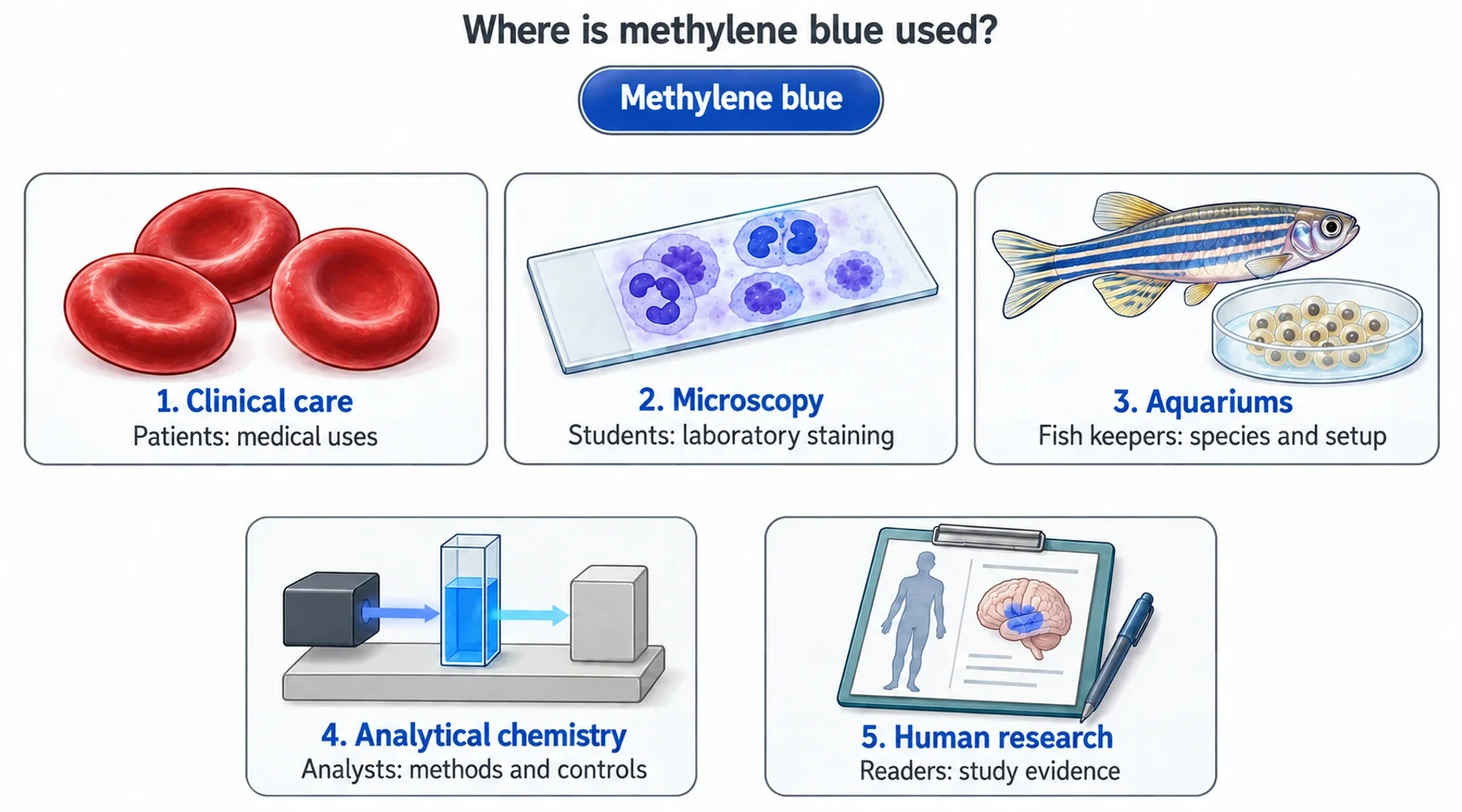
The map groups applications by the question a reader needs answered. Its illustrations represent uses, not experimental observations. Follow the matching route below.
| Map route | Start with this question | Read next |
|---|---|---|
| 1. Patients and caregivers | What condition and medicinal product are involved? | Medical uses of methylene blue |
| 2. Students and laboratory readers | What specimen and staining method are involved? | Methylene blue in laboratory staining |
| 3. Fish keepers | Which species, problem, and treatment setup are involved? | Methylene blue for aquarium fish |
| 4. Analysts | What is being measured, and what controls establish the result? | Analytical testing and environmental research |
| 5. Readers evaluating health claims | What did the human study actually test? | Evidence for proposed methylene blue benefits |
What is methylene blue used for in medicine?
One established use is treating acquired methemoglobinemia. In this condition, some hemoglobin iron is oxidized into a form that cannot bind oxygen normally. Methylene blue participates in a reduction pathway that helps restore functional hemoglobin. This is a specific chemical problem, rather than a general claim about increasing oxygen or energy.
The US prescribing information for ProvayBlue identifies an intravenous medicine for acquired methemoglobinemia in adults and children. It also carries a boxed warning about serious or fatal serotonin syndrome with serotonergic drugs and opioids, and contraindicates use in G6PD deficiency because of hemolytic anemia risk. A person considering human use needs a clinician or pharmacist to assess the actual product, medication list, and relevant conditions. The methylene blue safety overview explains these distinctions.
A different application uses the dye's visibility. The European Medicines Agency describes Lumeblue as a diagnostic medicine that improves visualization of colorectal lesions during colonoscopy. Its tablets are designed to release the dye in the colon. This is neither the intravenous antidote formulation nor evidence that an ordinary oral solution provides the same diagnostic result.
Laboratory and aquarium uses answer different questions
In laboratories, methylene blue can provide contrast in biological specimens and participate in analytical procedures. The IARC application overview includes biological staining, redox indicators, and measurement of anionic surfactants. These are methods with specified preparations and interpretation rules. A blue signal means only what that method has established it means.
For aquariums, Kordon's product labeling describes uses involving fish eggs and superficial fungal infections. It also warns about interference with biological filtration and states that the product is not intended for human consumption. Fish-care instructions cannot be transferred to a person, and a medicinal indication cannot establish that an aquarium treatment is appropriate for every sick fish.
What research does, and does not, establish
A 2016 randomized study by Rodriguez and colleagues enrolled 26 healthy adults and compared oral methylene blue with placebo under double-blind conditions. Participants completed attention and short-term memory tasks during functional MRI before treatment and one hour afterward. The investigators reported changes in task-related brain activity and improved retrieval within the methylene blue group, but the behavioral comparison of changes against placebo was not statistically significant (P = .09).
The study is relevant because it tested people rather than only cells or animals. Its boundaries matter just as much: a small, short-term experiment does not establish persistent cognitive improvement, prevention of dementia, or safety of daily use. Brain imaging activity is also a different endpoint from functioning better at work or remaining independent with age. The guide to methylene blue research explains how to compare these endpoints.
When a claim mentions “methylene blue,” look for the next layer of detail: product, route, population, purpose, and measured result. Those details determine whether two statements concern the same intervention. Without them, an application list can easily make an experimental idea look equivalent to an established medical use.