
Article
Methylene blue and sleep: what the trials recorded, and what nobody measured
A single line in an adverse-event table is the largest piece of sleep evidence that exists for this drug family. In a 52-week randomised trial in behavioural variant frontotemporal dementia, insomnia was reported by 3 of 110 patients taking 8 mg per day and by 7 of 108 taking 200 mg per day. The authors list insomnia among the adverse events that increased with dose, alongside anaemia, diarrhoea, nausea, dysuria, pollakiuria and vomiting.
Twenty-five times the dose produced about two and a half times the insomnia. That is a small signal in a small table, and it runs in the opposite direction to the reason most people search for this topic.
No randomised trial of methylene blue, or of its reduced form hydromethylthionine mesylate, has measured sleep as an outcome. Searches for this article located no study using a sleep questionnaire, actigraphy, or a night in a sleep laboratory. What exists is what a patient happened to report and a clinician happened to code, which is a weaker instrument than it sounds.
What the randomised programmes recorded
Three datasets contain every sleep-related entry located. Two are randomised trials of hydromethylthionine, the reduced form of the same phenothiazine core stabilised as a salt. The third is the US prescribing information for the intravenous product.
| Source | Participants | Arms compared | Insomnia | Somnolence or drowsiness | Sleep measured as an outcome |
|---|---|---|---|---|---|
| Frontotemporal dementia phase 3, 2020 | 220, randomised | 8 mg/day vs 200 mg/day | 2.7% vs 6.5% | Not listed separately | No |
| Alzheimer's phase 3, 2026 | 598 randomised, 332 on active drug | MTC 4 mg twice weekly (control) vs 8 mg/day vs 16 mg/day | 1.6%, 2.5%, 2.4%, 2.4% pooled | 0.4%, 2.5%, 1.2%, 1.5% pooled, 0.9% judged treatment-related | No |
| PROVAYBLUE prescribing information | 31 patients treated for methemoglobinemia | IV 0.78 to 2 mg/kg | Not listed | Not listed | No |
Two details in the second row matter more than the numbers. First, the control arm was methylthioninium chloride, the same compound sold as methylene blue, at 4 mg twice weekly, given as an inactive urinary colourant so that participants could not tell the two arms apart by looking at a toilet bowl. Second, none of the eight insomnia cases in the active arms were judged by the investigator to be related to the drug. Three cases of somnolence out of 332 were.
An adverse event is not a measurement. It is what someone mentioned, recorded in a different vocabulary from the one a reader uses, in a population of people with a neurodegenerative disease, many of them also taking sedatives and antidepressants. Reading “not listed” in the third row as “does not occur” would be a mistake for the opposite reason: 31 patients is a sample small enough to miss almost anything, and the prescribing information states plainly that the exposure-response and exposure-safety relationship for the drug is unknown.
Where the sleep claims come from
Almost every article, video, and product page connecting this compound to sleep eventually points at one result. In 2007, Oxenkrug and colleagues measured monoamine oxidase activity and rat pineal indoles after a single subcutaneous dose.
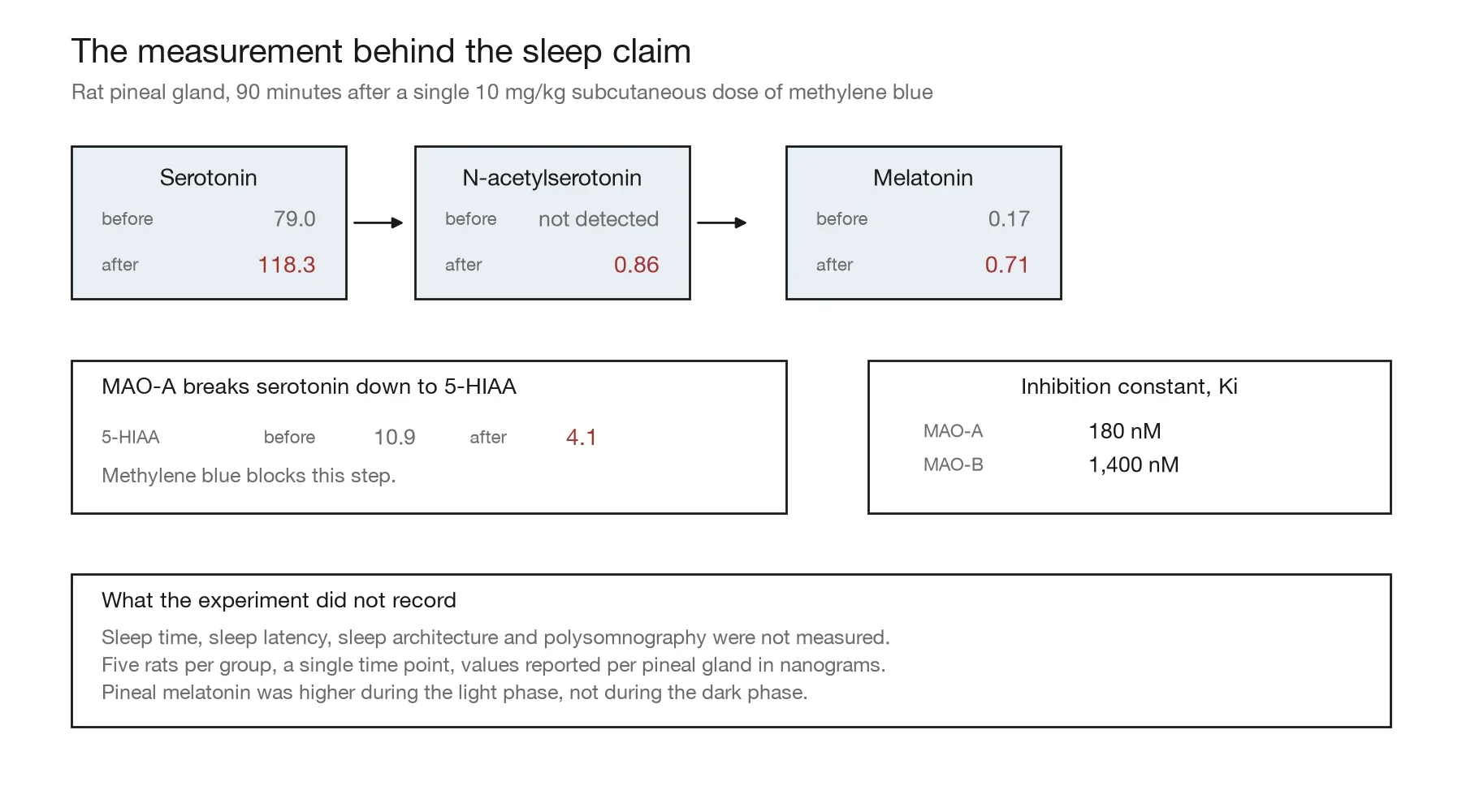
Methylene blue was a reversible competitive inhibitor of monoamine oxidase type A at a Ki of about 180 nanomoles, and of type B at about 1,400 nanomoles, roughly an eightfold preference for the A form. Five rats per group, 10 mg/kg under the skin, pineal glands removed 90 minutes later. Melatonin rose from 0.17 to 0.71 nanograms per gland. N-acetylserotonin, the immediate precursor of melatonin, went from below the detection limit to 0.86. Pineal serotonin rose from 79 to 118, and 5-HIAA, the breakdown product, fell from 10.9 to 4.1.
The reasoning that follows is sound chemistry. Serotonin is the raw material for melatonin, and noradrenaline drives the acetylation step that converts serotonin into N-acetylserotonin. Block the enzyme that destroys both, and the pineal has more raw material during the light phase and more precursor available when the dark phase arrives.
It is also a long way from a person sleeping better. The measurement is the content of a gland in an anaesthetised animal at a single moment, and nothing in that design records how long a rat slept, how quickly it fell asleep, or how it felt the next morning. The paper was written about antidepressant mechanisms, and its discussion proposes that raising daytime melatonin might correct a shifted circadian rhythm in depressed patients. That is a hypothesis in a discussion section, and it is the source of the sleep claim.
The vivid-dream claim has no published source
Searches for this article located no case report, no case series, no trial entry, and no study in which methylene blue was associated with vivid dreams, nightmares, or changed dream recall. The claim exists in discussion threads, not in the literature.
The class evidence points the other way during treatment. When clorgyline and pargyline, selective inhibitors of monoamine oxidase types A and B, were given for four weeks to patients with affective disorders, REM sleep was almost completely suppressed and total sleep time fell. A systematic review of antidepressants and dreaming, covering 21 clinical studies and 25 case reports, found that dream recall frequency falls under phenelzine, the classic monoamine oxidase inhibitor. Nightmares in that literature appear during withdrawal, when REM sleep rebounds, not while the drug is being taken.
So the mechanism usually cited as the reason for vivid dreams predicts less REM sleep and less dream recall in the ordinary case, with an unpleasant rebound when it stops. Whether methylene blue does either in a person has not been tested. Its inhibition is reversible, it is a far weaker inhibitor than phenelzine, and the human studies that would answer the question were never run.
The jet-lag claim does have a real origin
One paper is behind it. Oxenkrug and Requintina built a rat model of jet lag by shifting the light cycle, then measured pineal serotonin, N-acetylserotonin and melatonin by high-performance liquid chromatography with fluorescence detection.
Two findings were reported. Melatonin injections at the start of a new dark period accelerated recovery of the N-acetylserotonin and melatonin rhythms. And N-acetylserotonin and methylene blue, described in the paper as an inhibitor of monoamine oxidase A, attenuated the light-induced disruption of N-acetylserotonin, but not of melatonin.
Read that carefully. In the animal model of the exact situation the claim is about, methylene blue moved one precursor marker and did not move the melatonin rhythm. The paper's own conclusions are about what arrival time is preferable on an eastward flight and about how melatonin should be timed. It does not propose methylene blue as a jet lag treatment, and no human study has tested it as one.
Sleep deprivation in mice is not a sleep measurement
The experiment most often cited as evidence that methylene blue helps with sleep deprivation did not measure sleep. Marzabadi and colleagues put 60 male BALB/c mice into a modified multiple platform setup, in which an animal placed on a narrow platform is forced to stay awake, and compared a wide-platform control group against sleep-deprived animals, methylene blue alone, an 810-nanometre pulsed laser alone, and the two combined.
Methylene blue was injected at 0.5 mg/kg on ten consecutive days before the deprivation began, with the laser applied every other day. Learning and memory were scored with a T-maze, a social interaction test and a shuttle box, and hippocampal levels of PSD-95, GAP-43 and synaptophysin were measured afterwards.
Sleep deprivation reduced alternation rates, sociability, social novelty and the memory index. Neither single treatment reversed most of those measures. The combination did, and it raised all three synaptic markers. The finding is that a pretreatment combination protected memory in animals whose sleep had been disrupted. The deprivation is the injury in the design, not the outcome. No sleep latency, sleep duration or sleep architecture was recorded, and reading the paper as evidence about how well anyone sleeps inverts what it measured.
Morning or night: the numbers do not settle it
Timing advice is repeated with confidence and has never been tested. No trial has compared morning with evening dosing, in any population, for any sleep outcome.
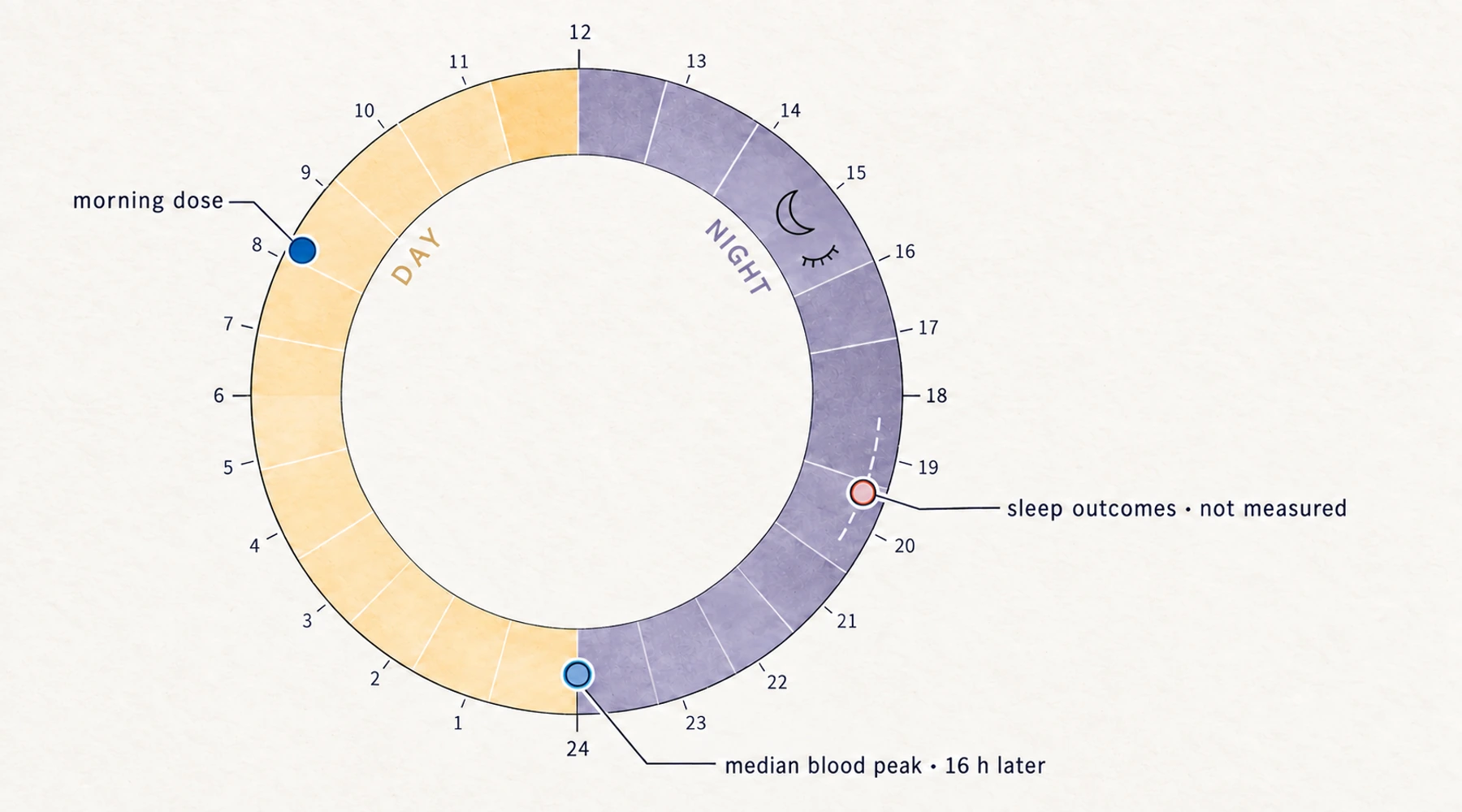
What has been measured is how slowly the compound moves. In a single-dose study in healthy volunteers, 200 mg taken orally after bowel preparation produced blood concentrations that rose for twelve hours and peaked at a median of 16 hours. The half-life ranged from 14 to 27 hours at that dose and from 6 to 26 hours at 400 mg. The intravenous product in the prescribing information has a half-life of about 24 hours, and about 40% is excreted unchanged in the urine, with exposure increasing substantially in impaired kidney function.
An oral dose taken at breakfast therefore reaches its measured peak around midnight. That is worth sitting with, because two pieces of advice in common circulation depend on it not being true. “Take it in the morning so it does not disturb sleep” assumes an effect that has passed by bedtime. “Take it at night because it wears off quickly” assumes the opposite. The one human pharmacokinetic study available does not support a short evening effect, and the rat experiment behind the melatonin story argues for dosing at the beginning of the light period for an entirely different reason, to raise daytime melatonin precursor. There is a separate guide to how long the compound stays in the body if the clearance numbers are what you came for.
The honest answer to the timing question is that nobody knows, and the measured concentrations argue against pretending otherwise.
The one human report of a sleep disorder changing
There is exactly one human publication located in which methylene blue was given to someone with a sleep disorder, and it is a single case.
A 2021 case report in Cureus describes a 15-year-old male with Kleine-Levin syndrome, a rare condition of recurrent episodes of hypersomnia lasting days to weeks, accompanied by confusion, derealisation and changed behaviour. He had been treated for three years with lithium, and modafinil, methylprednisolone, atypical antipsychotics and amantadine had produced no improvement. At 18 he entered an episode lasting almost six months. With parental consent, he was given 10 mg of methylene blue orally one hour before 25 minutes of nightly intranasal red light at 633 nanometres, 11.4 joules per square centimetre. Within a week, hypersomnia and the behavioural symptoms resolved. Two years later he had not relapsed and was taking no other medication.
The authors state the limitation themselves: one subject, not longitudinal, and Kleine-Levin episodes are known to become less frequent over years, which makes it impossible to attribute the remission to the treatment. There is a second limitation they do not stress. The exposure was two interventions at once, and one of them was red light delivered into the nasal cavity alongside a compound whose entire photodynamic use depends on light activating it. A reader cannot separate the dye from the light from the passage of time, and the report is not a reason to try methylene blue for a sleep problem.
The direction that does have human data is sedation
Where human measurements of the central nervous system exist, they mostly point at sedation rather than alertness.
A 2008 study in Anaesthesia compared 11 patients pretreated with methylene blue against 11 matched controls during induction and surgery, using the Bispectral index and a target-controlled propofol infusion. At a predicted effect-site propofol concentration of 2 micrograms per millilitre, sedation scores and index values were significantly lower in the treated group. Across the operation, the pretreated patients needed a mean of 50% less propofol to reach the same depth of anaesthesia. The paper opens by noting that delayed emergence from anaesthesia and neurological disturbances had already been reported in patients having parathyroid surgery who received methylene blue beforehand, and it closes by advising careful titration whenever the drug is infused perioperatively.
The prescribing information says the same thing in different words. Treatment may cause confusion, dizziness and disturbances in vision, and patients are advised to avoid driving or hazardous machinery until those have resolved, an instruction with no obvious relationship to a compound sold as a sleep aid.
Then there is the use that does treat a sleep-like state. Ifosfamide, a chemotherapy drug, can cause an encephalopathy whose defining features are severe somnolence, agitation and confusion, progressing to coma. Methylene blue is one of the treatments given for it. In a review of 24 cases at the MD Anderson Cancer Center, 20 patients received methylene blue and symptoms resolved in 19, with recurrence in three of five who were later re-challenged while receiving it preventively.
A drug that deepens anaesthesia, that causes dizziness and confusion, and that is used to reverse a chemotherapy-induced state of excessive sleepiness is not obviously a sleep aid. It is a drug with real central nervous system effects whose direction depends on what else is on board.
Night-time medicines, and breathing at night
Two entries in the prescribing information deserve attention from anyone who takes methylene blue in the evening alongside something else.
The first is the interaction list. The label names SSRIs, SNRIs, MAOIs, bupropion, buspirone, clomipramine, mirtazapine, linezolid, opioids and dextromethorphan, and advises against taking any serotonergic drug within 72 hours after the last dose. Two of those sit on bedroom tables. Mirtazapine is a sedating antidepressant commonly taken at night. Dextromethorphan is the cough suppressant in night-time cold preparations, and it is sold over the counter. Neither combination is theoretical: the label records serotonin syndrome cases from methylene blue class products, and some of them were fatal. A published perioperative case describes a 67-year-old man whose agitation, clonus and hyperthermia became apparent only as he emerged from general anaesthesia, after methylene blue was given during the operation.
Melatonin, benzodiazepines, z-drugs such as zopiclone, and diphenhydramine are not serotonergic, so the concern there is not serotonin syndrome. It is the one the anaesthesia study measured, which is additive sedation at a dose nobody has characterised.
The second entry is respiratory. Among adverse reactions reported for methylene blue class products, the prescribing information lists nasal congestion, oropharyngeal pain, rhinorrhoea and sneezing. Those are spontaneous reports without incidences and without a stated route, and they are the kind of change that could show up as waking with a dry mouth and a sense of having breathed through the nose differently overnight. One reader account of a sudden change to mouth breathing during sleep exists in a forum thread without an examination, a medication history or any measurement, which establishes that a report was made and nothing more.
Anyone whose sleep problem is snoring, witnessed pauses in breathing, or daytime sleepiness severe enough to fall asleep while driving should be looking at the sleep apnoea question rather than at a supplement. Apnoea is diagnosable, it is treatable, and none of the evidence above touches it.
The material is a variable here too
The doses in every study above were measured quantities of a specified compound from a pharmaceutical manufacturer, with a certificate of analysis behind them. A bottle from an unverified seller is not that, and the difference is not cosmetic. The USP designation is the standard a buyer can check, and material that does not conform is likely textile grade, which may carry organic impurities such as Azure B, residual solvents and heavy metals at levels a pharmaceutical specification limits.
Most sellers who describe a product as third-party tested screen for heavy metals only and present that single panel as full compliance. Blupreme tests the complete USP specification: identity, purity, organic impurities, residual solvents, elemental impurities, residue on ignition, microbial limits and bacterial endotoxins. Every lot ships with a certificate of analysis, and reading one correctly means matching the lot number and the laboratory to the bottle in your hand.
None of that creates a sleep benefit, and it is not the reason to take this compound. If you take it anyway, knowing what is in the capsule is the minimum, and the safety reference and the interaction guide cover the questions that come before any discussion of timing.
Bottom line
No randomised trial has measured sleep during methylene blue treatment. The only sleep entries in the randomised record are adverse-event lines, and in the largest dose comparison available the rate of insomnia was 2.7% at 8 mg per day against 6.5% at 200 mg per day.
The vivid-dream claim has no published source, and the monoamine oxidase literature predicts the opposite during treatment. The morning-versus-night question has never been tested, and an oral dose peaks in the blood at a median of 16 hours, which is closer to midnight than to lunchtime for anyone who doses at breakfast. The sleep-deprivation experiment that circulates as evidence is a memory study in which no sleep was recorded, and the single human report of a sleep disorder improving is one unblinded patient receiving two treatments at once.
The human evidence overview collects what these trials do establish, the memory and focus review works through the cognitive endpoints that sit closest to sleep in the same studies, and the research library indexes the papers behind every claim on this page.