
Article
Methylene blue for sleep apnea and snoring: what a claim would have to show
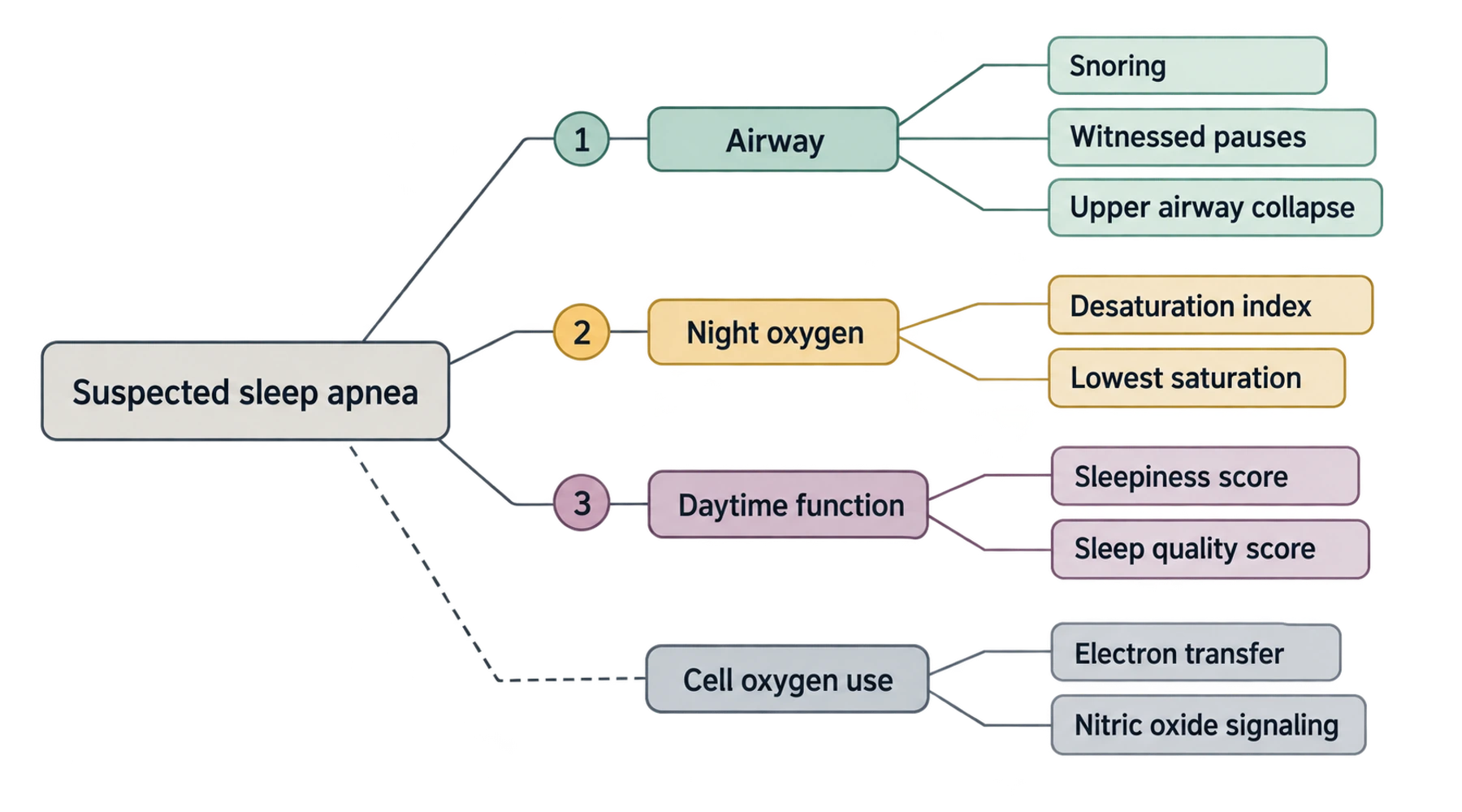
A claim travels around sleep forums in roughly this form. Methylene blue improves oxygen use in the cells, people say, and after a few days of taking it they stopped snoring, stopped waking up gasping, and started breathing through the night without a mask. The pharmacology attached to the claim is not invented. Methylene blue really does interact with mitochondrial electron transfer. What the argument does is skip a step: sleep apnea is a mechanical failure of the upper airway, and nothing about changing how a cell handles oxygen changes whether the throat stays open.
The gap separates three things that get spoken about as if they were one: the condition, the measurements that define it, and the reported experience of a better night.
The condition is a plumbing problem
During sleep, the muscles that hold the throat open relax. In some people the airway narrows enough that air moving through it makes soft tissue vibrate, and that vibration is snoring. In others the airway closes completely for ten seconds or longer, which is an apnea, or narrows enough that airflow falls and oxygen drops, which is a hypopnea. The event ends when the falling oxygen and rising carbon dioxide drive a brief arousal, muscle tone returns, the airway opens, and the person settles back to sleep.
The relevant variables are anatomical and behavioral. Jaw shape, tongue base, neck circumference, nasal patency, body position, alcohol, sedatives and the depth of sleep all shift how often the airway closes. A drug that makes a cell handle oxygen differently sits nowhere in that list. This is why the mechanistic story, however accurate its parts, does not transfer. It is a description of a different system.
What a sleep study counts, and what it does not
A polysomnogram records airflow at the nose and mouth, breathing effort from belts around the chest and abdomen, oxygen saturation from a finger probe, snoring sound, body position, and the brain's electrical activity with eye and chin muscle channels so sleep stages and arousals can be scored. A home sleep apnea test strips this down, typically to airflow, effort, oximetry and position.
From those channels come numbers. The apnea-hypopnea index is the count of apneas and hypopneas per hour of sleep. The oxygen desaturation index counts drops in saturation per hour. The arousal index counts sleep interruptions per hour. Alongside them the study reports total sleep time, sleep efficiency, time spent awake after falling asleep, and time in each sleep stage.
Here is the part that matters for evaluating any treatment claim. Every one of those numbers measures something that happened during a particular night. None of them measures the airway's tendency to collapse. That tendency is inferred from the night, and the inference is only as good as the night is representative.
Event counts are also not stable. A person who spends more of the night on their side will score fewer events. Body position, sleep stage, nasal congestion, recent alcohol, weight change, the type of airflow sensor and the scoring rules all move the result, and the first night in a laboratory is often worse than the second. Whatever else a treatment claim needs, it needs a design that survives the fact that two consecutive nights in the same untreated person can disagree.
A better night is not a measured change
The symptoms people act on are impressions: snoring fell, gasping stopped, I slept better, I have more energy. These are real experiences and they are also poor measurements of airway obstruction.
The Epworth Sleepiness Scale asks a person to rate how likely they are to doze in eight everyday situations. The Pittsburgh Sleep Quality Index asks about the previous month. Both are a person's account of themselves, which is what makes them easy to fill in and easy to shift without the underlying problem changing. People seek treatment when they feel worst, so the first measurement is already biased toward the bad end, and the next one tends to look better for that reason alone. Anyone who knows they have taken a treatment expects improvement.
There are concrete routes by which a night improves with no change in the airway. An arousal that fragments sleep can occur without much desaturation, and a deep-sleep night has fewer of them. A person who happens to spend the night on their side scores fewer events. None of this is deception; it is the ordinary reason that subjective reports and scored studies disagree.
Where methylene blue actually works
Methylene blue is a redox dye. It accepts and donates electrons, and it can carry them from parts of the electron transport chain to cytochrome c. In isolated brain mitochondria it increased ATP production and restored membrane potential when complex I or complex III was inhibited. In mouse hepatocytes it protected cells whose electron transport had been blocked by two drugs, and in astrocytes deprived of both glucose and oxygen it improved cellular respiration.
Read the details and the picture changes shape. In the same brain mitochondria, methylene blue raised hydrogen peroxide generation and increased resting oxygen consumption while leaving ADP-stimulated respiration unchanged. More oxygen consumed while a mitochondrion is idle is not more energy produced. In isolated rat liver mitochondria, increasing concentrations lowered respiratory control ratios and provoked swelling, which the authors described as uncoupling of oxidative phosphorylation. Methylene blue does not simply make respiration more efficient; it changes the coupling between oxygen consumption and ATP output, in a direction that depends on concentration.
The classic version of the story, that methylene blue inhibits nitric oxide signaling, is also less tidy than it is usually told. In cultured pulmonary arterial smooth muscle cells, the inhibition of cyclic GMP accumulation by nitrovasodilators and by endothelium-derived relaxing factor was reproduced by generating superoxide, and methylene blue generated superoxide itself. In cultured endothelial cells with no glucose available, concentrations above about 5 micromolar raised intracellular oxidant stress. A review of the dose-response literature describes the pattern as hormetic: intermediate doses increase cytochrome oxidase activity, and higher doses decrease it. The direction of the effect reverses as the dose rises.
Two more measurements make the same point. In dogs, methylene blue shifted the arterial lactate-to-pyruvate ratio, a marker of tissue redox state, and left cardiac output, heart rate and arterial pressure essentially alone. In human volunteers given methylene blue intravenously, global cerebral blood flow fell rather than rose, which is difficult to reconcile with the idea that the drug delivers more oxygen to the brain.
A measurable biochemical change with no matching functional change is the pattern a claim has to overcome, not evidence that it has already been established.
Three arguments that do not close the gap
The first is nasal. A blocked nose pushes people toward mouth breathing, and mouth breathing makes snoring worse, so it is tempting to treat nasal symptoms and expect the whole problem to improve. Nasal patency is one contributor to sleep-disordered breathing. It is not the collapse. Obstruction in sleep apnea happens behind the soft palate and at the base of the tongue, downstream of the nose, and nothing in the published work on methylene blue shows it opening those structures.
The second is the mitochondrial argument, the one most often made. Cells using oxygen more effectively is a statement about tissue metabolism. An apnea is a statement about flow. During an obstructive event arterial oxygen falls because air has stopped moving, not because cells have declined to use it. Shuttling electrons better inside a mitochondrion does not reopen a closed pharynx, and if methylene blue raises resting oxygen consumption while leaving coupled respiration unchanged, the question it raises in a low-oxygen night is about demand, not supply.
The third is the anecdote. A person who tries methylene blue cannot run a blinded trial on themselves, and for this drug the problem is unusually severe: it is a vivid dye. Urine turns blue, and so can sweat and tears. Methylene blue is also a potent reversible inhibitor of monoamine oxidase A, which changes how the gut handles dietary amines when it is taken by mouth and carries documented interaction risks with serotonergic medication. A stimulant effect of that kind can easily read as sleeping better without being a change in the airway.
None of this argues that a person is mistaken about their own nights. It argues that a report of a better night needs a measurement beside it before it becomes a claim about apnea.
What the claim would have to show
Set out plainly, a credible claim looks like this.
- A diagnosis confirmed by a scored sleep study before treatment began, with the severity stated, so that there is something to compare against.
- A concurrent control group, randomized. Because event counts drift on their own, an uncontrolled before-and-after series cannot separate a treatment effect from that drift. A crossover design is attractive and brings its own problems: urine color is a strong clue about which period the participant is in.
- A candid account of blinding. A trial of a visibly colored compound has to say how it handled the fact that participants can see which arm they are in, and a dye-matched placebo is one way to do it.
- An objective primary endpoint: change in events per hour, or in the desaturation index, from baseline. Questionnaire scores belong in the secondary list, where they can be reported honestly without carrying the claim.
- Enough recorded nights to absorb night-to-night variation, which usually means more than one night in each condition.
- Adherence measured rather than assumed.
- Safety reporting that fits the population, which includes people taking serotonergic medication.
- An outcome and analysis plan fixed before the data were collected.
A worksheet you can fill in against any specific claim is included with this article: outcome comparison worksheet. The self-contained HTML file also works offline when saved and opened in a browser.
If a trial reported a meaningful fall in events per hour in people with confirmed disease, that would be a striking result, and it would demand an explanation of how a compound acting on electron transfer reached the pharynx.
Related reading in this series: the evidence on methylene blue and sleep, which covers insomnia and dosing timing, and the parallel case for methylene blue in COPD and low oxygen. Two pages matter if you are using this in practice: what methylene blue does to pulse oximetry and laboratory tests, because a dye in the blood changes what some instruments report, and the list of questions to ask a clinician about methylene blue.
What to do instead, and one thing that is worth checking
Nothing above is a reason to stop positive airway pressure therapy or to skip a diagnostic sleep study. Those remain the reference standard, and a night on a machine produces measurements that a supplement cannot.
If you are taking methylene blue for another reason and sleeping badly, get the sleep measured rather than inferred. Ask for the numbers: how many events per hour, the desaturation index, how much time was spent below ninety percent saturation, and the arousal index. Those values are what a treatment has to move.
The one variable a buyer can actually verify is the content of the product. Purity is the difference between a material that conforms to a pharmacopeial specification and one that does not, and the practical route to the highest purity available is conformance to the United States Pharmacopeia monograph for methylene blue. Many sellers claiming that conformance test only for heavy metals and stop there. Blupreme works with a pharmaceutical manufacturer, tests the full specification, including identity, purity, organic impurities, residual solvents, elemental impurities, residue on ignition, microbial limits and bacterial endotoxins, and publishes the complete certificate of analysis for the batch. That documentation tells you what is in the material. It does not tell you that the material treats sleep apnea.