
Article
Methylene blue for exercise and recovery: what has actually been measured
In March 2022 an elite marathon runner posted a sponsored endorsement of a methylene blue lozenge, saying it "can help to improve focus, endurance and sleep" and that she used it before hard workouts. That same week, doctors quoted in the national press described the wider trend as influencers ingesting fish tank cleaner. Neither position answers the question a runner actually has.
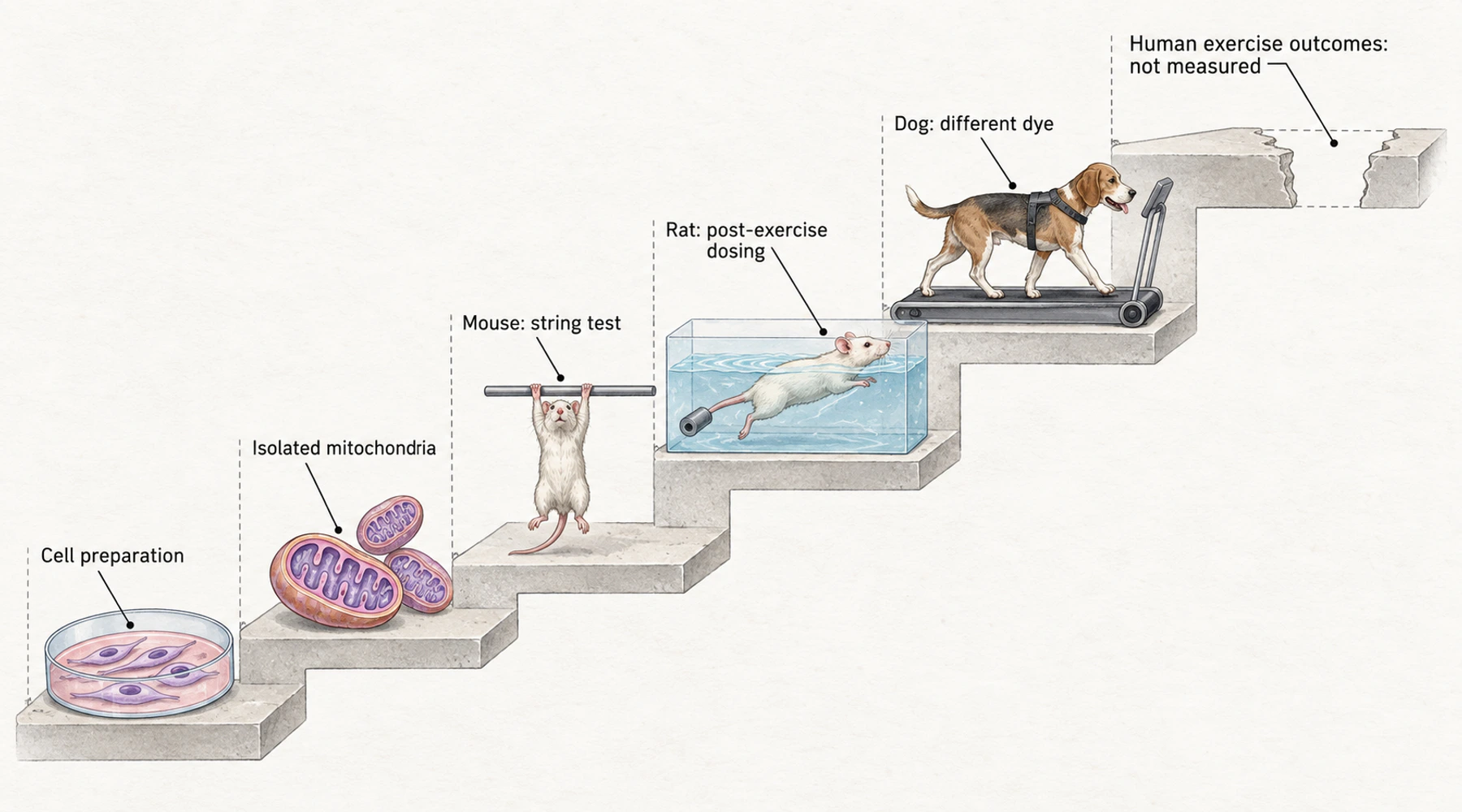
Has anyone given methylene blue to people and measured how far, how fast, or how well they recovered? Searches for this article did not locate a single controlled human study with an exercise performance or recovery outcome. The citation trail contains three species of animal, several laboratory preparations, and one compound that is not methylene blue at all.
Endurance, recovery, and mechanism are different claims
| What is measured | Examples | What a change means |
|---|---|---|
| Performance | Time to exhaustion, time trial or race time, distance covered, work performed, peak power | More mechanical work, or the same work faster |
| Recovery | Soreness at 24, 48, and 72 hours, strength lost after a hard session, creatine kinase, return to training, performance in a second bout | Return to baseline sooner |
| Physiological markers | Whole-body oxygen consumption, blood lactate, lactate-to-pyruvate ratio, muscle oxygenation, mitochondrial respiration in a biopsy | A process changed. That is not itself a result |
| Perception | Rating of perceived exertion, "felt easier", mood, sleep quality | An experience was reported, subject to expectation |
A marker can move in the opposite direction from performance, or move without performance changing at all. That is not a technicality: it is the exact pattern in the most-quoted exercise study of methylene blue.
The dog study used a different dye
The paper most often cited for methylene blue and exercise is Imai and colleagues' 1986 treadmill study in conscious dogs. It tested whether the rise in cardiac output during exercise depends on tissue redox state, using what the methods describe as "4 mg/kg of new methylene blue 3,7-bis(ethylamino)-2,8-dimethylphenazothonium chloride, Eastman Kodak Company". New methylene blue is a separate thiazine dye, with two ethylamino groups where methylene blue has two dimethylamino groups, best known as a reticulocyte stain. A result obtained with it is not a result obtained with methylene blue.
The study still matters, because it is the cleanest demonstration that a marker and the physiology can move separately. Dogs ran two 20-minute stages at 2.5 and then 5.0 mph on a 6 percent incline. Exercise doubled cardiac output and raised total-body oxygen consumption three- to fourfold in both groups. In the saline group the arterial lactate-to-pyruvate ratio rose from 6.0 to 9.97. In the treated group it did not rise.
Every functional measure was unchanged. Heart rate, arterial pressure, left ventricular contractility, and plasma catecholamines rose identically in both groups, and the relationship between cardiac output and whole-body oxygen consumption was statistically indistinguishable. The authors conclude the ratio changes "are not causally related to the circulatory stimulation occurring during mild to moderate exercise."
The ratio is weaker than it looks. It fell because pyruvate rose, from 0.14 to 0.38 mmol per litre, while lactate also rose, from 1.05 to 2.85 mmol per litre. In dogs given the dye at rest, oxygen consumption rose slightly, arterial pH rose, and carbon dioxide fell, changes the authors call "similar" to those of 2,4-dinitrophenol, a mitochondrial uncoupler. Speed was fixed by the protocol, so no dog was ever run to exhaustion.
The rat swimming study, and its dose
The strongest animal performance result is Peng and colleagues' 2025 experiment in Frontiers in Behavioral Neuroscience. Rats swam for ten consecutive nights with weights equal to 3 percent of body weight tied to their tails, at least two hours per night, until a scored exhaustion endpoint. After each session, one group received methylene blue intranasally and another received saline the same way. Treated rats swam longer before meeting the exhaustion criteria, moved more in the open field the next day, showed less anxiety-like behaviour, and had less neuron loss, myelin disruption, and mitochondrial fragmentation in the hippocampus and striatum.
The dose is routinely left out of retellings. A 1 percent solution is 10 mg/mL; ten microlitres went into each nostril, so the total was about 20 microlitres, or 0.2 mg per rat per session. Intranasal delivery is chosen to reach the brain through the olfactory and trigeminal pathways, and the authors state that their study "did not measure oxidative reactions, inflammation, or hormone levels in the brain and plasma." Their recommended next step is to study "the comprehensive effects of MB supplementation prior to exercise."
That is what a runner would want tested. This protocol gave the compound after the work, to limit injury. Longer swimming the next day in an exhausted-rat model is a recovery finding, not a finding about a trained human taking a dose before a session.
Where the word "endurance" came from
The mouse study usually described as showing improved endurance is Gureev and colleagues' 2016 work in Neuroscience Research. Mice drank water containing methylene blue at 15 mg/kg per day for 60 days. The "physical endurance" is the string test, or horizontal bars, which scores grip strength, motor coordination, and balance together. Mid-aged untreated mice scored 1.17; treated mice scored 2.23, close to the adult level. Adult mice improved on nothing.
Resting oxygen consumption rose about 15 percent. Hydrogen peroxide production in brain mitochondria rose from 94.9 to 176.7 pmol per minute per milligram of protein. Mitochondrial DNA increased 2.3-fold. That is increased mitochondrial turnover in ageing animals, with the oxidative signalling that drives it. It is not a demonstration that a healthy athlete would go faster.
Cell experiments, and where they stop
Louters and colleagues reported in 2005 that methylene blue activates glucose transport through GLUT1 in L929 fibroblast cells, by up to 800 percent at 50 micromolar. A 2008 follow-up showed that methyl-beta-cyclodextrin binds methylene blue directly and blocks the effect. That is a finding about a cell line, never shown in skeletal muscle.
The mechanism itself is contested
In Tretter and colleagues' 2014 study of isolated guinea pig brain mitochondria, methylene blue at 100 nanomolar to 1 micromolar increased resting oxygen consumption, restored membrane potential and ATP production when Complex I or Complex III was inhibited, and increased hydrogen peroxide production. Critically, "the ADP-stimulated respiration was unaffected by MB with any of the substrates" tested. Maximal coupled respiration, which is what an exercise claim rests on, did not increase.
In Gureev and colleagues' 2019 follow-up, the same laboratory that produced the mouse result found that methylene blue "fails to restore the membrane potential and respiration inhibited by antimycin" in mouse brain mitochondria, and concluded that the electron acceptor is the Qo site of Complex III rather than anything further downstream. The simple picture of the dye shuttling electrons past a blocked respiratory chain does not hold in every preparation.
None of this rules out a human effect. It does mean the mechanism-only argument, in which plausible mitochondrial chemistry is treated as a result, has problems inside the mechanism itself.
Two design problems a human trial would have to solve
Methylene blue is difficult to blind. It turns urine blue-green and people notice. The 2017 crossover trial in bipolar disorder said so directly: "We chose this design because methylene blue discolours urine, and thus we could not use a traditional placebo." That trial compared a low dose against a high dose rather than against an inert pill.
The problem is worse in exercise research than almost anywhere else, because perceived exertion and time-trial performance respond strongly to expectation. A trial that cannot blind its participants has measured a belief as much as a drug.
A documented solution exists. The 2016 randomised imaging trial in 26 healthy adults gave 280 mg of USP-grade methylene blue, about 4 mg/kg, or a placebo of FD&C blue no. 2 food colouring in identical opaque capsules, and asked participants to urinate before dosing but not again, "to avoid compromising the blinding as a result of any urine coloration."
The second problem is dose and route. Oral methylene blue is partly excreted in urine, and brain exposure after oral dosing is roughly half that after intravenous dosing, as the Gureev group notes when citing the pharmacokinetic work of Peter and colleagues. Intranasal delivery in a rat does not translate to a capsule, and the human dose range in the published work is 0.5 to 4 mg/kg, with the 2016 imaging trial noting the opposite effect above 10 mg/kg.
The human studies measure something else
Two controlled human experiments appear in retellings of this topic, and neither measured exercise. In the 2016 imaging trial, vigilance reaction time showed no significant drug-by-time interaction, with placebo at 230 then 220 milliseconds and methylene blue at 230 then 230 milliseconds, P = .43. In a 2023 intravenous study in eight healthy women, cerebral blood flow and the cerebral metabolic rate of oxygen both fell rather than rose. The energy and fatigue evidence guide covers both.
If you decide to try it anyway
A self-experiment will not establish efficacy, but it can be recorded well enough to avoid fooling yourself. Note the product and lot, the route, the timing before training, the exact session with distance or load, perceived exertion on a numbered scale, sleep, caffeine and any medication, and next-day soreness and 48-hour performance in the same session type. Then repeat the same sessions without it.
One person tracking one variable cannot separate a drug effect from fitness, motivation, weather, and the ordinary noise of training. The subjective part is the part most likely to mislead.
Methylene blue also carries risks that have nothing to do with performance. It inhibits monoamine oxidase A, which places it next to prescribed antidepressants and other serotonergic medicines, and it is contraindicated in G6PD deficiency because of haemolytic anaemia risk. The safety guide covers both, and the drug interaction guide organises the medication questions by class. If you compete under anti-doping rules, check the rules rather than a retailer's claim.
The material is a variable in every study above
Every dose described here was a measured quantity of a specified compound. A bottle from an unverified seller is not that. Conformance to the USP monograph is the standard a buyer can check, and material that does not conform is likely textile-grade, which may carry organic impurities such as Azure B, residual solvents, and heavy metals at levels a pharmaceutical specification limits. What the USP designation does and does not establish covers the grade, and the impurity test methods cover what a laboratory looks for.
Most sellers who describe a product as third-party tested screen for heavy metals only, then present that single panel as though it satisfied the full specification. Blupreme tests the complete USP specification: identity, purity, organic impurities, residual solvents, elemental impurities, residue on ignition, microbial limits, and bacterial endotoxins. Every lot ships with a certificate of analysis, and reading it correctly means matching the lot number and the laboratory to the bottle you hold.
Bottom line
No controlled human study has measured methylene blue against endurance, speed, strength, or recovery. The dog study cited for a lactate effect used a different dye and found no performance difference. The rat swimming study dosed 0.2 mg intranasally after the work. The mouse study behind the word "endurance" used a grip-and-coordination test in ageing animals, and the mechanism is contested in the mitochondrial literature.
That leaves a plausible mechanism, a set of small animal results, one study-design problem with a documented solution, and no human performance data. The review of human benefit evidence places exercise claims next to the rest of the human literature, and the research library indexes the studies behind each claim.
If you are training for something, the variable with the strongest evidence behind it is the training itself.