
Article
Does methylene blue improve energy or fatigue?
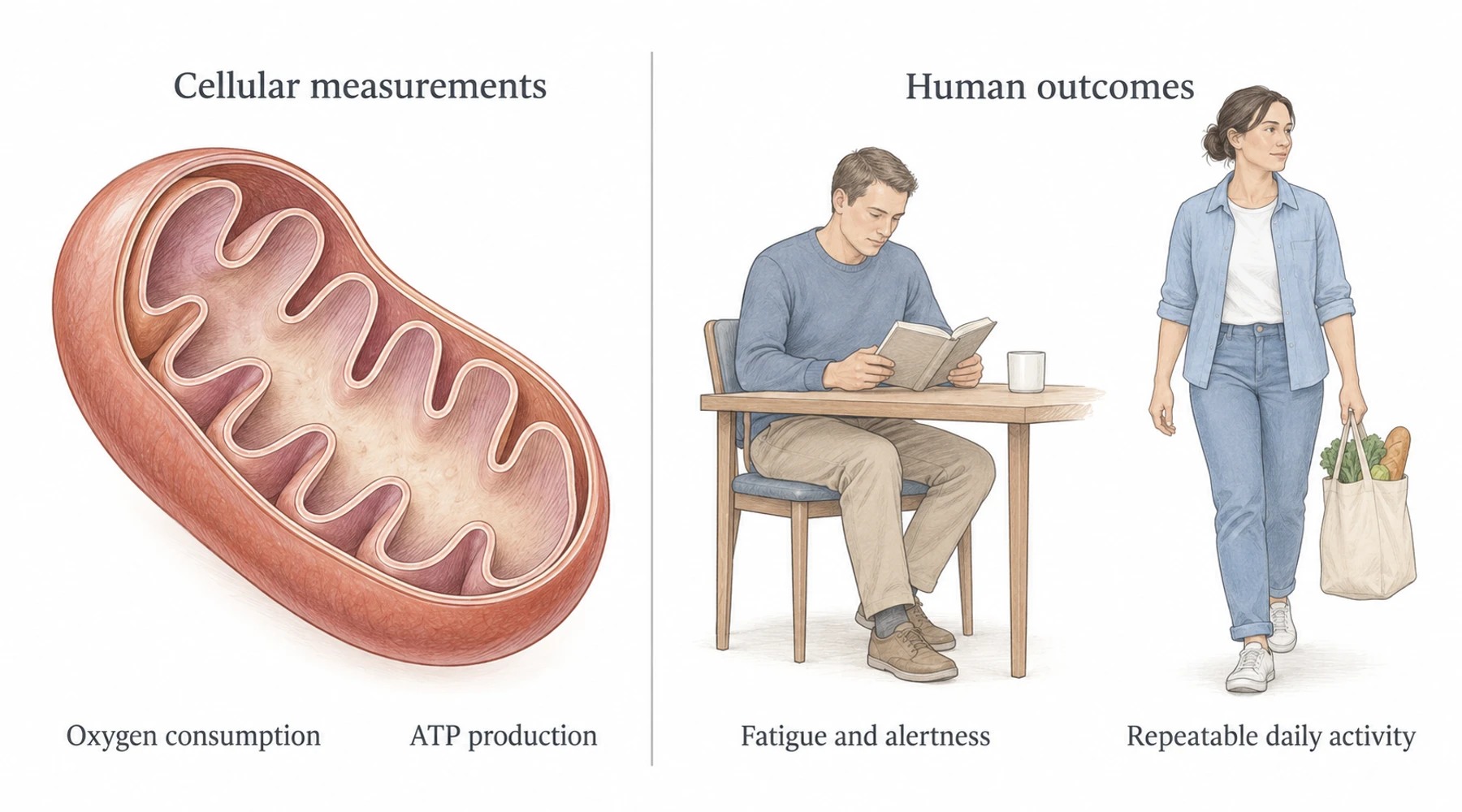
Methylene blue has not been established as a reliable treatment for everyday fatigue or as an energy enhancer in healthy people. Searches for this article did not locate convincing controlled human evidence of sustained improvement in fatigue, ordinary daily activity, or exercise recovery. Some experiments show biological effects. That is a narrower finding than showing that people feel and function better.
The confusion begins with the word energy. In a laboratory, it can refer to oxygen consumption or production of ATP, a molecule that powers cellular processes. In ordinary life, it can mean staying awake, concentrating, finding motivation, walking farther, or recovering after effort. A result in one category does not automatically answer the others.
What the mitochondrial studies actually measured
Methylene blue can accept and donate electrons. That chemistry gives researchers a reason to investigate its effects on mitochondrial respiration. It does not make every increase in respiration beneficial.
In Visarius and colleagues' 1997 rat-liver experiment, investigators studied isolated mitochondria, including preparations exposed to chloroacetaldehyde. Methylene blue stimulated respiration but also reduced respiratory control ratios as concentrations increased and caused mitochondrial swelling. The authors described uncoupling of oxidative phosphorylation. Uncoupling means oxygen consumption and ATP production become less tightly linked. Measuring more of the former therefore does not establish more usable energy for a person.
A 2017 study of mitochondria isolated from diabetic and healthy rat hearts found increased oxygen consumption after methylene blue was added directly to the preparation. Its effect on hydrogen peroxide depended on the supplied fuel: release increased with glutamate and malate but decreased with succinate. The study title's reference to decreased oxidative stress needs that qualification.
Neither experiment treated tired volunteers, measured a patient's fatigue score, or tested whether someone could get through a working day more comfortably. They demonstrate why the experimental preparation, concentration, and measured endpoint matter.
An outcome-focused evidence table
Use this table to check what a claim actually rests on. “Controlled” describes the comparison, while the population and outcome determine which question the comparison can answer.
| Evidence type | Population and comparison | Actual finding or observation | What it establishes about human energy |
|---|---|---|---|
| Mitochondrial mechanism | Isolated rat-liver mitochondria under defined laboratory conditions, 1997 | Respiration increased alongside evidence of uncoupling and swelling | Biological activity; no demonstrated fatigue relief |
| Mitochondrial mechanism | Isolated healthy and diabetic rat-heart mitochondria, 2017 | Oxygen consumption increased; hydrogen peroxide changed in opposite directions with different substrates | A context-dependent effect, not proof of better stamina |
| Subjective report | An individual describing feeling clearer or more energetic, without a blinded comparison | A perceived change at a particular time | An experience worth recording; cause, durability, and typical response remain uncertain |
| Controlled human task result | 26 healthy adults; randomized, double-blind oral methylene blue versus placebo, 2016 | No significant drug-by-time effect on vigilance reaction time; memory improvement within the treated group did not yield a significant interaction between groups | No demonstrated vigilance improvement; no established daily-energy benefit |
| Controlled human physiology | Eight healthy women; randomized session order, single-blind intravenous methylene blue and placebo, 2023 | Cerebral blood flow and estimated oxygen metabolism decreased; post-infusion energy ratings were also collected | Human physiological activity, without establishing sustained fatigue relief from oral use |
| Controlled animal outcomes | Rats undergoing exhaustive exercise; intranasal treatment versus the exercise comparison group, 2025 | Improved exhaustion time and several behavioral outcomes | Relevant animal performance evidence; no established benefit for human athletes or recovery |
Study identities and results are discussed here; the methylene blue research library organizes the wider literature by population and study type.
Do the human brain studies show more alertness?
The 2016 randomized imaging study in 26 healthy adults is frequently used to support broad cognitive claims. After one oral administration, investigators measured brain imaging signals, sustained attention, and short-term memory tasks. Vigilance reaction time did not show a significant treatment-by-time interaction, with P = .43.
The often-repeated “7% memory improvement” was a before-and-after change within the methylene-blue group. The corresponding interaction testing whether change differed between the treatment and placebo groups was not statistically significant, with P = .09. That does not prove that methylene blue has no cognitive effect. It means this result should not be presented as a demonstrated 7% advantage over placebo, much less a 7% improvement in energy.
In Singh and colleagues' 2023 human imaging experiment, eight healthy women attended placebo and two intravenous methylene-blue sessions in randomized order. Cerebral blood flow and estimated cerebral oxygen metabolism decreased, contrary to the investigators' original expectation. The study also collected subjective energy and mood ratings after infusion. It was not a trial of sustained fatigue treatment, daily oral supplementation, or return to normal activities in fatigued patients.
These studies support investigation of brain effects. Their measurements cannot be combined into a simple claim that methylene blue “boosts brain energy.” The broader review of human benefit evidence separates other clinical questions from these experiments.
Exercise performance and recovery
Animal exercise research provides a more direct outcome than an isolated mitochondrial assay, but the species and route still matter. In Peng and colleagues' 2025 study, rats underwent repeated exhaustive swimming and received intranasal methylene blue after training sessions. The treated group showed improved time to exhaustion and behavioral performance, alongside changes in brain injury measures.
This was not a human training study, and intranasal administration is not interchangeable with oral use. It does not establish better race times, strength gains, reduced next-day soreness, or faster recovery in people. A useful human trial would measure a predefined performance or recovery outcome, compare it with placebo, and record adverse effects. Mitochondrial measurements could help explain a result, but they could not substitute for it.
Feeling more energetic is an observation, not a cause
A person who feels better after taking something may be describing a real improvement. The uncertainty is what caused it and how long it lasts. Sleep, caffeine, meal timing, changing workload, expectation, and normal symptom variation can coincide with taking a new substance. A report selected because it was unusually positive also tells little about the experience of everyone who tried it.
For example, “I completed two hours of paperwork” is more informative when paired with sleep the previous night, breaks, other substances, and how the person functioned later that day. Feeling stimulated while sleeping worse is a different outcome from having less fatigue over a week. Neither experience independently identifies a mitochondrial mechanism.
Persistent fatigue and ME/CFS need separate assessment
Persistent or worsening unexplained fatigue deserves assessment of its cause rather than an assumption that mitochondria need stimulation. The relevant clinical question depends on the symptom pattern, medical history, sleep, and medicines.
ME/CFS is also distinct from ordinary tiredness. Post-exertional malaise involves worsening illness after activity, often delayed. CDC describes a typical delay of 12 to 48 hours, with symptoms potentially lasting days or weeks. A good hour cannot establish improvement if the following days become worse. The ME/CFS and post-exertional malaise evidence review addresses disease-specific claims and ways to record delayed symptoms without testing activity limits.
Methylene blue also has material risks. The U.S. intravenous PROVAYBLUE prescribing information concerns acquired methemoglobinemia. It warns about serious serotonin syndrome with serotonergic medicines and opioids and contraindicates use in G6PD deficiency because of hemolytic anemia risk. It does not establish an oral wellness regimen. Review the methylene blue safety and contraindication guide with the actual product and medication list available; do not stop prescribed medicines to accommodate it.