
Article
Methylene blue versus NAD+ approaches: mechanisms, evidence, and combination claims
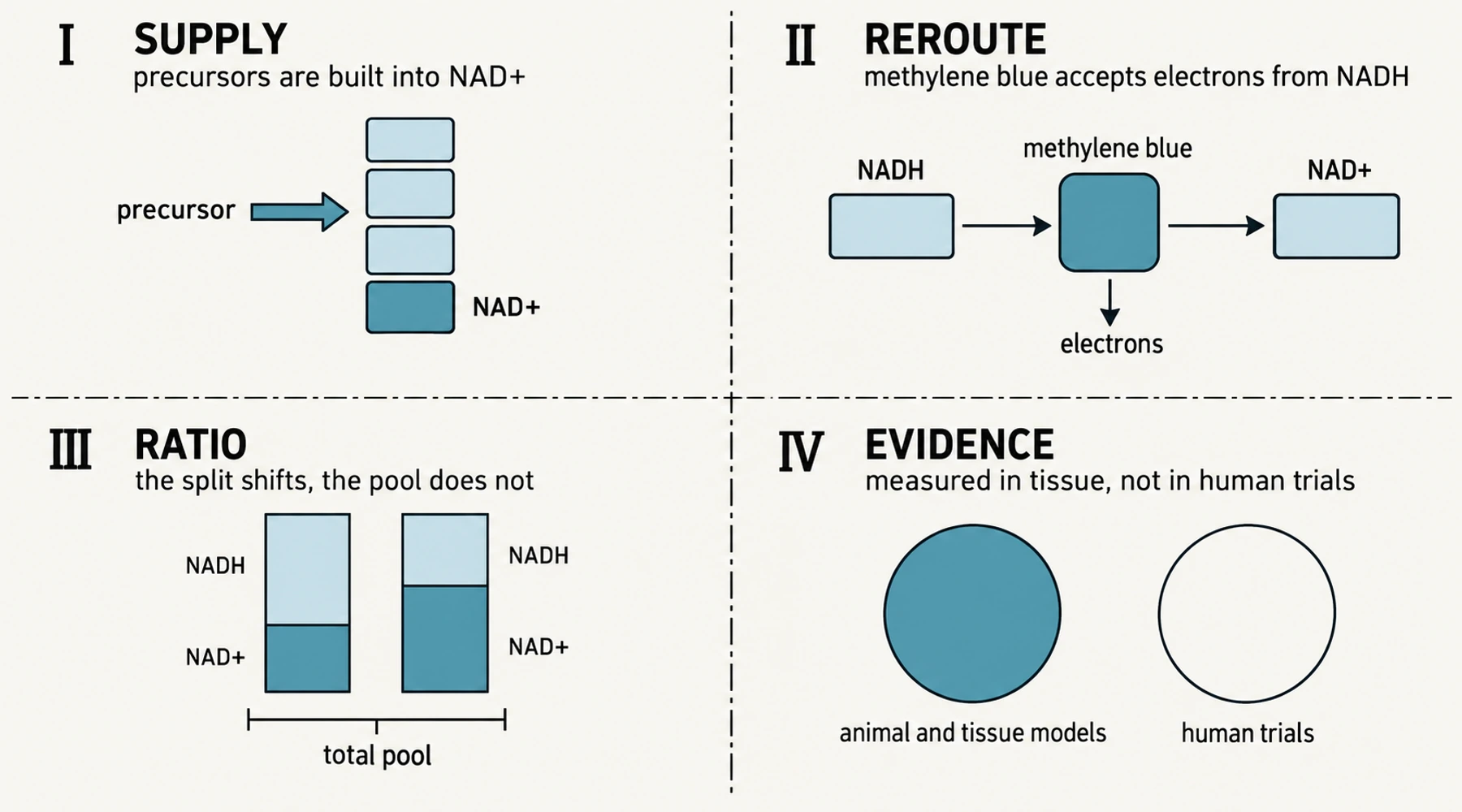
Methylene blue and the supplements sold as NAD+ boosters are both explained with the words mitochondria and cellular energy. Neither description tells you what the product actually does.
The two approaches act on different variables. One tries to change how much NAD+ your cells contain. The other changes the ratio between the two forms of it. Those are not two roads to the same place.
Two numbers that are always confused
NAD+ is a coenzyme. It accepts a pair of electrons, in the form of a hydride ion, and becomes NADH. When NADH hands those electrons onward, it becomes NAD+ again. Cells use this cycle constantly: it is how the energy extracted from food reaches the protein machinery that builds ATP.
Because NAD+ and NADH are two states of the same molecule, a cell has two separate quantities worth tracking. The first is the total pool: how much NAD+ and NADH exists altogether. The second is the ratio between them, which describes how loaded the electron carriers currently are.
A reservoir makes the distinction concrete. The volume behind the dam is the pool. The split between water held upstream and water released downstream is the ratio. You can raise that ratio without adding a litre, by opening a gate. That is not a metaphor for what methylene blue does. It is closer to a literal description.
The supply approach
NAD+ precursor supplements, including nicotinamide riboside, nicotinamide mononucleotide, and nicotinamide, are building material. Cells assemble NAD+ through a recycling route called the salvage pathway, and precursors feed into it. The aim is to enlarge the pool.
In animals, this is well established: tissue NAD+ falls with age and metabolic disease in many models, and precursor feeding tends to raise it. In people, the picture narrows. Human trials do show that these compounds raise measured blood NAD+ levels. What they have not produced is a consistent improvement in a clinical endpoint, meaning the things a person would notice or that a trial is designed to measure.
"NAD+ levels increased" measures something inside the body. It is not a finding about how someone felt, moved, or recovered.
What methylene blue does instead
Methylene blue is not a precursor. It is a redox dye, old enough to have been used in medicine for well over a century, and its authorised uses are narrower than its investigational ones.
Inside a cell, flavin-dependent enzymes reduce it to a colourless form, leucomethylene blue, which is then reoxidised. Electrons that would have passed through complex I, the first station of the respiratory chain can instead be emptied from NADH through methylene blue. NADH becomes NAD+.
The ratio rises. The pool does not grow.
A rat study in the diabetic heart measured this directly in isolated cardiac mitochondria. Adding methylene blue at concentrations from 6 to 18 micromolar during fatty-acid oxidation caused a dose-dependent fall in NADH and in the NADH-to-NAD+ ratio. The absolute amount of NAD+ was far less responsive than NADH, which is what you would expect from a compound converting one form into the other rather than manufacturing more of either.
The destination of those electrons matters. In isolated brain mitochondria, methylene blue at 100 nanomolar to 1 micromolar improved energy production when the respiratory chain was inhibited, and simultaneously increased hydrogen peroxide production while decreasing its elimination, across every condition tested. The authors trace the hydrogen peroxide to direct reduction of oxygen by reduced methylene blue. Electrons leaving NADH by this route do not vanish. They land on oxygen.
A separate study in Achilles tendon tissue states the point cleanly. Methylene blue restored NAD+/NADH balance and lifted ATP production in injured tenocytes and in a rat tendinopathy model, and the paper records that the total NAD pool showed no significant change.
What the tissue and animal experiments establish
Four experiments across four decades trace the same idea and repeatedly draw its boundary.
In chronic alcohol feeding in rats, ethanol lowered both the cytosolic and the mitochondrial NAD+/NADH ratios in the liver. Adding methylene blue to the diet largely prevented that shift. It did not reduce the fatty liver that ethanol caused. Correcting the ratio did not correct the outcome. That 1985 result is worth remembering before any claim that a redox shift is the mechanism behind a benefit.
In liver cells and mice on a high-fat diet, methylene blue raised the NAD+/NADH ratio, increased SIRT1, decreased acetylation of PGC-1alpha, activated AMPK, and reduced hepatic fat accumulation. Here the outcome did move with the ratio. The same paper shows the effect is not monotonic: three milligrams per kilogram per day increased mitochondrial DNA content more effectively than ten did, while oxygen consumption and AMPK signalling rose with dose.
In the diabetic heart, methylene blue given in drinking water for eleven weeks lowered the NADH-to-NAD+ ratio in cardiac mitochondria and raised sirtuin 3 activity. Lysine acetylation fell at 83 sites across 34 proteins, concentrated in fatty-acid transport and oxidation. Ejection fraction improved. But complex I-supported respiration was not fixed. And a knockout experiment separated two effects that are easy to conflate: the ratio change occurred largely without sirtuin 3, while the deacetylation depended on it.
In the tendon study, methylene blue was applied while complex I was chemically blocked with rotenone. It still restored NAD+ balance, and it still failed to prevent oxidative stress, matrix degeneration, and loss of cell viability. Restoring the ratio was not sufficient for the tissue to recover.
| What is being changed | NAD+ precursor approaches | Methylene blue |
|---|---|---|
| Total NAD quantity | The target. Precursors feed the salvage pathway, and human trials show blood NAD+ rising. | Unchanged in the models that measured it, including the tendon study. |
| NAD+/NADH ratio | Rarely reported as an outcome. | The direct effect. NADH is emptied and NAD+ rises, while the pool holds. |
| Clinical endpoints | Human trials exist; endpoint results are mixed and generally small. | Animal endpoints move, but not consistently with the ratio, and complex I defects are not repaired. |
| Direct combination evidence | No located study tests the two together. | Same. |
A printable sheet with the full citations uses the same rows.
Why sirtuins get pulled into the argument
Sirtuins remove acetyl groups from proteins, and they consume NAD+ to do it. Their activity responds to NAD+ availability, so any compound that changes availability changes sirtuin activity downstream.
This is the hinge on which most "methylene blue for NAD+" marketing turns. It is also where the logic slips. Shifting the ratio can raise sirtuin activity. It does not follow that the product supplies NAD+, and it does not follow that the effect is equivalent to taking a precursor. The redox interpretation of these measurements has its own set of pitfalls worth reading before you accept either framing.
What has been tested in humans
Methylene blue has decades of clinical use in acute, monitored settings: methemoglobinemia, ifosfamide-related neurotoxicity, and severe low blood pressure during surgery. Those are narrow, supervised applications, not evidence for daily oral use as a performance aid.
Searches for this article did not locate a human study measuring NAD+ metabolites after methylene blue in healthy volunteers. The findings above come from isolated mitochondria, cultured cells, rat tissue, and human tissue explants. Explanted tendon kept alive in a dish is a useful step up from a cell line. It is still not a person.
The precursor literature is genuinely human, and its results are modest. Blood NAD+ rises. Clinical endpoints are mixed and generally small.
So the combination claim is a fair question with an unsatisfying answer: no published study, trial, or case series located for this article has tested methylene blue together with nicotinamide riboside, nicotinamide mononucleotide, or an NAD+ infusion. Anyone describing the combination as supported, or as synergistic, is extrapolating from two separate bodies of evidence.
Extrapolation can fail in both directions. It can be too optimistic, if the pool was never the limiting variable once the ratio is restored. It can also be too simple, because methylene blue has a dose-response that turns over. Its own investigators describe the compound as hormetic: lower concentrations favour reduction, while higher concentrations reroute electrons away from the respiratory chain and can behave as a pro-oxidant. Adding more substrate does not make that curve safer.
There are also interaction concerns that have nothing to do with NAD+. Methylene blue inhibits monoamine oxidase A, which is why it carries a serotonin-related risk alongside certain antidepressants; a review of reported CNS toxicity found that 13 of 14 cases met the Hunter criteria for serotonin toxicity. It can also cause methemoglobinemia at high exposure. If you take prescription medication, the combination question to ask your clinician is about those pathways, not about redox balance. The same discipline applies to ordinary pairings: other supplements taken alongside methylene blue have their own, largely untested, evidence base.
Why purity decides which experiment you are actually running
A methylene blue product is a mixture until a laboratory proves otherwise. The impurity that matters here is Azure B, a demethylated phenothiazine that is not inert. It is a redox-active dye sharing the same basic electrochemistry, so a product carrying meaningful Azure B is not a cleaner or dirtier version of the same intervention. It is a different mixture acting on the same pathway, at a ratio nobody has characterised.
USP grade is how a buyer reaches a defined substance. A product that is not USP grade is most likely textile-grade dye, and textile grades carry impurities that rule them out for consumption, including heavy metals and residual solvents.
The gap is not only between grades. Many sellers who claim conformance to USP test for heavy metals and nothing else, then present that single panel as full compliance. The full specification covers identity, purity, organic impurities, residual solvents, elemental impurities, residue on ignition, microbial limits, and bacterial endotoxins. A partial panel cannot speak to the ones it omits, and the omissions cover related substances and solvent residues.
Blupreme buys from a pharmaceutical manufacturer of methylene blue and publishes a certificate of analysis covering the full specification, so the substance in the bottle is the substance the research describes. If you want to check the reasoning yourself before buying, how to read methylene blue research explains what each study type can and cannot show.
The distinction that survives scrutiny
Adding an NAD+ precursor changes how much NAD+ exists. Methylene blue changes what the existing NAD+ is doing. The first is a supply question, the second is a flux question, and the experiments supporting one say little about the other.
What methylene blue has behind it is a coherent mechanism, confirmed in isolated mitochondria and in animal tissue, with a clear and repeated qualifier: shifting the ratio is not the same as fixing the tissue. What it lacks is human trials measuring the NAD+ effect in people. What neither category has is a direct test of the two taken together.
Both categories deserve the same treatment. Ask which variable the product claims to change, then ask which measurements exist for that variable in humans. When the answer is a cell study, a rat, or a plausible pathway, that is what it is. It is not a stack.