
Article
Methylene blue with alcohol, caffeine, and supplements
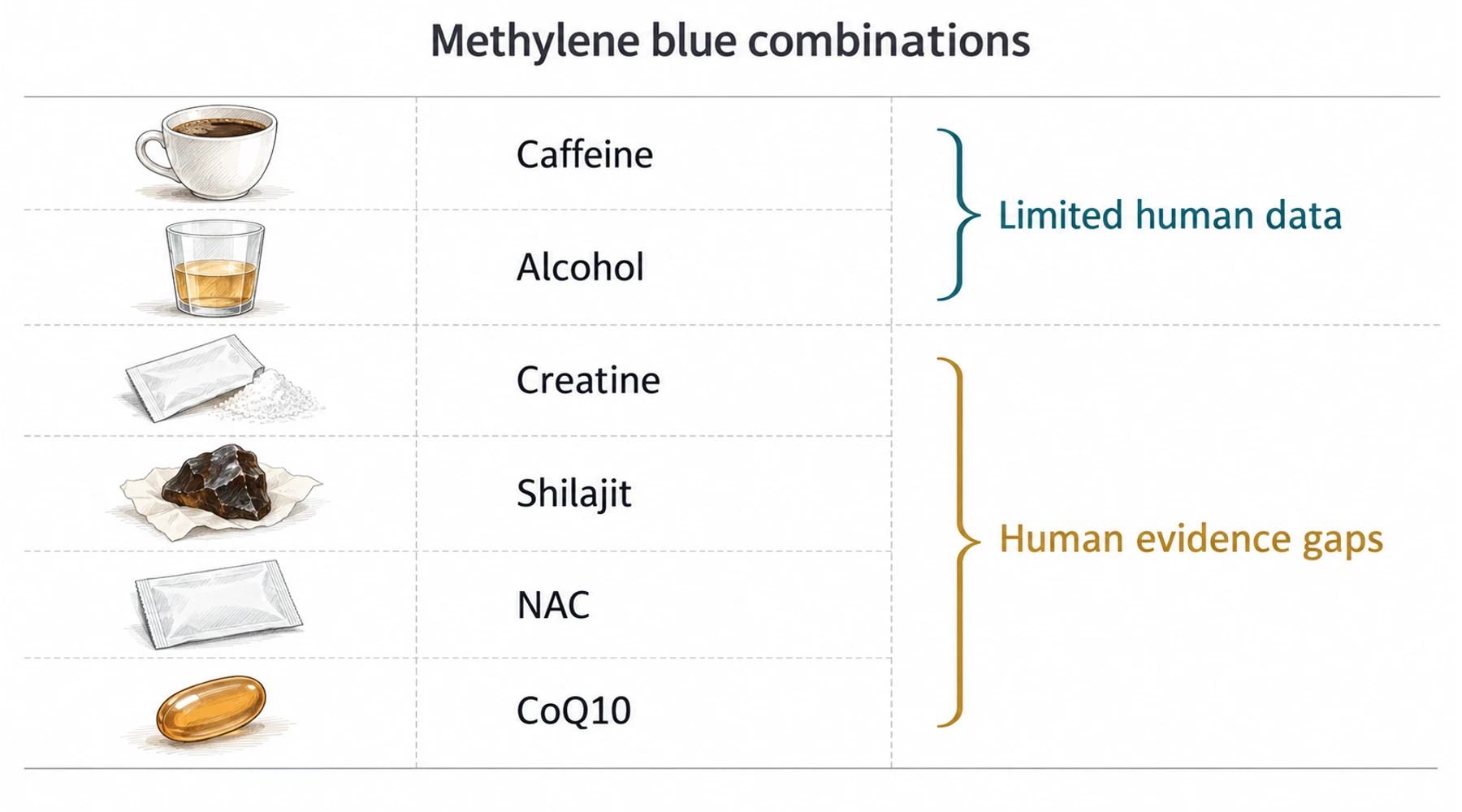
Methylene blue cannot be cleared for use with alcohol, coffee, or a supplement stack from the phrase “no known interaction.” That phrase may mean nobody has adequately tested the combination. It may also conceal a more useful finding: a study measured one outcome and found no change, while leaving other outcomes unanswered.
Alcohol and caffeine have some direct human evidence. For creatine, shilajit, N-acetylcysteine (NAC), and coenzyme Q10 (CoQ10), the sources located for this article do not establish the safety or benefit of routine oral combinations with methylene blue. These are different evidence categories, and the table below keeps them separate.
Interaction evidence table
“Human evidence gap” means suitable human combination evidence was not located for this article. It does not mean a harmful interaction has been demonstrated, or that no study could exist. The table addresses lifestyle combinations; prescription-drug interactions and serotonin syndrome require a separate medication assessment.
| Combination | Evidence available | What the evidence supports | What remains unresolved |
|---|---|---|---|
| Alcohol | A study of ethanol disposition in rats and healthy volunteers included human measurements. | Methylene blue did not change ethanol pharmacokinetics in the volunteers. | This does not establish drinking safety, prevent intoxication, or validate a hangover treatment. |
| Coffee or caffeine | The PROVAYBLUE prescribing information reports a clinical interaction study. | Caffeine exposure was unchanged when administered with intravenous methylene blue under the tested conditions. | Repeated oral use, different products, sleep effects, and individual susceptibility are not settled by that result. |
| Creatine | Human evidence gap for the combination. | No supported claim of added cognitive or exercise benefit from combining the two. | Tolerability, effects over time, and interactions within a larger stack remain uncertain. |
| Shilajit | Human evidence gap for the combination. | A mineral or “mitochondrial support” description does not establish compatibility. | Exact product composition and the safety of taking it with methylene blue require separate assessment. |
| NAC | Preclinical work includes a combination study in cats with acetaminophen toxicosis. | The combination has been investigated in a specific veterinary poisoning context. | That is not evidence for a daily human supplement stack or a method to neutralize methylene blue. |
| CoQ10 | Human evidence gap for the combination. | Shared discussion of cellular energy does not demonstrate useful synergy. | Combination safety and added benefit remain unestablished; CoQ10 also has its own medication interactions. |
The cover is a conceptual map of these evidence categories. The ingredient drawings identify questions, rather than tested formulations or recommended combinations.
Alcohol: the animal result did not carry over to people
Researchers have tested whether methylene blue changes ethanol handling, rather than relying only on a biochemical rationale.
In the 2000 study by Vonlanthen, Beer, and Lauterburg, methylene blue increased ethanol metabolism in isolated liver cells and intact rats. In healthy human volunteers, however, it neither changed ethanol pharmacokinetics nor corrected the ethanol-associated rise in the lactate-to-pyruvate ratio, a marker of the redox change being investigated.
That is a concrete failure of the proposed benefit to translate under the human study conditions. It gives no basis for taking methylene blue to sober up faster. It also illustrates why a metabolic measurement and a safety assessment are different: unchanged ethanol clearance cannot tell you that judgment, coordination, or symptoms will be unaffected.
Avoid using methylene blue as a reason to drink or as a way to compensate for drinking. If methylene blue is part of medical treatment, ask the treating team about alcohol in that treatment context. Questions about tyramine and fermented foods are related to monoamine oxidase inhibition, but they are not equivalent to measuring ethanol clearance.
Coffee: unchanged exposure is a narrow finding
The labeled caffeine study used a 2 mg/kg intravenous dose of methylene blue. Caffeine acted as a probe for CYP1A2, an enzyme involved in its metabolism. The reported absence of an exposure change addresses whether methylene blue altered how much caffeine circulated under those conditions. It is a study description, not an oral dose recommendation.
A coffee drinker usually wants a broader answer: will this combination make me anxious, keep me awake, or affect my heart rate? A pharmacokinetic result cannot answer all of those questions. The FDA describes insomnia, palpitations, anxiety, and nausea among caffeine's own adverse effects. Their appearance after a combination does not, by itself, identify a new chemical interaction or prove a change in neurotransmitter levels.
Include all caffeine sources when describing an exposure: coffee, tea, energy drinks, pre-workout products, and tablets. A general caffeine limit for healthy adults is not a tested safety limit for methylene blue combinations. Nor does a caffeine result cover every other ingredient in an energy blend.
Supplements: a mechanism is not a tested stack
Creatine, NAC, and CoQ10 often appear together in discussions of energy metabolism or oxidative stress. Those broad categories do not predict the clinical result of adding methylene blue. A useful combination study would compare the combination against its individual components and assess both benefit and harm. Separate studies of each ingredient cannot supply that comparison.
NAC is a particularly useful example. A laboratory comparison involving nitric-oxide-induced methemoglobinemia evaluated methylene blue, riboflavin, and NAC in vitro. Finding their names together in a paper does not establish that people should swallow them together. Neither a laboratory comparison nor the cat poisoning study validates NAC as protection against methylene blue toxicity.
Product identity adds another uncertainty for shilajit and multi-ingredient blends. The NCCIH describes toxic-metal concerns with some Ayurvedic preparations. This does not establish contamination of every shilajit product. It means that composition and quality are separate questions from drug interactions; passing a contaminant test would not establish combination safety.
An interaction can also involve a third substance. The NCCIH identifies possible CoQ10 interactions with warfarin and insulin. These are not evidence of a methylene-blue interaction. They show why checking only the two ingredients named in a search can miss the clinically relevant combination.
What to bring to an interaction assessment
Methylene blue's inhibition of purified human monoamine oxidase A is established experimental pharmacology. Serious serotonin toxicity with serotonergic medicines is also recognized in its drug labeling. Calling a product a supplement does not remove the need to check its active ingredients against those hazards.
Bring the actual labels, methylene-blue concentration and route, quantities taken, timing of the exposure, other medicines, and any new symptoms to a pharmacist or clinician. Timing is useful for reconstructing an exposure; it does not supply a validated separation interval for an unstudied stack. Do not stop prescribed treatment to make room for methylene blue.
New confusion or agitation with fever, marked sweating, tremor, or muscle rigidity after a combination warrants urgent medical assessment. Broader contraindications and the information needed to assess an adverse reaction are covered in methylene blue side effects and safety.