
Article
Methylene blue, tyramine, and fermented foods: what MAOI warnings mean
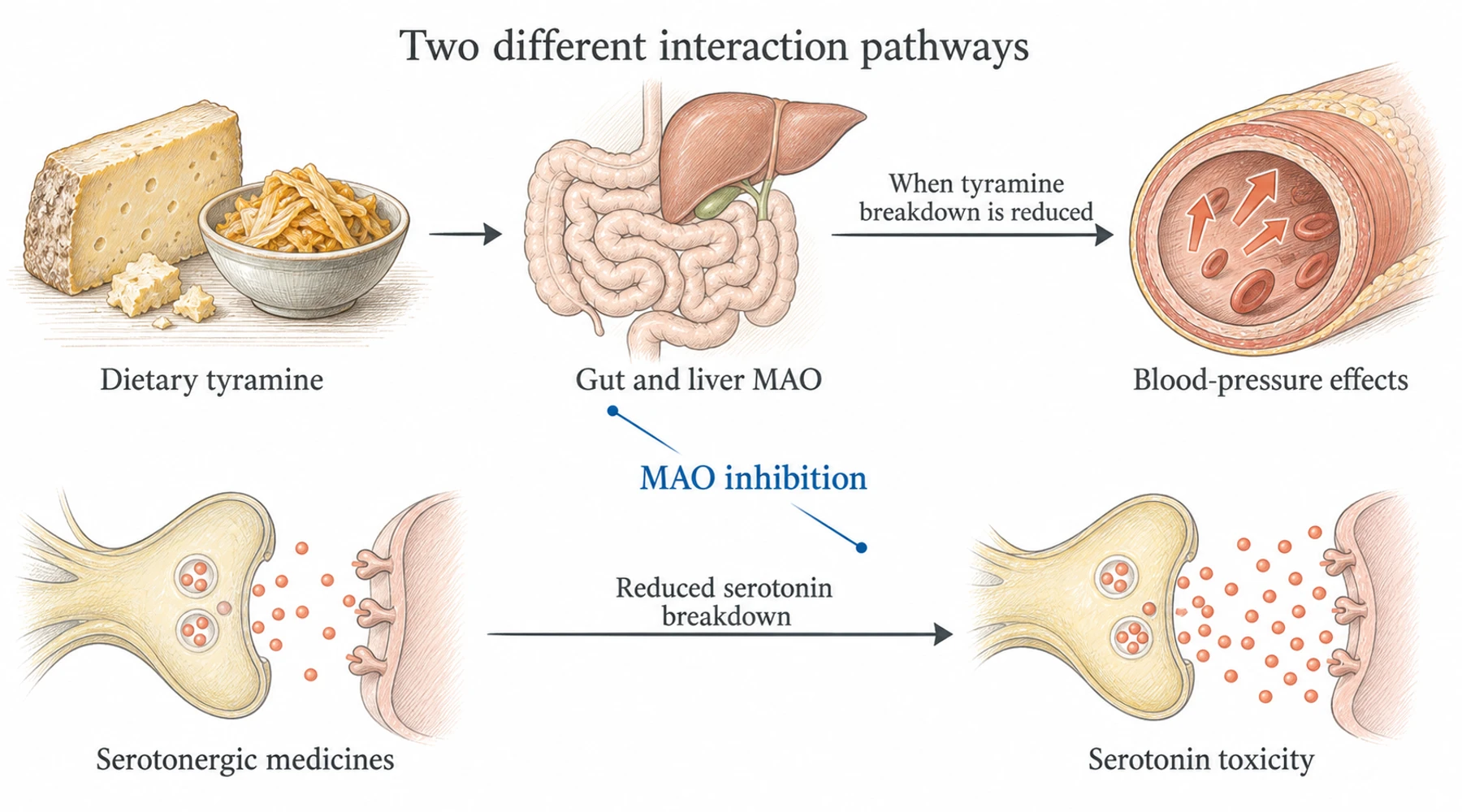
Methylene blue inhibits monoamine oxidase, so questions about aged cheese, fermented vegetables, and other tyramine-containing foods have a pharmacological basis. However, that finding does not establish a universal methylene blue food-avoidance list or a safe waiting interval. Diet instructions for another MAO inhibitor cannot simply be copied across.
Two questions need separate answers: could reduced tyramine breakdown amplify a food-related blood-pressure response, and could reduced serotonin breakdown cause toxicity when combined with serotonergic medicines? Avoiding fermented foods does not resolve the second question.
Why tyramine enters the discussion
Tyramine is a biogenic amine that some microorganisms make from the amino acid tyrosine. The ETH Zurich project on tyramine in fermented foods describes this process in cheese and fermented meat. Fermentation is therefore relevant, but the word “fermented” does not state how much tyramine a serving contains.
Microbial strains, ingredients, ripening, storage, and portion size affect exposure. In an experimental study of Olomouc curd cheese, investigators measured biogenic amines by chromatography while varying storage temperature and duration. Tyramine concentrations varied substantially across the tested conditions. Those measurements describe that cheese experiment, not a reliable value for every cheese, sauerkraut, or yogurt in a kitchen.
Normally, monoamine oxidase in the digestive tract helps break down ingested amines before substantial amounts reach the circulation. If that protection is sufficiently reduced, absorbed tyramine can stimulate noradrenaline release from sympathetic nerves and raise blood pressure. The EMSAM prescribing information explains this tyramine mechanism. It also illustrates an essential distinction: the mechanism explains why an interaction is possible; drug-specific studies determine how it informs a particular medicine's instructions.
“MAOI” does not describe one diet rule
Monoamine oxidase has two forms, MAO-A and MAO-B. Medicines differ in which form they inhibit, how strongly they inhibit it at a given exposure, and whether inhibition is reversible. They also differ in delivery to the gut, liver, and other tissues.
Older nonselective, irreversible MAO inhibitors, such as tranylcypromine, differ from a reversible MAO-A inhibitor such as moclobemide. Reversible inhibition can lessen tyramine potentiation, but “reversible” does not mean interaction-free. The moclobemide product information generally does not require a special diet while still advising avoidance of large amounts of tyramine-rich food.
A double-blind, placebo-controlled study in 16 healthy volunteers directly compared moclobemide with tranylcypromine during repeated treatment. Researchers administered increasing amounts of tyramine with a meal and measured the amount needed to raise systolic pressure by at least 30 mmHg. Tranylcypromine amplified the pressor response much more than moclobemide. This was a controlled challenge experiment, not a home food test and not a methylene blue study.
Route and exposure also matter within one medicine. The selegiline patch label distinguishes its tested strengths: its evidence supports no modified diet at 6 mg per 24 hours, while the 9 and 12 mg per 24 hours systems carry dietary restrictions. Those numbers belong to that patch. They are not transferable thresholds for oral methylene blue.
What methylene blue research establishes
In Ramsay and colleagues' 2007 enzyme study, researchers tested purified human MAO using kinetic and spectroscopic methods. Methylene blue strongly and reversibly inhibited MAO-A; inhibition of MAO-B required higher concentrations. This establishes a molecular interaction. It does not measure the blood-pressure response to a fermented meal in people taking an oral product.
There is also older experimental evidence involving tyramine itself. In dog mesenteric-artery tissue experiments, methylene blue reduced tyramine deamination in tissue homogenates and altered noradrenaline handling. A homogenate is disrupted tissue studied outside the animal. Its measured concentration cannot be converted into a safe oral amount or food serving.
For the sources inspected here, I did not locate a human food-challenge result that validates a general diet or avoidance interval for ordinary methylene blue products. That is a limitation of the located evidence, not proof that every food combination is safe or that no relevant research exists. A related formulation, a different route, or an enzyme assay would each need its own applicability assessment.
Evidence table: food, medicines, and route
Read each row across. Evidence for one outcome does not automatically answer the neighboring question.
| Exposure or question | Evidence available | What it supports | What remains unresolved |
|---|---|---|---|
| Tyramine plus older MAOI antidepressants | Drug-specific labels and controlled human tyramine challenges | A food-related pressor interaction can be clinically important | Those instructions do not establish a methylene blue diet |
| Methylene blue plus tyramine in laboratory systems | Purified-enzyme and animal-tissue experiments described above | A plausible concern about reduced amine breakdown | Human meal response, food limits, and duration by formulation and route |
| Intravenous methylene blue plus serotonergic medicines | Clinical reports and the PROVAYBLUE boxed warning | A serious, potentially fatal serotonin-toxicity interaction | These reports do not quantify tyramine-food risk |
| Oral methylene-blue-containing medicine plus serotonergic drugs | Published individual case report | Oral administration cannot be assumed to remove serotonin-toxicity risk | Frequency and exposure-response relationship across oral products |
| Skin application, local tissue exposure, or products described as “low dose” | No general food-safety rule established by the sources reviewed here | Route, formulation, absorption, amount, and repeated use require separate assessment | A validated food-avoidance interval or interaction-free threshold |
The current PROVAYBLUE label concerns an intravenous injection. Its boxed warning addresses serotonin syndrome with serotonergic drugs and opioids. It does not provide a tyramine diet schedule. Neither that omission nor its medication-timing instructions should be converted into a food-safety guarantee.
Oral exposure also has clinical relevance: Zuschlag and colleagues reported serotonin toxicity after an oral urinary analgesic containing methylene blue was started in a person taking multiple serotonergic medicines. A single case cannot estimate incidence or isolate every contributing factor. It does contradict the assumption that oral delivery makes this interaction irrelevant.
Blood-pressure symptoms and serotonin toxicity are different questions
A tyramine pressor reaction concerns excess adrenergic activity and potentially severe hypertension. Serotonin toxicity concerns excessive serotonergic activity and can include agitation, fever, sweating, muscle rigidity or jerking, and unstable blood pressure. Their symptoms can overlap. A headache after a meal cannot identify the mechanism by itself.
Seek emergency medical help for sudden severe headache, chest pain, new weakness or difficulty speaking, collapse, or fever with confusion and marked muscle stiffness or jerking after a suspected interaction. Do not wait to identify the food or reproduce the reaction. Bring the product container and medication list if readily available.
For planned use, the useful question is specific: “For this formulation, route, amount, and treatment duration, what dietary instructions apply, and what evidence supports their duration?” Do not stop prescribed medicines to accommodate an online regimen or infer safety from the phrase “low dose.”
Use the clinician conversation checklist to record the product and exposures. The separate guides to methylene blue drug interactions and blood-pressure effects explain those clinical questions in more detail. Questions about alcohol, caffeine, and supplements involve additional mechanisms, while neurotransmitter research explains why an enzyme result cannot predict a person's neurotransmitter levels.