
Article
Methylene blue and blood pressure: mechanisms, clinical use, and risks
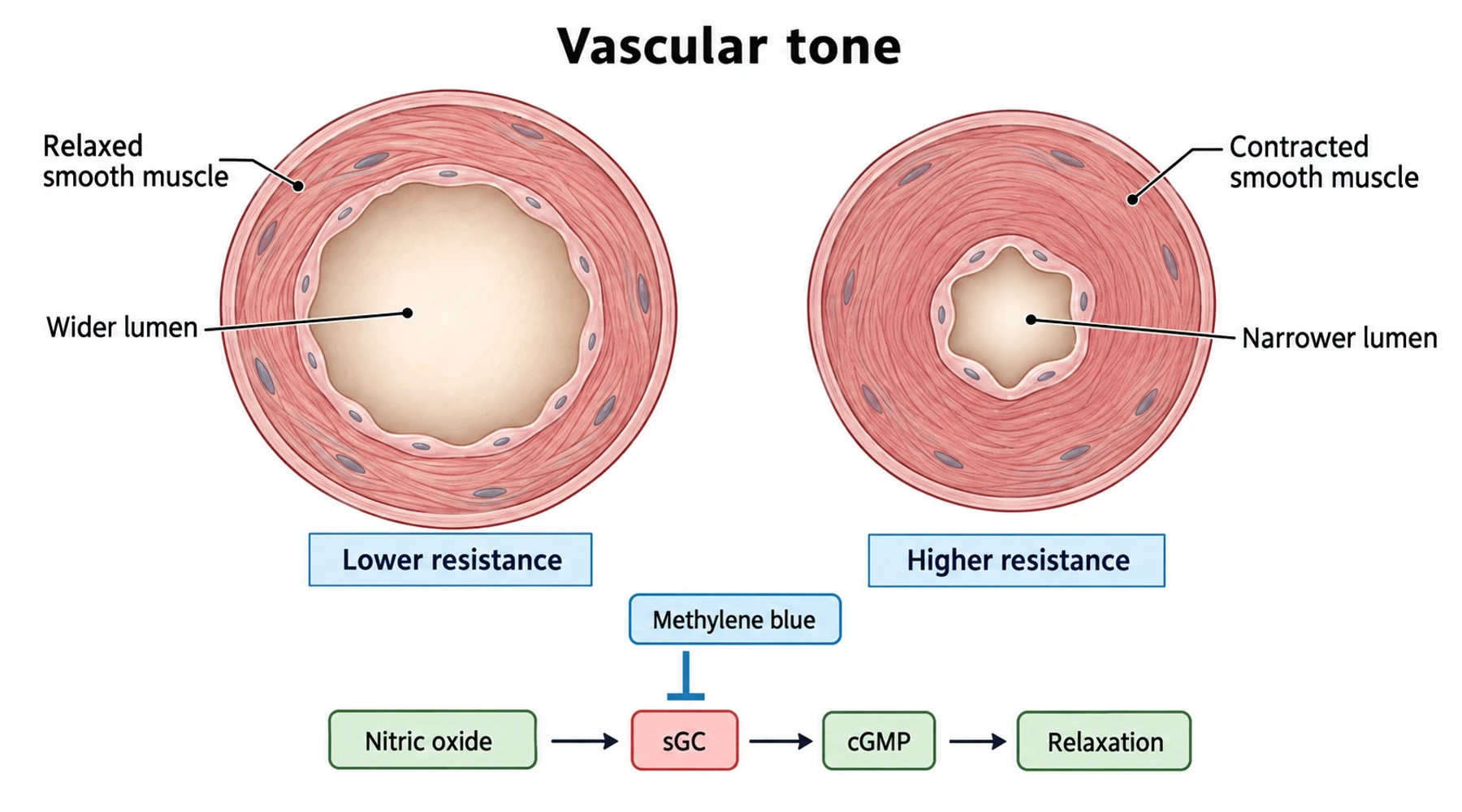
Methylene blue can raise blood pressure, particularly when given intravenously to patients whose blood vessels are excessively dilated. That effect helps explain its investigation in certain forms of shock. It does not establish methylene blue as a treatment for ordinary low blood pressure, and it is not an established treatment for high blood pressure.
For someone considering an oral product, the useful question is more specific: what evidence predicts the effect of this formulation, taken by this route, in someone with this medical history? The hospital studies below do not provide that prediction.
Why vascular resistance matters
Arteries contain smooth muscle that changes their internal diameter. Relaxation widens the passage through which blood flows; contraction narrows it. Across the circulation, this contributes to systemic vascular resistance. Blood pressure also depends on the amount of blood the heart pumps, so changing resistance does not determine the entire response.
One relaxation pathway begins with nitric oxide, or NO. It activates soluble guanylate cyclase, abbreviated sGC, which produces the intracellular messenger cyclic GMP, or cGMP. The resulting signaling promotes smooth-muscle relaxation.
Methylene blue can interfere with this pathway. However, calling it a perfectly selective sGC blocker oversimplifies its pharmacology. In Mayer and colleagues' experimental work on nitric oxide synthesis, isolated-vessel relaxation and endothelial-cell signaling were more sensitive to methylene blue than effects produced by directly activating sGC. The findings implicated effects upstream on NO synthesis as well. Experiments like these explain a plausible vascular action; they do not tell a person how much their home blood-pressure reading will change.
The cover illustrates this simplified relationship between vascular tone and resistance. Its vessel drawings are conceptual, not measured changes from a patient or a dose-response experiment.
What the clinical evidence actually tested
Vasoplegia means severely reduced vascular tone, usually discussed in a setting such as major cardiac surgery or critical illness. A patient can have low pressure despite normal or high cardiac output because resistance has fallen. This differs from low pressure caused primarily by blood loss or poor cardiac pumping.
The table separates treatment after vasoplegia develops, prevention in selected surgical patients, and adjunctive treatment of septic shock. IV means intravenous. These are study exposures, not instructions for administration.
| Route and clinical setting | Population and comparison | What was measured or found | What the result cannot establish |
|---|---|---|---|
| IV methylene blue after cardiac surgery | Levin et al., 2004: 56 patients with postoperative vasoplegia randomized to methylene blue or placebo | Vasoplegia lasted under six hours in all treated patients; eight controls remained affected beyond 48 hours. Deaths were 0/28 versus 6/28. | A small, specific surgical trial cannot establish a general survival benefit or treatment for outpatient hypotension. |
| IV methylene blue before coronary bypass surgery | Ozal et al., 2005: 100 selected high-risk patients; preoperative 1% solution by infusion versus no methylene blue | Vasoplegia occurred in 0/50 versus 13/50 patients. This was prevention around surgery, not treatment of chronic low pressure. | Findings do not justify preventive oral use or identify who outside this surgical setting would benefit. |
| IV methylene blue added to septic-shock care | Ibarra-Estrada et al., 2023: 91 analyzed adults; six-hour infusion daily for three doses versus matched sodium-chloride placebo | Median time to stopping vasopressors was 69 versus 94 hours. Mortality and ventilation duration were similar. | Earlier vasopressor withdrawal is not proof of improved survival or a predictable blood-pressure increase in healthy people. |
| IV licensed medicine for acquired methemoglobinemia | PROVAYBLUE prescribing information; treatment of abnormal hemoglobin, not a blood-pressure trial | Hypertension is among reported adverse reactions to methylene blue class products. | An adverse-reaction listing does not estimate the chance or size of a pressure rise with a retail oral product. |
| Oral consumer use for high or low blood pressure | No directly applicable controlled treatment trial located in the literature searched for this article | The IV studies above supply no validated oral pressure target or regimen. | Absence of a located trial is neither proof of safety nor proof that every oral exposure changes pressure. |
In the septic-shock trial, both groups received intensive care, including norepinephrine, hydrocortisone, and vasopressin when indicated. Treatment began within 24 hours of starting norepinephrine. Clinicians adjusted vasopressors to a pressure target; the main question was whether patients needed those drugs for less time. Patients with several important risk factors, including recent SSRI use and a G6PD-deficiency history, were excluded. Those design choices matter when interpreting both benefit and safety.
The broader clinical-trial review of vasoplegia and septic shock examines the critical-care evidence in more detail.
Does methylene blue lower blood pressure?
The vascular rationale above points toward reducing excessive relaxation, not treating hypertension. A lower reading after someone takes methylene blue cannot, by itself, establish a drug effect. Posture, rest, measurement technique, other medicines, and the condition prompting measurement can all change the comparison.
Likewise, a higher reading is a finding to assess, not confirmation that a desirable mechanism has been activated. A clinically useful treatment needs evidence about symptoms, function, adverse effects, and outcomes as well as a number on a monitor.
The same distinction applies to methylene blue claims about POTS and orthostatic intolerance. Standing symptoms and heart-rate changes require their own clinical evidence; vasoplegic shock is a different study population.
Medication context changes the question
Bring a complete medication list to a clinician or pharmacist before considering methylene blue. Three contexts deserve separate attention:
- Serotonergic medicines and opioids. The IV product label warns of potentially fatal serotonin syndrome with these combinations. Unstable blood pressure may occur alongside agitation, fever, sweating, tremor, or muscle rigidity. This is a toxicity concern, not the desired vascular response. See the methylene blue interaction guide.
- Medicines acting on NO and cGMP. Nitrates and PDE5 inhibitors such as sildenafil involve this signaling system. The sildenafil label explains its vasodilating action and nitrate interaction. Opposing arrows in a pathway diagram do not show that methylene blue can safely cancel another medicine's effects.
- An existing blood-pressure prescription. A reading after methylene blue is not a basis for skipping, replacing, or increasing prescribed treatment. Record the product, concentration, amount, route, timing, readings, and symptoms so the prescriber can assess the exposure.
Blood pressure is only one part of the overall safety assessment. For example, the IV label contraindicates use in G6PD deficiency because of hemolysis risk. A normal cuff reading cannot exclude that problem or a drug interaction.
When a reading needs urgent attention
For nonpregnant adults, the American Heart Association advises urgent action for readings above 180 systolic and/or 120 diastolic. With chest pain, breathlessness, weakness, vision changes, or difficulty speaking, call emergency services immediately. Without new concerning symptoms, repeat after at least one minute and contact a healthcare professional promptly if it remains that high.
Seek emergency help for collapse, severe breathing difficulty, or suspected serotonin syndrome after an exposure regardless of the cuff reading. Do not take more methylene blue to correct either a high or a low number.