
Article
Methylene blue and POTS: why vascular mechanisms do not establish treatment
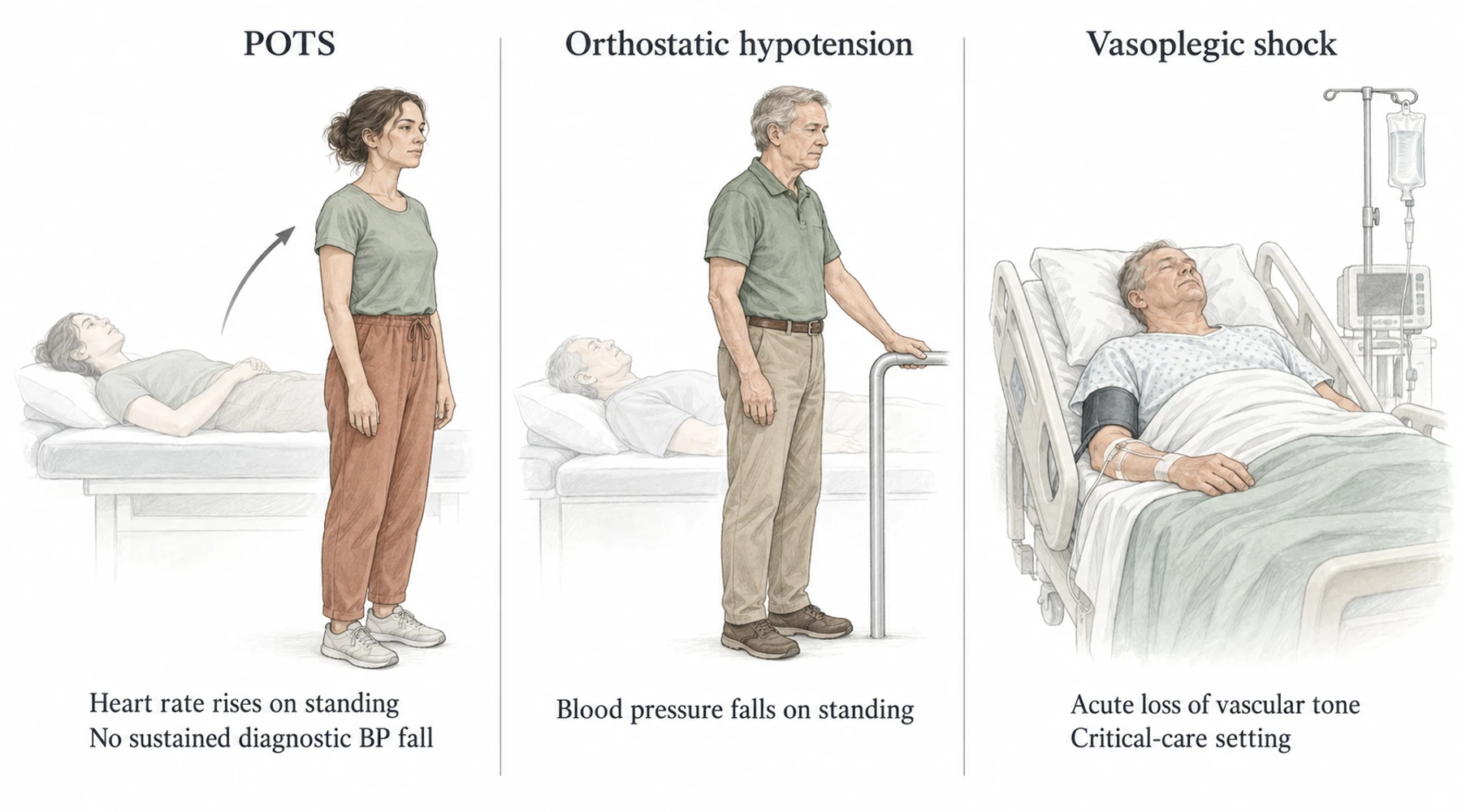
Methylene blue is not an established treatment for postural orthostatic tachycardia syndrome, or POTS. In the literature search for this article, no controlled clinical trial was located demonstrating that it improves POTS symptoms or daily function. Studies in septic shock and experimental blood vessels answer different questions.
The tempting argument is that POTS involves circulation, methylene blue can oppose some vessel-relaxing signals, and therefore methylene blue should improve POTS. Each step needs examination. A drug's effect on a vascular pathway does not establish that the pathway is the cause of a particular person's symptoms, or that changing it will help them stand comfortably.
What needs distinguishing first
Orthostatic intolerance means symptoms associated with being upright. POTS is one defined syndrome within that broader problem. Dysautonomia is broader still, referring to disorders of autonomic regulation; it does not name one blood-pressure pattern.
The NIH expert consensus account of POTS describes a sustained heart-rate increase of at least 30 beats per minute within 10 minutes upright, or at least 40 for ages 12–19, together with chronic upright symptoms, improvement on lying down, and absence of sustained orthostatic hypotension. Symptoms must have lasted at least three months, and other explanations for the tachycardia must be excluded. A watch reading alone cannot establish that combination.
Classical orthostatic hypotension has a different defining measurement: the autonomic societies' consensus definition specifies a sustained fall of at least 20 mmHg systolic or 10 mmHg diastolic within three minutes of standing or head-up tilt. Vasoplegic shock concerns an acute loss of vascular tone severe enough to threaten circulation. It is not diagnosed by a standing test.
Comparison: condition, outcome, and evidence gap
| Question | POTS | Classical orthostatic hypotension | Vasoplegic shock |
|---|---|---|---|
| What distinguishes it? | Chronic upright symptoms with excessive heart-rate rise, without the sustained diagnostic BP fall | Sustained BP fall after becoming upright | Acute, markedly reduced vascular tone with circulatory failure |
| Why posture matters | Standing provokes the defining tachycardia and symptoms | Standing reveals the defining pressure drop | Hypotension and organ perfusion problems require assessment independent of standing |
| What would meaningful benefit include? | Less upright dizziness and palpitations, better daily function, paired heart-rate and BP assessment | Fewer symptoms and falls, better upright function, acceptable pressure while lying down | Restored perfusion, less vasopressor support, organ recovery and survival |
| What methylene blue evidence was located? | Mechanistic discussion and uncontrolled reports; no controlled POTS efficacy trial | No controlled evidence located establishing routine treatment of chronic orthostatic hypotension | Clinical trials in septic shock, including a placebo-controlled study discussed below |
| What cannot be transferred? | A higher BP or altered vessel response alone does not establish symptom benefit | An ICU response cannot establish outpatient benefit or safety | Shorter vasopressor use cannot establish treatment of chronic orthostatic syndromes |
This comparison separates study questions; it is not a diagnostic worksheet. Download the condition comparison and discussion questions to keep the distinctions together. They also matter when interpreting methylene blue and blood-pressure changes.
What the shock trial actually tested
In Ibarra-Estrada and colleagues' 2023 randomized trial, adults with septic shock received intravenous methylene blue or saline placebo alongside intensive-care treatment. The analysis included 91 patients, 45 receiving methylene blue and 46 placebo. Treatment involved infusions over three days, with outcomes assessed through 28 days.
The primary outcome was time until vasopressors could be discontinued. These are drugs used to support blood pressure in shock. Median time was 69 hours with methylene blue and 94 hours with placebo. Mortality and duration of mechanical ventilation were similar between groups.
That is evidence about an adjunct during acute, infection-associated circulatory failure. It does not show that oral methylene blue reduces standing tachycardia, prevents presyncope, or improves school attendance in POTS. The patients, route, accompanying treatments, time frame, and primary outcome all differ. The separate review of methylene blue trials in vasoplegia and septic shock examines that critical-care evidence in its own setting.
Why the nitric oxide explanation is incomplete
Nitric oxide participates in vascular relaxation, including signaling through soluble guanylate cyclase and cyclic GMP. Methylene blue can interfere with this biology, but describing it simply as a nitric oxide blocker hides experimental differences.
For example, Wolin and colleagues' 1990 vascular experiment applied methylene blue locally to the exposed skeletal-muscle microcirculation of anesthetized rats. It reduced dilation to acetylcholine and nitric oxide. Superoxide dismutase prevented that inhibition, supporting an extracellular superoxide mechanism in that preparation. This was a local arteriole experiment, not an oral treatment study in people with POTS. Its result cannot establish either clinical benefit or nerve injury in those patients.
The disease-side assumption is also uncertain. A 2005 study of microvascular responses in POTS compared 15 participants with low-flow POTS, 17 with normal-flow POTS, and 13 healthy reference participants, aged 14–22. Researchers measured skin blood flow during local vascular challenges. Their findings suggested reduced flow-dependent nitric oxide release in the low-flow group. They did not test methylene blue as treatment.
This finding challenges the idea that all POTS represents excessive nitric oxide that should be suppressed. It does not prove that every person with POTS has deficient nitric oxide either. As Mar and Raj's clinical review explains, partial autonomic neuropathy, low circulating volume, and heightened adrenergic activity can contribute in overlapping ways. The distinctions between NOS, cGMP, and vascular signaling matter because a pathway name is not a patient-specific diagnosis.
What contradictory patient reports can tell us
A Phoenix Rising discussion includes a report of substantial POTS worsening during methylene blue use. Conversely, a Reddit POTS discussion contains a report of immediate heart-rate improvement attributed to methylene blue. These accounts describe experiences and questions; they do not establish the cause of improvement or deterioration.
The useful questions are specific. Were symptoms measured in the same posture? Did blood pressure change along with heart rate? Were medicines or other supplements changed? Did the person feel better only briefly, or regain useful upright time over subsequent days? An account that lacks those details cannot separate a drug effect from concurrent changes or ordinary symptom variation.
For people who also have ME/CFS, an immediate feeling of energy does not answer whether activity led to delayed worsening. ME/CFS, methylene blue, and post-exertional malaise addresses that separate outcome. Neither enthusiastic reports nor alarming ones justify a home trial protocol.
What would make a POTS claim persuasive?
A useful study would enroll patients with a documented diagnosis, specify the formulation and route, use a credible comparator, and measure both symptoms and function. Heart rate and blood pressure should be assessed together. Follow-up must be long enough to examine sustained benefit and adverse effects, rather than treating one favorable reading as recovery. These are requirements for testing the claim, not evidence that the treatment works.
Safety is relevant to this exact proposal. The US prescribing information for intravenous ProvayBlue warns about potentially fatal serotonin syndrome with interacting drugs and contraindicates use in G6PD deficiency because of hemolytic-anemia risk. Its indication is acquired methemoglobinemia, not POTS. That label does not validate an oral regimen for orthostatic symptoms.
Bring the specific claim, product, current medicine list, and intended outcome to a clinician familiar with your orthostatic symptoms. The questions to ask before considering methylene blue help structure that conversation. The unresolved question is whether it produces a worthwhile, sustained benefit for POTS patients, not whether it can alter blood vessels in another setting.