
Article
Methylene blue, methylfolate, and methyl-B12: different compounds and roles
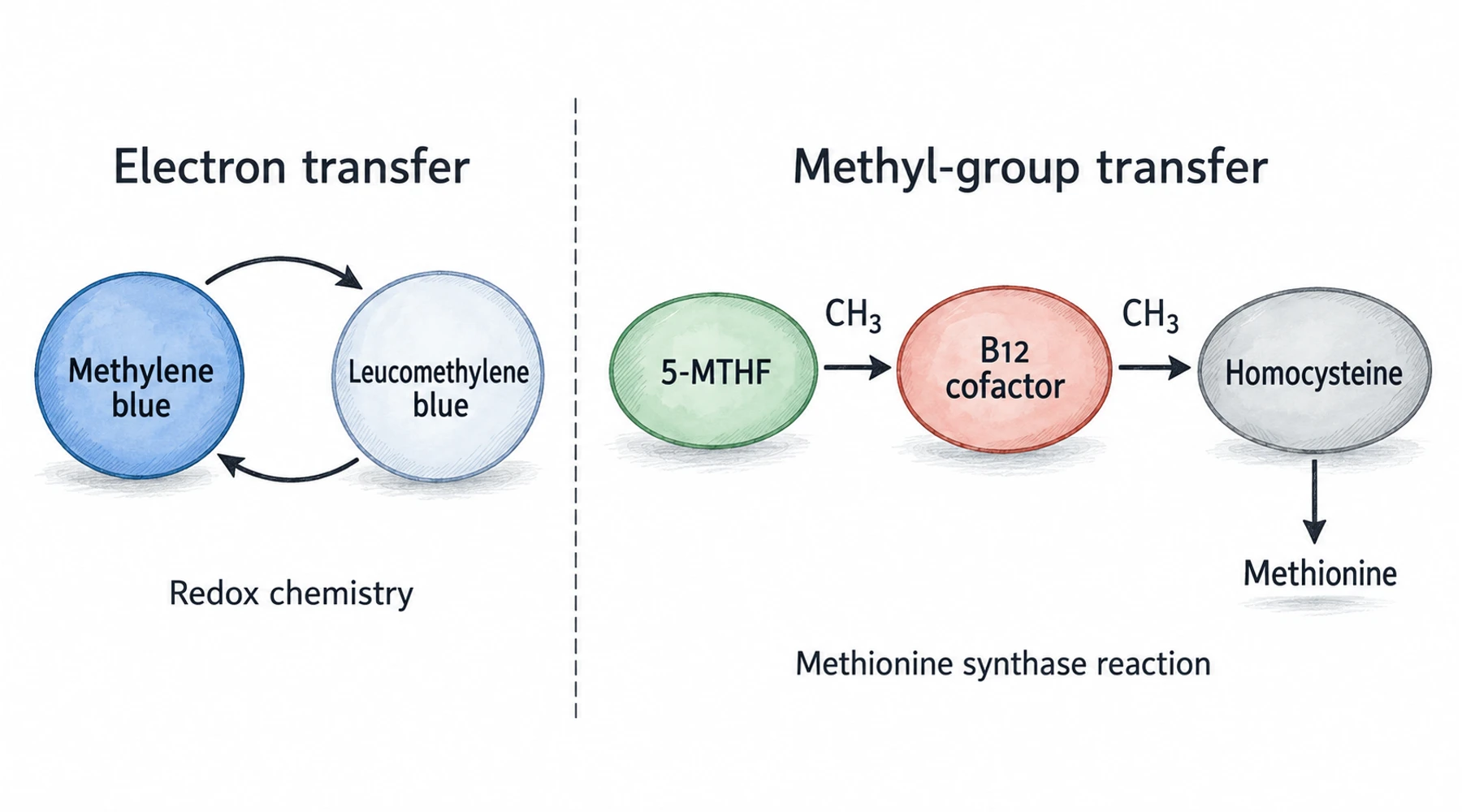
Methylene blue is not methylfolate or methyl-B12. Methylfolate is a form of vitamin B9; methyl-B12 is methylcobalamin, a form of vitamin B12. They participate in a shared biochemical reaction. Methylene blue is a synthetic dye and pharmacological agent with different chemistry. It is not a nutritional methyl donor or a replacement for either vitamin.
The similar names make an unsupported claim sound plausible: if something contains “methyl,” perhaps it improves “methylation.” A chemical name cannot establish that function. The relevant questions are what the molecule does in a particular reaction and whether that action has a demonstrated benefit for the person considering it.
Compare identity before comparing benefits
PubChem identifies methylene blue as methylthioninium chloride, a phenothiazinium dye. The NIH folate fact sheet identifies methylfolate as 5-methyltetrahydrofolate, usually abbreviated 5-MTHF. The NIH vitamin B12 fact sheet distinguishes methylcobalamin from other B12 forms. These identities explain the comparison below.
| Question | Methylene blue | Methylfolate | Methyl-B12 |
|---|---|---|---|
| What is it? | Methylthioninium chloride, a synthetic dye | 5-MTHF, a folate form | Methylcobalamin, a cobalt-containing B12 form |
| Is it a vitamin? | No | A form of vitamin B9 | A form of vitamin B12 |
| Relevant biochemical role | Can accept and transfer electrons through redox chemistry | Supplies a methyl group in the methionine synthase reaction | Enzyme-bound cofactor that participates in transferring that group to homocysteine |
| What distinction matters? | Pharmacological action differs from nutrient replacement | Folate chemistry differs from B12 chemistry | A cofactor is not the enzyme itself |
| What does its name fail to establish? | A role as a folate substitute or methylation treatment | That everyone needs this particular folate form | That this supplement form is best for every B12-related problem |
This is a comparison of functions, not a ranking. A product cannot replace a nutrient merely because both are described using words such as “energy” or “brain health.” For the broader identity and application context, see what methylene blue is.
What folate and B12 actually do together
One-carbon metabolism moves single-carbon units through connected reactions. The carbon unit is attached to a carrier molecule; it does not circulate as a free “methylation booster.”
The MTHFR enzyme converts 5,10-methylenetetrahydrofolate into 5-methyltetrahydrofolate. The similar-looking words here refer to two folate forms. Neither is methylene blue.
In the methionine synthase reaction, the methyl group from 5-MTHF passes through the enzyme’s B12 cofactor to homocysteine, producing methionine. Folate and B12 therefore have connected but distinct jobs: one supplies the group, and the other participates in its transfer. Methionine can subsequently be used to make S-adenosylmethionine, or SAM, which supplies methyl groups in many other reactions.
This sequence also explains why “more methyl groups” is an incomplete treatment rationale. A biochemical pathway includes substrates, enzymes, cofactors and regulation. Showing where a nutrient participates does not establish a deficiency, the cause of a symptom, or the benefit of adding more.
B12 has another active form, adenosylcobalamin, that supports a different enzyme reaction involving methylmalonyl-CoA. Calling methylcobalamin “active B12” does not mean it is the only useful B12 form. NIH’s comparison of supplemental B12 forms does not establish a generally superior form for everyone.
Why methylene blue is not a methylation substitute
The PROVAYBLUE prescribing information provides a concrete example of methylene blue’s redox action. In treating acquired methemoglobinemia, methylene blue is reduced to leucomethylene blue through an NADPH-dependent process. The reduced form helps convert hemoglobin iron from the ferric state to the ferrous state. This is electron-transfer chemistry, not delivery of a methyl group to homocysteine.
Methylene blue’s structure contains methyl groups. Their presence does not make those groups usable in the folate/B12 pathway. A claim that it is a “methyl donor” needs evidence of the actual transfer reaction; pointing to its name or structure is insufficient.
Likewise, an MTHFR result does not demonstrate that methylene blue bypasses an impaired reaction or improves an associated health outcome. The drug label establishes an indication for acquired methemoglobinemia, not treatment of common MTHFR variants. Broader human evidence for methylene blue benefits requires separate evaluation for each outcome.
What an MTHFR result does and does not tell you
MTHFR is a gene, and its product is an enzyme. Common variants such as C677T are different from rare variants that cause severe inherited disease. A consumer genetic report should not collapse these categories into the claim that someone’s “methylation is broken.”
The CDC’s explanation of common MTHFR variants states that people with these variants can process folic acid. A common variant alone is not a reason to avoid it. The CDC’s clinical overview also does not recommend changing folate intake solely on the basis of MTHFR genotype.
A genotype is not a nutrient measurement. Homocysteine is not a complete “methylation score,” either: low folate, low B12 and kidney function can influence it. Evaluation has to connect a specific result to the person’s nutritional status, symptoms and other findings. That evidence cannot be replaced by matching a gene name to a product name.
Glossary of commonly confused terms
| Term | Meaning | Common confusion to avoid |
|---|---|---|
| Methyl group | A carbon bonded to three hydrogens, written CH₃, attached within a molecule | Its presence does not automatically make a compound a biological donor |
| Methyl donor | A molecule that supplies a methyl group in a particular reaction | The role needs a reaction context |
| Methylation | Addition of a methyl group to a molecule | It is not one body-wide function with a universal “optimal” setting |
| Folate | The vitamin B9 family | Folic acid and 5-MTHF are distinct forms |
| MTHFR | Gene name and shorthand for methylenetetrahydrofolate reductase | It does not stand for methylene blue |
| Cofactor | A nonprotein component required for an enzyme’s activity | B12 assists an enzyme; it is not methionine synthase itself |
| Redox | Coupled oxidation and reduction, involving electrons | Electron transfer and methyl-group transfer are different processes |
| Methyl blue | A separately named dye | See the comparison of similarly named blue dyes before substituting laboratory reagents |
Why the distinction changes a health decision
Folate and B12 are not interchangeable even when the same blood finding appears in both deficiencies. NIH explains that large folate intakes can improve the anemia of B12 deficiency without treating its neurological damage. Treating a label such as “methylation problem” can therefore miss the actual condition.
Methylene blue adds a different set of concerns. Its prescription label includes a serious serotonin-syndrome interaction warning and a contraindication for G6PD deficiency because of hemolysis risk. Pairing it with vitamins does not remove those properties. Claims about neurotransmitter effects or combinations with NAD+ approaches need their own mechanistic and clinical evidence.
When evaluating a claim, identify the exact compound, the reaction being proposed, the condition being addressed and the human outcome measured. If the explanation moves directly from a similar name to a treatment recommendation, the necessary evidence is missing.