
Article
Methyl blue is not methylene blue: CAS numbers, structures, and uses
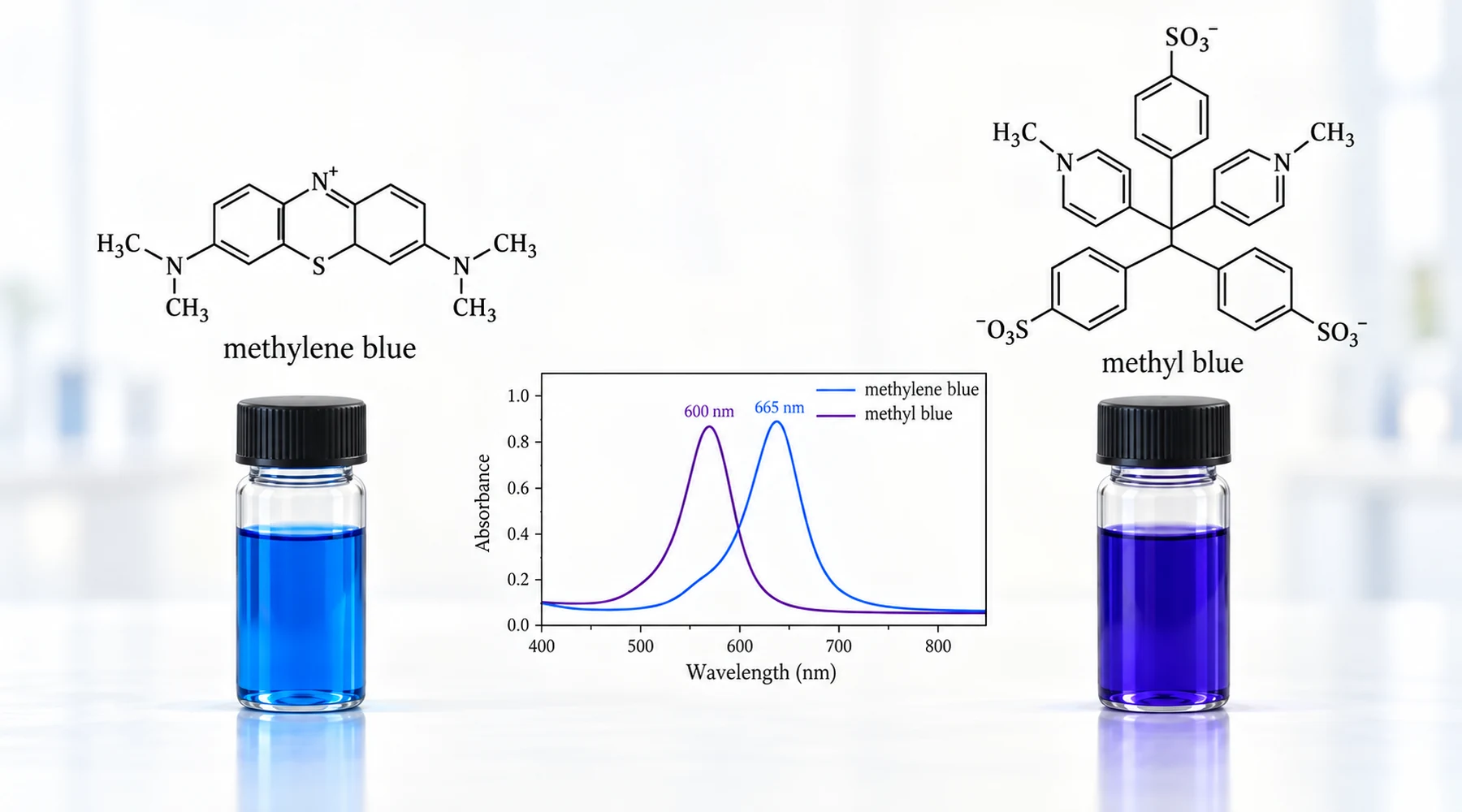
Two bottles sit on the bench. One says methyl blue. The other says methylene blue. A tired reader sees the same word twice. The chemistry sees two different molecules.
This is a naming failure with practical consequences. Order the wrong dye and the stain behaves differently, the redox indicator never appears, or the formulation contains a compound nobody validated. The fix is simple: treat the common name as a hint and the identifier as the decision. Check the CAS number, the Colour Index number, and the hydrate state before anything else.
The short answer
Methylene blue is a small cationic phenothiazine dye, C.I. 52015, built around a compact three-ring chromophore with two dimethylamino groups. Methyl blue is a large anionic triarylmethane dye, C.I. 42780, built from sulfonated triphenylmethane units. They share a color family and part of a name. They share almost nothing else.
Toluidine blue O sits closer to methylene blue. Both are cationic thiazine dyes, but toluidine blue O carries one amino group plus a ring methyl substituent where methylene blue carries its second dimethylamino group. That small change shifts its absorption peak and its staining selectivity, so the two are not interchangeable either.
Identity table: check these fields on every order
Catalog names drift. Vendors reuse synonyms loosely. The fields below do not drift, and a competent certificate of analysis lists them. PubChem records methylene blue as methylthioninium chloride, C.I. Basic Blue 9, which is the reference point for everything that follows.
| Dye | Common synonyms | CAS | C.I. | Formula and weight | Class |
|---|---|---|---|---|---|
| Methylene blue | Methylthioninium chloride, Basic Blue 9 | 61-73-4 anhydrous; 7220-79-3 trihydrate; 122965-43-9 hydrate unspecified | 52015 | C16H18ClN3S, 319.85 anhydrous; C16H24ClN3O3S, 373.90 trihydrate | Cationic phenothiazine (thiazine) dye |
| Methyl blue | Acid Blue 93, Cotton Blue, Water Blue, soluble aniline blue | 28983-56-4 | 42780 | C37H27N3Na2O9S3, 799.80 (commercial salt) | Anionic triarylmethane (triphenylmethane) acid dye |
| Toluidine blue O | Tolonium chloride, Basic Blue 17 | 92-31-9 | 52040 | C15H16ClN3S, 305.83 | Cationic phenothiazine (thiazine) dye, strongly metachromatic |
Two details in this table cause most of the purchasing errors. First, methylene blue has several CAS numbers for different hydrate states, and 122965-43-9 denotes an unspecified hydrate rather than the specific trihydrate (7220-79-3), as the USP monograph mapping records. Weighing from the wrong formula weight silently shifts every concentration calculated downstream. Second, one vendor synonym list for toluidine blue O includes the phrase Methylene Blue T50, which means a name-only catalog search can return the wrong dye entirely.
Structure explains behavior
Picture the two chromophores side by side and the confusion ends. Methylene blue centers on a phenothiazinium system: three fused rings with sulfur and nitrogen in the middle ring and a dimethylamino group at each end. The colored species is the methylthioninium cation with a chloride counterion. Small, flat, positively charged, and ready to associate with negatively charged cell components.
Methyl blue is roughly two and a half times the mass. Its color comes from a triphenylmethane core decorated with sulfonated anilino phenyl groups, supplied as a disodium salt. Those sulfonate groups make it an anionic acid dye with the opposite charge character and entirely different tissue affinities. Where methylene blue enters cells and participates in redox cycling, methyl blue serves as a collagen and connective-tissue stain and as the Cotton Blue in fungal preparations such as lactophenol cotton blue protocols. Substituting one for the other does not produce a weaker version of the same result. It produces a different experiment.
Toluidine blue O keeps the phenothiazinium skeleton, so its behavior rhymes with methylene blue without matching it. Its absorption maximum sits near 626 nm against methylene blue at about 660 to 665 nm, and its metachromatic staining of acidic tissue components (mast-cell granules, mucins, cartilage, nucleic-acid-rich structures) follows its own selectivity described in histology reviews. A laboratory that swaps TBO for methylene blue should expect shifted spectra and different contrast, not a bargain substitute.
What each dye is actually for
Methylene blue began as a textile dye, then moved into bacteriology, hematology, and microscopy, a trajectory summarized in its history literature. Its second career is chemical: the oxidized form is blue and the reduced leucomethylene blue is nearly colorless, which makes it a working redox indicator. Its third career is pharmaceutical. Methylthioninium chloride is the prescription agent PROVAYBLUE, indicated for acquired methemoglobinemia, and that medical role is what pulls purity requirements far above staining or textile grades. How methylene blue acts as a redox dye explains the mechanism behind these uses.
Methyl blue never made that journey. It remains a dye for paper, textiles, leather, and microscopy: a certified stain for collagen in Mallory-type connective-tissue procedures, a substitute for fast green in Gomori trichrome variants, and the fungal stain in mycology. Some methyl blue products carry a pH-indicator range around 9.4 to 14. None of that makes it a redox therapeutic, and no staining certificate converts it into one.
Toluidine blue O is principally a biological stain with metachromatic properties, used across histology and microbiology, and separately as a clinical vital stain that helps delineate suspicious oral lesions before biopsy. It is an adjunct for selecting biopsy sites, not a replacement for histopathology. Anyone comparing toluidine blue vs methylene blue for a diagnostic or formulation purpose should compare spectra, tissue targets, and grade documentation, not names.
Nearby names that trap buyers
Three more names deserve a place on the verification checklist. New Methylene Blue N is not methylene blue. It is C.I. 52030 (CAS 1934-16-3), an ethylated and ring-methylated phenothiazine used in histology and hematology, and new methylene blue staining methods belong to that separate literature. Azure B is closer: a singly N-demethylated analogue of methylene blue (CAS 531-55-5, C.I. 52010) that doubles as a major methylene blue metabolite and a documented impurity in methylene blue material, which is why the USP program pairs methylene blue reference material with an Azure B standard. The relationship between the two, and why impurity profiling matters, is covered in azure B as impurity and metabolite. Crystal violet, sometimes sold under the old name gentian violet, is a triarylmethane dye (CAS 548-62-9, C.I. 42555) with no thiazine ring at all.
Verify identity before money changes hands
A robust purchase specification names the exact chemical, the CAS number, the C.I. number, the hydrate state, and the grade, then confirms them against the certificate of analysis rather than the front label. The absorption maximum is a fast independent check: methylene blue near 665 nm, toluidine blue O near 626 nm, methyl blue near 595 to 605 nm under its specified acidic conditions. A peak in the wrong place means the wrong dye, whatever the bottle claims.
Grade documentation answers a different question from chemical identity. Biological Stain Commission certification tests a specific batch for dye content and staining performance, which matters when reproducibility of a stain is the goal. USP conformance addresses pharmaceutical identity, purity, organic impurities, residual solvents, elemental impurities, and microbial control, which matters when the material will be consumed. The two programs overlap in intent and differ in content, so one certificate cannot stand in for the other.
This is where buying quality becomes concrete. High purity matters because non-USP methylene blue is typically textile grade, with impurity loads such as Azure B, heavy metals, or residual solvents that no staining protocol screens for. Most sellers that claim USP conformance test only heavy metals and declare victory. Full conformance covers identity, assay, organic impurities, residual solvents, elemental impurities, residue on ignition, microbial limits, and bacterial endotoxins, and how to choose pharmaceutical-grade methylene blue walks through reading that documentation. Blupreme works with a pharmaceutical manufacturer of methylene blue, tests the full USP specification, and publishes the complete COA, which is the practical meaning of the identity discipline this article recommends.