
Article
Methylene blue and neurotransmitters: serotonin, dopamine, GABA, and acetylcholine
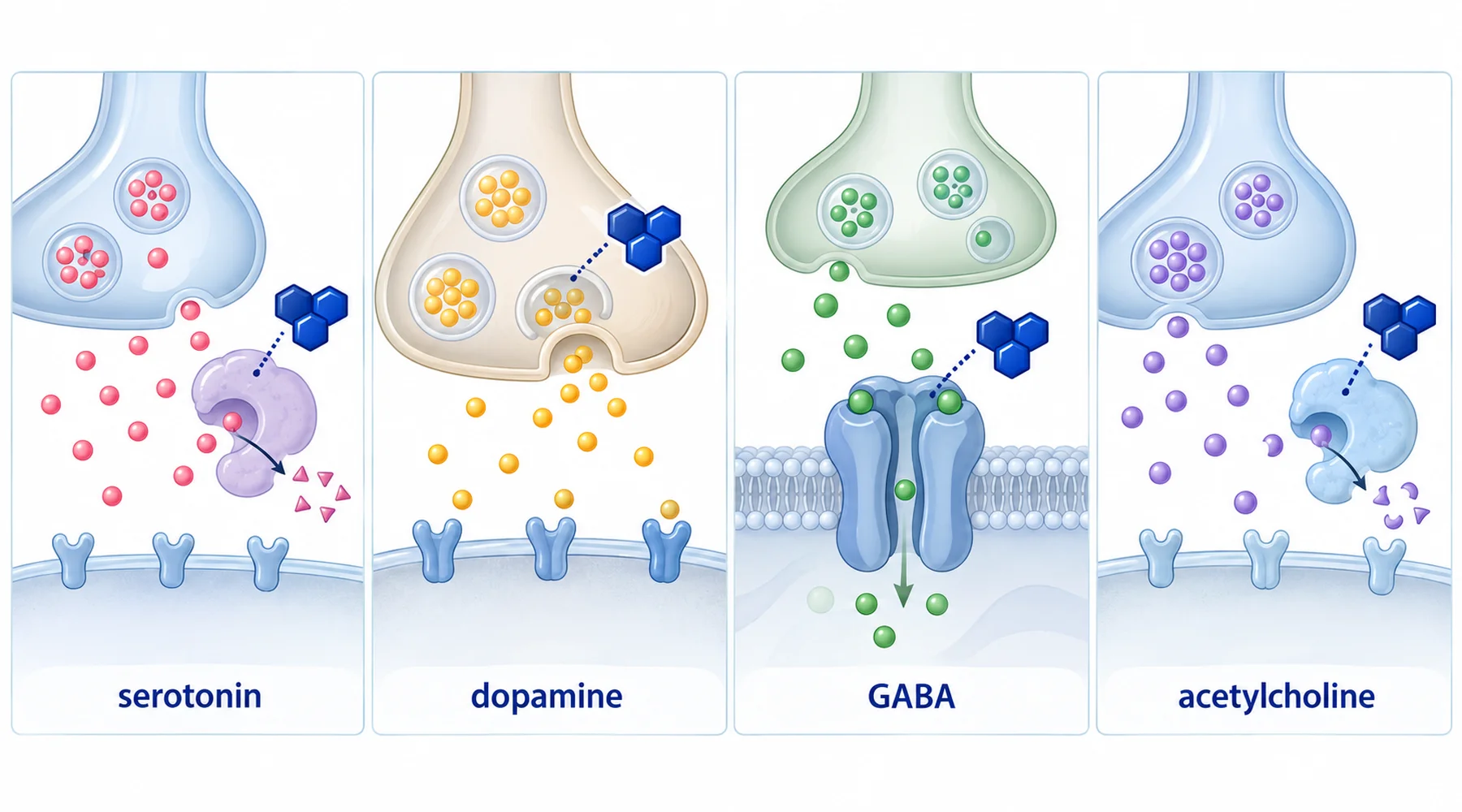
A common sentence about methylene blue says it raises serotonin, raises dopamine, calms GABA, and sharpens acetylcholine, all at once. That sentence treats four separate laboratory findings as one effect inside a person. The papers behind it measured different targets, in different preparations, at concentrations that differ by a factor of roughly a thousand. Once you separate the targets, the picture becomes both more interesting and more cautious than the single sentence allows.
The organizing idea is simple. A molecule that binds an enzyme in a test tube has done one thing: bound an enzyme in a test tube. Whether that changes the level of a neurotransmitter in a living brain depends on the concentration that reaches the tissue, on which chemical form the molecule is in when it arrives, and on everything else the molecule does at the same concentration. Each section below keeps those three questions attached to the finding it belongs to.
Serotonin: two targets, two concentrations
Serotonin has the strongest evidence of the four systems, and it comes from two distinct molecular targets that should not be merged.
The first target is monoamine oxidase type A, the mitochondrial enzyme that breaks serotonin down. Purified human MAO-A is inhibited by methylene blue as a tight-binding inhibitor with a Ki near 27 nanomolar, while MAO-B needs far higher concentrations before it is affected, as shown in the kinetic study that connected the dye to serotonin toxicity. A companion line of work found the same selectivity in rat pineal tissue, where MAO-A blockade raised serotonin-derived indoles, lowered the serotonin metabolite 5-HIAA, and altered a serotonin-linked righting reflex in frogs, reported in the study of redox dyes and pineal indoles. Two different preparations, same direction: less breakdown, more serotonin retained where the enzyme would have removed it.
The second target is the serotonin transporter itself. In cells expressing the human transporter, methylene blue reduced uptake of both a fluorescent substrate and labelled serotonin with an IC50 around 1.4 micromolar, and it suppressed serotonin-evoked currents in patch-clamp recordings, according to the direct characterization of methylene blue at SERT. The authors checked the obvious alternative explanations and found the effect independent of cGMP signalling, calcium changes, and transporter surface expression.
Note the gap between the two numbers. MAO-A inhibition is a nanomolar affair. Transporter inhibition needs roughly fifty times more dye. A low exposure that fully engages the enzyme may barely touch the transporter. Anyone combining these into a single claim about serotonin is averaging two different dose ranges into one.
Whether either target matters in a person taking other serotonergic drugs is a medication question, and it belongs to the drug interaction guide. This article maps the targets; that page carries the clinical advice.
Dopamine: the weakest direct case
Dopamine is where honesty requires the most restraint. There is no well established study showing methylene blue blocking the dopamine transporter or binding dopamine receptors directly. The frequently quoted transporter IC50 of 1.4 micromolar belongs to the serotonin transporter, not DAT, and it should never be relabelled.
What exists instead is indirect. Because MAO enzymes also metabolize dopamine, MAO inhibition preserves dopamine alongside serotonin and noradrenaline. In mitochondrial preparations, methylene blue blocked the MAO-B mediated conversion of the neurotoxin MPTP into its dopaminergic poison with potency comparable to the Parkinson drug deprenyl, as the MPTP bioactivation study and related MAO-B work describe. Animal work adds fragments: about a threefold rise in basal dopamine release from rat striatal slices at 10 micromolar, studied in a nitric oxide signalling context rather than as transporter blockade, and mixed regional results after systemic dosing, with some studies finding serotonin and noradrenaline rising while dopamine barely moved.
So the dopamine story is real but secondhand. It runs through an enzyme that handles several monoamines at once, not through a dopamine-specific handle. Any claim that methylene blue raises dopamine in people skips the step where that was actually shown.
GABA: blocking the brake at the binding pocket
The GABA finding is precise and runs against the grain of the dye's reputation. In cells expressing human GABA-A receptors, methylene blue inhibited GABA-evoked currents starting around 3 micromolar, with an IC50 near 31 micromolar for the common alpha1-beta2-gamma2 configuration, in the electrophysiology study that mapped the site of action.
The site mapping is the valuable part. Mutations at the picrotoxin site left the inhibition intact, and the benzodiazepine and zinc sites were ruled out by subunit comparisons. Instead, mutations at two residues known to form the GABA binding pocket itself sharply reduced the block, which marks the action as competitive antagonism at the agonist site rather than allosteric modulation elsewhere. The effect held across synaptic and extrasynaptic subunit combinations and washed out rapidly.
This creates a genuine tension worth stating plainly. A molecule investigated for memory support also suppresses fast inhibitory transmission in a dish. Whether that suppression occurs in a living brain depends on local concentration, and 31 micromolar is high relative to most systemic exposures, which the final section takes up. The tension itself is the finding; resolving it would need experiments nobody has run.
Acetylcholine: two opposing handles
Acetylcholine gets two findings that pull in opposite directions, which is exactly why they must be reported separately.
On one side, methylene blue inhibits the enzymes that clear acetylcholine. Cow red cell acetylcholinesterase was competitively inhibited around 0.57 micromolar, bovine enzyme near 0.42 micromolar, and human plasma esterase activity near 1.1 micromolar, with butyrylcholinesterase inhibited across roughly 0.4 to 5.3 micromolar depending on species and preparation, summarized in the review of methylene blue actions in the nervous system. Slowing clearance leaves more transmitter in the synapse, the same logic behind several approved Alzheimer drugs.
But the chemistry has a condition attached. The oxidized blue form inhibits the enzyme; the reduced colourless form does not, and long incubations that let the dye reduce themselves report weaker inhibition for that reason alone. Any assay number for cholinesterase comes with an invisible variable: how much of the dye was still blue when measured.
On the other side, methylene blue blocks the alpha7 nicotinic receptor, one of the receivers acetylcholine acts on. Human alpha7 receptors expressed in frog oocytes were inhibited with an IC50 near 3.4 micromolar through noncompetitive, voltage-independent antagonism that left agonist potency unchanged, and 3 micromolar abolished choline-driven synaptic responses in rat hippocampal slices, as the alpha7 receptor study reports. So at similar low-micromolar concentrations, the dye both preserves the transmitter and dulls one of its receptors. The net effect on cholinergic signalling cannot be read off either finding alone. That ambiguity connects to the broader Alzheimer literature, and to the related discussion of cognitive and disease research, without resolving itself here.
The comparison, in one place
| Target | Preparation | Concentration | Measured effect |
|---|---|---|---|
| MAO-A | Purified human enzyme | Ki ~27 nM | Tight-binding inhibition; serotonin breakdown blocked |
| SERT | Human transporter in cultured cells | IC50 ~1.4 uM | Serotonin uptake and evoked currents reduced |
| MAO-B / MPTP activation | Human mitochondria | Low micromolar | Toxin bioactivation blocked; dopamine wire indirectly protected |
| GABA-A receptor | Human subunits in HEK293 cells | IC50 ~31 uM, visible from ~3 uM | Competitive block at the GABA pocket |
| Acetylcholinesterase | Bovine / human plasma enzyme | IC50 ~0.4 to 1.1 uM | Clearance slowed; oxidized form only |
| Alpha7 nicotinic receptor | Human subunit in oocytes; rat slices | IC50 ~3.4 uM | Noncompetitive antagonism; slice responses abolished at 3 uM |
Three orders of magnitude separate the most sensitive target from the least. That spread is the article in one table.
Do these concentrations reach the brain?
A test tube number means nothing without an exposure number beside it. After an intravenous bolus near 1.4 mg per kg, mean human plasma levels around 5 micromolar have been reported, while a 100 mg oral dose produced whole blood levels near 0.08 micromolar in the same literature tradition. Rat distribution work finds brain levels roughly ten to twenty times circulating levels, though that is total dye in homogenized tissue, not free oxidized dye at a synapse, and plasma protein binding near 94 percent plus blood cell partitioning push the free fraction lower.
Read against the table, the pattern is graded rather than binary. MAO-A inhibition sits far below typical intravenous exposures and is pharmacologically plausible whenever the dye is given that way. Cholinesterase and alpha7 effects sit in the low micromolar band that intravenous peaks overlap but ordinary oral doses may not reach. The GABA-A IC50 of 31 micromolar sits above most plausible systemic exposures, which makes that particular block the hardest to invoke in a whole person. Every row of this comparison needs the same caveat: the relevant concentration is free, oxidized, extracellular dye at the target, a quantity no blood draw measures directly.
What not to conclude
No row in the table establishes that methylene blue predictably raises or lowers any neurotransmitter in a person. Enzyme inhibition in a purified preparation, transporter block in a cell line, and receptor antagonism in a slice are each one controlled step removed from synaptic reality, and the cholinergic section shows two true findings cancelling into uncertainty. The responsible use of this page is as a map of handles the molecule has been shown to grip, with the grip strength labelled, so that discussion of mechanisms stays anchored to what was actually measured. For how these handles interact with prescribed medication, the interaction guide is the page that carries that weight, alongside further context in the pharmacology foundations and the companion mechanism explainer.