
Article
Methylene blue and herpesvirus claims: cold sores, EBV, and viral inactivation
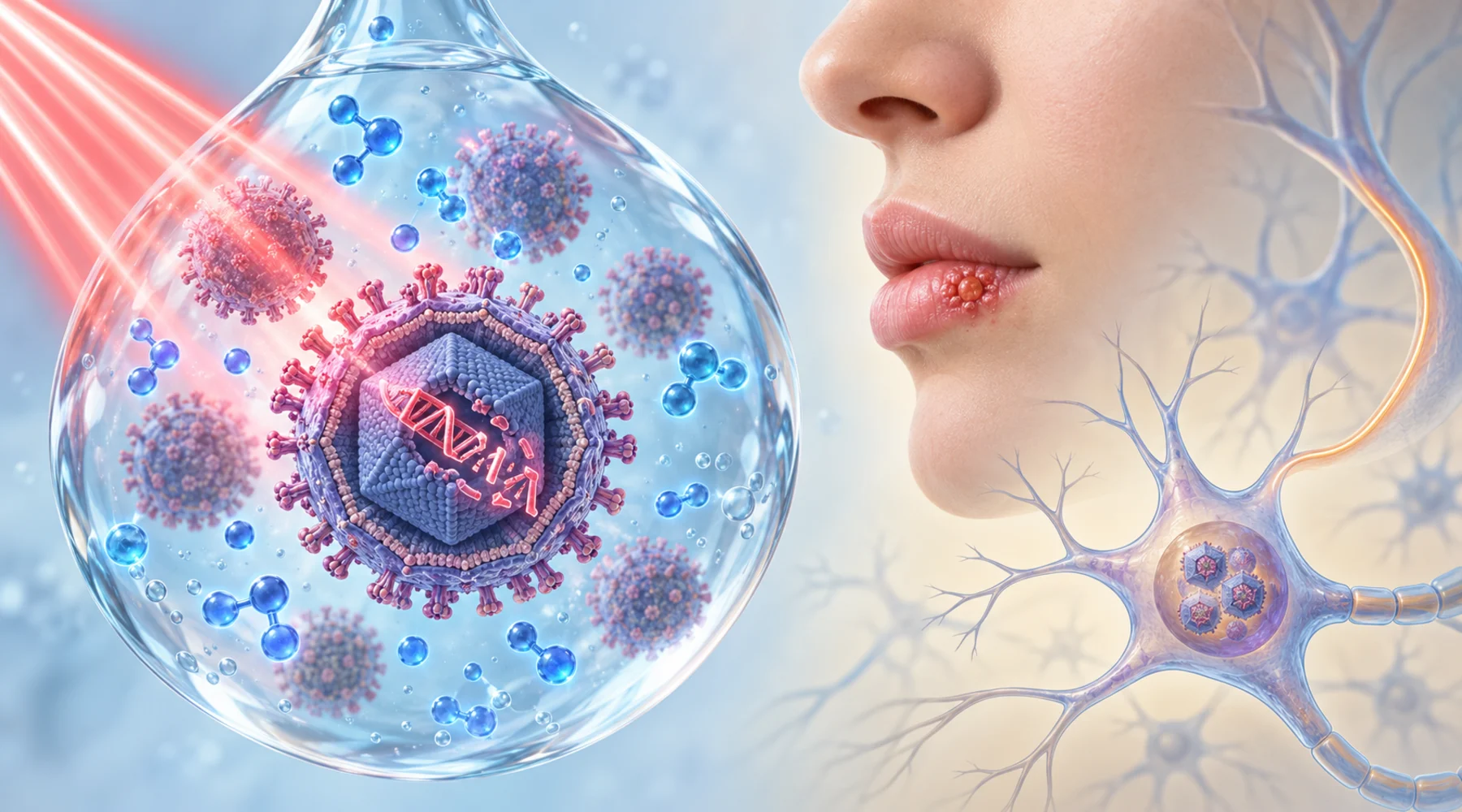
One word carries two concepts in this debate, and they need separate names. Concept one is virion inactivation: dye, oxygen, and light meet a virus particle in fluid and damage it so it cannot replicate. Concept two is treatment of infection in a person: fewer cold sores, faster healing, less shedding, or lower Epstein-Barr load. The first has been shown repeatedly for herpes simplex virus in the laboratory. The second has not been shown for oral methylene blue against either herpes simplex or Epstein-Barr virus. Once that distinction is in place, the literature is easy to sort.
A second confusion runs alongside it. HSV and EBV belong to the same large virus family but cause different diseases in different tissues. A cold sore is a superficial lesion with local lytic replication: dye can be painted on it and light can shine on the same spot. EBV persists latently in B cell reservoirs spread through blood and lymphoid tissue, where no topical dye and no red lamp can reach the whole reservoir. A result in one setting does not transfer to the other. Readers who want the general method behind this sorting will find it in the guide to reading methylene blue research.
Laboratory photoinactivation: extracellular HSV, light required
The oldest direct test used fresh clinical isolates rather than one lab strain. In the 1975 photodynamic inactivation study of herpesvirus hominis, 37 isolates from genital and oral lesions were mixed with methylene blue at 10 micromolar, held one hour in darkness, then split into dark and light halves exposed for five minutes to two 15 watt fluorescent tubes at 15 cm. Of 37 isolates, 27 lost detectable infectivity only in light and 4 fell by greater than 100 fold. Dark controls kept infectivity: without light, this concentration did not sterilize the sample.
A later study showed how modest plain dye plus light can be under some conditions. In the 1979 methylene blue, light, and electricity experiments on HSV-1 and HSV-2, 10 micromolar dye with incandescent light for 180 seconds cut infectious HSV-1 by about 60 percent, roughly 0.4 log. Only an added small direct current pushed the same system past 99.99 percent loss. Light alone, current alone, and light plus current without dye did little. The large effect required the electrical apparatus, so the paper should not be quoted as proof that ordinary dye plus lamp routinely gives four log killing.
Mechanistic work then asked what treated particles could still do. A 1980 Journal of Clinical Investigation study of photodynamic HSV mechanisms found single strand breaks in viral DNA without predominant double strand breaks: treated virions still attached and entered cells, yet maturation stalled. A 1997 infection cycle study after methylene blue and light confirmed this with 1 micromolar dye and red light: no gross envelope destruction, entry and DNA release intact, but replication abolished with illumination dependent DNA degradation. A 1995 singlet oxygen comparison implicated singlet oxygen with likely added radical chemistry. Details on how methylene blue absorbs light and generates reactive oxygen explain why dye, oxygen, and photons must coincide at the target.
The clearest quantitative demonstration comes from blood product work, which is also the clearest warning against overreading. In a 2013 plasma pathogen reduction study with red LEDs at 627 nm, HSV spiked into plasma fell by about 5.2 log at 1 micromolar and 6.0 log at 10 micromolar after 60 minutes. That is decontamination of an illuminated fluid, not treatment of latency in neurons, and it does not predict what a swallowed solution does inside the dark body.
Local treatment of lesions: small, old, and mixed
Local reports paint dye on the lesion and illuminate it, which at least preserves the laboratory geometry. The earliest is a case report of eczema herpeticum, a widespread HSV superinfection of eczema. The 1975 eczema herpeticum report on methylene blue and light described rapid improvement after local dye plus light, with 10 micromolar dye viricidal in light but not in darkness. Commentary specified 0.1 percent solution on half the area as a within patient comparison. As cold sore evidence it is a single patient era observation with poor dosimetry.
The larger historical series concerned genital lesions. In the 1975 genital herpes series of 56 patients, 36 received methylene blue, but only the first 35 were randomized among three dyes, so the cohort was not a clean trial. About 70 percent of treated recurrent cases were reported improved within roughly 48 hours, yet relapse frequency was not substantially reduced. Home illumination with fluorescent light or sunlight was uncontrolled. Acute improvement without fewer recurrences fits a local procedure that affects a present lesion but not the latent reservoir. The same caution belongs with photodynamic therapy protocols using methylene blue.
Modern cold sore trials are small and do not converge. A 2009 series of four herpes labialis patients used 0.01 percent dye with a 660 nm laser at 120 J per square cm and reported rapid healing, but there was no control and photobiomodulation followed, as described in the 2009 herpes labialis photodynamic case series. A 75 patient randomization to photodynamics, topical acyclovir, or both found no healing time or pain difference, per the 2021 photodynamic therapy and acyclovir trial. A 24 patient randomized trial with HSV-1 qPCR found no difference in resolution or one year recurrence, described in the 2025 randomized trial of antimicrobial photodynamic therapy for herpes simplex. A 60 patient 2025 trial of a bundle, dye photodynamics plus photobiomodulation plus vesicle drainage, reported faster pain relief that cannot be assigned to the dye, per the 2025 combined photodynamic and photobiomodulation report.
Adverse reporting here is thin. The 1975 papers lack modern ascertainment. Later small studies reported few or no acute effects, but blue staining is inherent and local phototoxic irritation remains possible. Staining plus a lamp differs from swallowing the dye, which is why the methylene blue safety record treats routes separately.
EBV: no direct methylene blue evidence
For EBV the search returns an absence. No peer reviewed experiment or controlled trial located for this review shows methylene blue, with or without light, reducing EBV infectivity, suppressing reactivation, or lowering viral load in people. Work on EBV positive nasopharyngeal carcinoma cells uses other sensitizers and measures tumor viability, not methylene blue clearance of virus. Reviews list EBV among viruses needing future trials, not established indications.
Biology explains why the HSV tube result cannot be borrowed. Cold sore treatment places all three requirements, dye, oxygen, and photons, on one accessible surface. EBV latency lives largely in B cells spread through blood and lymphoid tissue. Topical red light cannot expose that distributed reservoir, and a swallowed dye provides no targeted light at those sites. Killing an EBV positive tumor cell with a different sensitizer is cell killing, not proof of antiviral activity. That gap matters when reading how viral load and reactivation markers are actually measured.
Oral treatment and the recurrence free interval fallacy
No controlled human trial located for this review shows systemic or oral methylene blue reducing cold sore recurrence, shortening healing, lowering shedding, or changing any EBV endpoint such as blood or saliva DNA copies or defined lytic markers. The human herpes literature uses topical dye with local light. Systemic dosing without targeted illumination is a different intervention and needs its own trial: randomized, blinded, and placebo controlled, with confirmed recurrent cases, a run in for baseline rate, prespecified exposure checks, six to twelve months of follow up, serial swabs with qPCR, recorded triggers, and safety monitoring. General principles for oral dosing and absorption of methylene blue do not substitute for those endpoints.
This is where a common story fails. Someone starts several interventions at once, reports no cold sores for months, and credits one of them. HSV episodes cluster and then vanish for months with no eradication of virus from sensory ganglia. Triggers shift, expectancy alters reporting, and chance alone produces gaps. With several simultaneous changes there is no counterfactual assigning the gap to one component. The 1975 genital series showed the reverse pattern: acute improvement alongside unimproved relapse frequency. Healing this outbreak is not the same concept as preventing the next one.
Virus by setting evidence table
| Virus and setting | Intervention | Key result | What it cannot show |
|---|---|---|---|
| HSV isolates, cell free, 1975, n=37 | 10 micromolar dye, fluorescent lamp 5 min | 27 fully inactivated in light, 4 reduced over 100 fold, dark controls unaffected | Clinical healing, latency clearance, dosing for people |
| HSV-1 and HSV-2 virions, 1979 | 10 micromolar dye, incandescent light 180 s, with and without electric current | Dye plus light alone about 60 percent reduction; over 99.99 percent only with added current | That ordinary dye plus lamp gives the maximal kill |
| HSV genome mechanism, 1980 and 1997 | Low micromolar dye plus light | Entry retained, single strand DNA damage, replication blocked, degradation with illumination time | Direct killing of already infected cells |
| HSV in human plasma, 2013 | 1 and 10 micromolar dye, 627 nm LEDs, 60 min | About 5.2 and 6.0 log reduction | Oral treatment or neuronal latency effect |
| Eczema herpeticum, 1975, case report | Topical 0.1 percent to half the area plus light | Rapid clinical and virological improvement reported | General cold sore efficacy; illumination dose not recoverable |
| Genital herpes, 1975, 56 patients | Topical 0.1 percent, fluorescent light or sunlight at home | About 70 percent acute improvement; relapses not substantially reduced | Prevention of recurrence |
| Herpes labialis, 2009, n=4 | 0.01 percent, 660 nm, 120 J per square cm, then photobiomodulation | Rapid healing reported | Causal effect of the dye; recurrences uninterpreted |
| Recurrent labialis, 2021, n=75 | 0.005 percent photodynamics vs acyclovir vs both | No healing time or pain difference | Antiviral virion killing |
| Oral herpes simplex, 2025, n=24 | Antimicrobial photodynamics vs acyclovir, with qPCR | No difference in resolution or one year recurrence | Systemic or EBV benefit |
| Recurrent labialis, 2025, n=60 | Combined photodynamics, photobiomodulation, drainage | Faster pain relief in combined arm | Effect of methylene blue alone |
| EBV, any human setting | Any methylene blue route | No direct study located; no demonstrated load or reactivation effect | Borrowed HSV photoinactivation as EBV evidence |
| Systemic or oral use for HSV or EBV | Oral or systemic dye without targeted light | No controlled antiviral trial located | Clinical or virologic benefit |
How to use this evidence
Ask four questions of each citation. Light or dark, because photodynamic killing does not predict systemic killing. Free virions, present lesion, or latent reservoir, because only the matching target answers the claim. Infectivity, healing, recurrence, or viral load, because an infectivity number cannot answer a recurrence question. HSV or EBV, because the accessible lesion and the distributed B cell reservoir are different problems. The record supports one narrow statement: methylene blue can potently photoinactivate HSV when extracellular virus meets dye, oxygen, and appropriate light. Evidence for clinically important treatment of recurrent lesions is limited and mixed, evidence for oral prevention is absent, and direct evidence for an anti EBV effect is absent. A quiet interval without cold sores during a multi treatment regimen changes none of that.