
Article
Methylene blue for depression and anxiety: trials, limits, and interaction risk
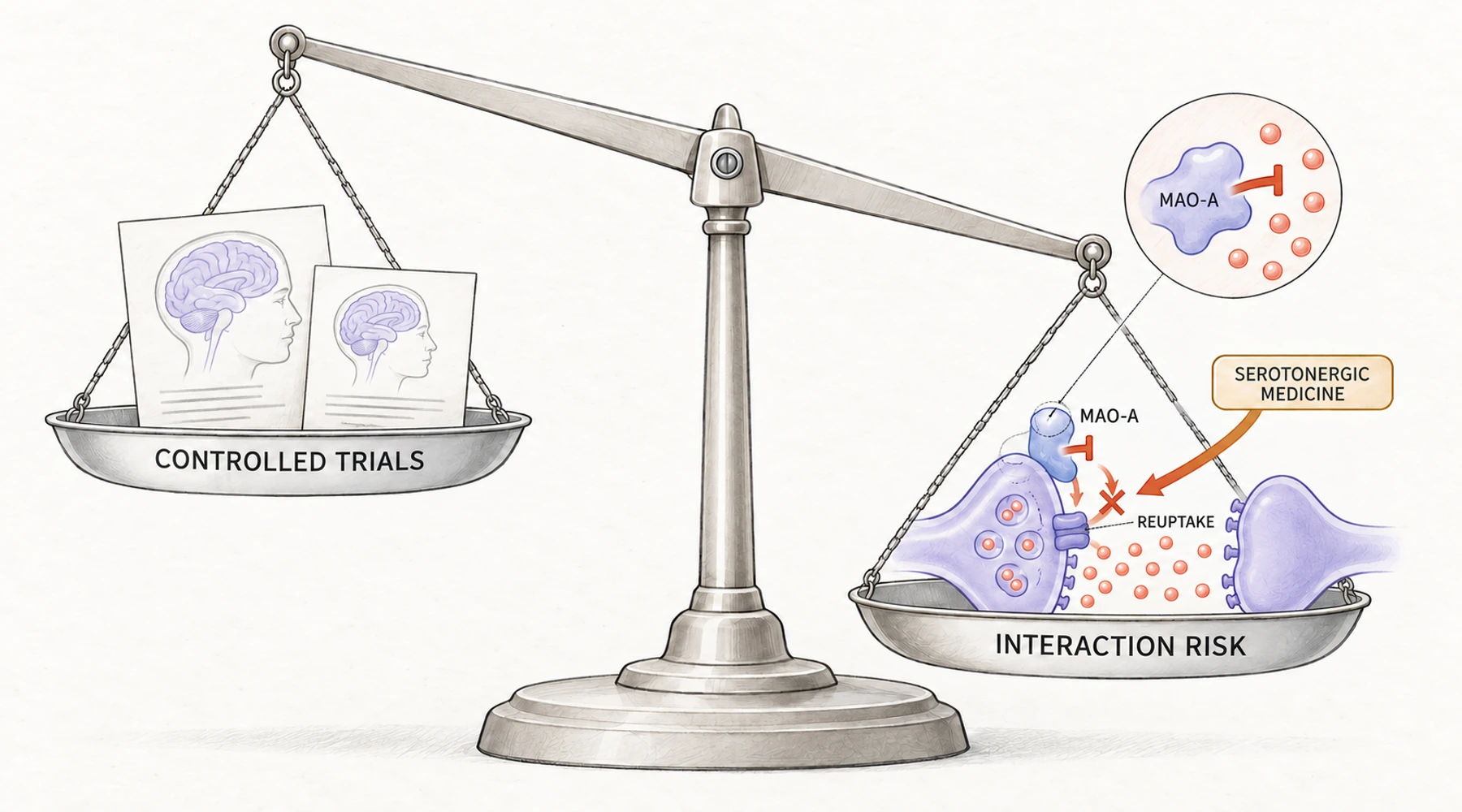
Methylene blue has been given to psychiatric patients since the 1890s, tested in controlled trials since the 1980s, and studied in animal models that produce unusually clean dose-response curves. A reader searching for "methylene blue depression" finds all three kinds of evidence mixed together, without the labels that separate them.
The separation matters. The entire controlled human evidence for mood is two trials and one laboratory exposure experiment, and both registered trials closed more than a decade ago. This article covers what each one found. It does not recommend methylene blue as a treatment for a mood disorder.
Why a dye ended up in the mood literature
Methylene blue was the first fully synthetic compound used as a medicine. Monoamine oxidase A, abbreviated MAO-A, breaks down serotonin, and medicines that block it are established antidepressants. Ramsay, Dunford, and Gillman measured the effect on purified human MAO-A and reported an inhibition constant near 27 nanomolar, with reversible inhibition. MAO-B needed more than fifty times the concentration. The same molecule also inhibits nitric oxide synthase and guanylate cyclase, which is why the 2017 review by Delport and colleagues treats the antidepressant action as multi-target rather than the product of one receptor.
That explains why the animal literature is both promising and strange. In rats, methylene blue produces antidepressant-like behavior in the forced swim test only inside a band of doses: Eroglu and Caglayan found effects between 15 and 30 mg/kg and none at 60 mg/kg, with the same inverted U for anxiolytic behavior. Microinjection into the dorsal periaqueductal gray worked at 30 nanomoles and not outside that range. This is hormesis, and a curve shaped like that cannot be extrapolated upward.
The 1980s trials and the placebo dose that may not have been one
Naylor and colleagues ran a two-year double-blind crossover in 31 patients with bipolar disorder, comparing 300 mg per day with 15 mg per day while lithium continued. Seventeen completed, and depression was significantly less severe on the higher dose.
The design contains a problem worth understanding, because it recurs. Fifteen milligrams per day was chosen as the "placebo" arm on the assumption that it was inactive. The authors then recorded their "doubts about blindness, and uncertainty as to whether or not 15 mg methylene blue per day could be considered a placebo." Methylene blue colors urine blue-green, so every patient in the crossover was taking a visibly active dye during both periods. If the low dose was not inert, the trial compared two active doses.
A shorter trial tested 15 mg per day against an actual placebo in severe depressive illness over three weeks, in 35 patients, and found significantly greater improvement on methylene blue. Three weeks and thirty-five patients is a real signal, and a small one.
The bipolar crossover trial: the strongest human evidence
The most informative trial is the 2017 study by Alda and colleagues, registered as NCT00214877. Thirty-seven participants with bipolar I or II disorder, all taking lamotrigine as their main mood stabilizer, most with mild or moderate residual symptoms. The design was double-blind crossover, 15 mg per day for three months against 195 mg per day for three months in random order. The authors give their reason for the low-dose comparator plainly: "We chose this design because methylene blue discolours urine, and thus we could not use a traditional placebo."
In the completers analysis of 27 patients:
- Depression improved more on the higher dose, with an effect size of 0.71 on the Hamilton Depression Rating Scale (95% CI 0.15 to 1.25, P = 0.034) and 0.80 on the Montgomery-Asberg Depression Rating Scale (95% CI 0.27 to 1.30, P = 0.020).
- Anxiety improved more on the higher dose, with an effect size of 0.79 on the Hamilton Anxiety Rating Scale (95% CI 0.22 to 1.33, P = 0.028). Psychic anxiety items carried the effect; somatic anxiety reached significance only in the intent-to-treat analysis.
- Manic symptoms stayed low and stable, with no switch toward hypomania or mania.
- Cognition did not change on any of the six tasks, including verbal learning, executive function, and recollection memory.
Ten of the 37 dropped out, one because of blue urine, one because anxiety increased, and one after clinical worsening. Side effects were transient and mild, mostly urinary tract burning, diarrhea, nausea, and headache. Between 20 and 27 participants were taking an antidepressant or an antipsychotic throughout, and the trial reported no serotonergic toxicity.
The population was not a severely depressed one. Baseline scores were 12.7 on the Montgomery-Asberg scale, which runs to 60, and 7.6 on the 17-item Hamilton scale: residual symptoms in stabilized patients, not major depressive disorder. An independent 2021 systematic review of anxiety treatment in remitted bipolar disorder counts the trial as one of only two pharmacological studies with a positive anxiety result out of ten randomized trials examined, and notes that high dropout and noticeable side effects may have compromised blinding.
The one controlled human anxiety experiment
The first controlled human experiment on methylene blue and anxiety was not a treatment trial but a memory-consolidation experiment. Telch and colleagues recruited adults with marked claustrophobic fear, each of whom completed six five-minute exposure trials in an enclosed chamber. Immediately afterward, and only afterward, they received 260 mg of methylene blue or a placebo, double-blind. Retesting a month later in a different chamber measured whether fear returned.
The result split the group. Participants who ended their exposure session with little fear retained that gain substantially better on methylene blue, while those who ended still frightened did worse than on placebo. The drug appears to amplify whatever learning happened, so a session that consolidated fear produced more fear. Contextual memory improved regardless, which confirms that the drug reached the brain. The same dose in the same protocol produced opposite outcomes depending on one variable, which is the subject of why the quality of an exposure session decides this result.
The PTSD trial and an independent verdict
The larger follow-up was Zoellner and colleagues' randomized trial in chronic PTSD, registered as NCT01188694. Forty-two patients received five daily imaginal exposure sessions followed by 260 mg of methylene blue, the same schedule followed by placebo, or a waitlist that later received standard prolonged exposure.
On the primary outcome, the independent-evaluator-rated PTSD Symptom Scale, methylene blue did not separate from placebo. The posted registry results show post-treatment scores of 17.10 on methylene blue against 14.67 on placebo, both improved from about 32 at baseline. The difference favored placebo.
Two secondary findings went the other way. More patients on methylene blue were rated treatment responders, with a number needed to treat of 7.5, and quality of life improved with an effect size of 0.58. Benefit depended on working memory capacity rather than on changes in trauma-related beliefs.
A 2023 systematic review of pharmacological memory modulation in trauma-focused psychotherapy then grouped methylene blue with the agents that showed no significant effect on PTSD symptom reduction. That is the current independent reading: not disproven, not established, and not strong enough for use outside a research protocol.
What separates the populations
Read the last column against the second, not against the abstract.
| Question | Who was studied | Dose and medication context | What changed |
|---|---|---|---|
| Does an adjunct help residual bipolar symptoms? | 37 adults with bipolar I or II disorder, mostly mildly symptomatic | 195 mg/day vs 15 mg/day, three months each, crossover, lamotrigine continued | Depression and anxiety scores improved on the higher dose; mania and cognition unchanged |
| Does a low dose help severe depression? | 35 patients with severe depressive illness | 15 mg/day vs placebo, three weeks | Greater improvement than placebo in a small, short, single-comparator trial |
| Does it strengthen fear extinction in anxious people? | 42 adults with claustrophobic fear in a laboratory exposure protocol | 260 mg as a single dose after six brief exposure trials | Better one-month fear retention after a low-fear session, worse after a high-fear session |
| Does it improve PTSD treatment? | 42 patients with chronic PTSD receiving imaginal exposure | 260 mg after each of five daily sessions | No difference on the primary severity measure; more treatment responders |
None of these trials tested methylene blue as a standalone treatment for major depressive disorder, and ClinicalTrials.gov lists no newer interventional study in a depressive or anxiety disorder than the two above, which were registered in 2003 and 2009. Anyone describing methylene blue as a proven antidepressant is describing a hypothesis with a plausible mechanism and one small positive trial behind it. No trial has reported a manic switch.
The interaction risk is the reason to be careful
Methylene blue inhibits MAO-A. That is what makes it interesting for mood, and it is also what makes it dangerous next to other serotonergic medicines, including most antidepressants. An MAO inhibitor added to a reuptake inhibitor raises serotonergic activity through two distinct routes, and the combination can cause serotonin toxicity, which is occasionally fatal.
The intravenous product carries a boxed warning about this. The FDA warned about the interaction in 2011 and later narrowed its emphasis toward intravenous administration and particular antidepressants. Methylene blue is also an ingredient in some urinary analgesic products, which is how at least one oral case arose in a patient taking several serotonergic medicines. The drug interaction guide breaks the risk down by drug class and route.
Neither mood trial contradicts the concern, but neither settles it. Both ran in patients mostly taking additional psychiatric medication and neither reported serotonergic toxicity, which is reassuring inside small, monitored trials with exclusions rather than a safety margin for self-directed combination. Serotonin toxicity presents as agitation or confusion, fever or heavy sweating, fast heart rate, tremor, muscle stiffness, and involuntary jerking, and it is not a condition to assess at home.
What the grade of the product has to do with it
Two bottles with the same label can differ in what else is present. Conformance to the USP monograph is what a buyer can check, and product that does not conform is likely textile-grade material, which can carry organic impurities such as Azure B and Azure C, residual solvents, and heavy metals at levels that a pharmaceutical specification limits.
Most sellers using the phrase "third-party tested" test for heavy metals and nothing else, then present that single panel as though it satisfied the full specification. Blupreme tests the complete USP specification: identity, purity, organic impurities, residual solvents, elemental impurities, residue on ignition, microbial limits, and bacterial endotoxins, and publishes the certificate of analysis per lot. Reading one correctly means checking the lot number, laboratory, methods, and limits rather than looking for a pass mark.
The honest bottom line
The bipolar trial is the strongest human evidence, and it shows a moderate adjunctive effect on residual symptoms in a stabilized, mildly symptomatic population. The severe-depression trial is three weeks long and thirty-five patients. The claustrophobia experiment shows a real effect on memory consolidation that can work in either direction. The PTSD trial did not replicate on its primary outcome. Nothing has been tested since.
That is what a promising mechanism looks like before it becomes a treatment, and it is also what it looks like when a compound is sold on the strength of its mechanism instead of its results. If you take a prescribed antidepressant, an MAO inhibitor, an opioid, or any other serotonergic medicine, that list belongs at the start of the conversation, ahead of any question about dose. The full research library indexes the trials and experimental studies behind these claims. Start with the side effects and contraindications overview and the review of what human research supports, and read the evidence in bipolar disorder specifically if that is your diagnosis. Do not stop a prescribed medicine to make room for an experimental one.