
Article
Is methylene blue natural, organic, or found in food?
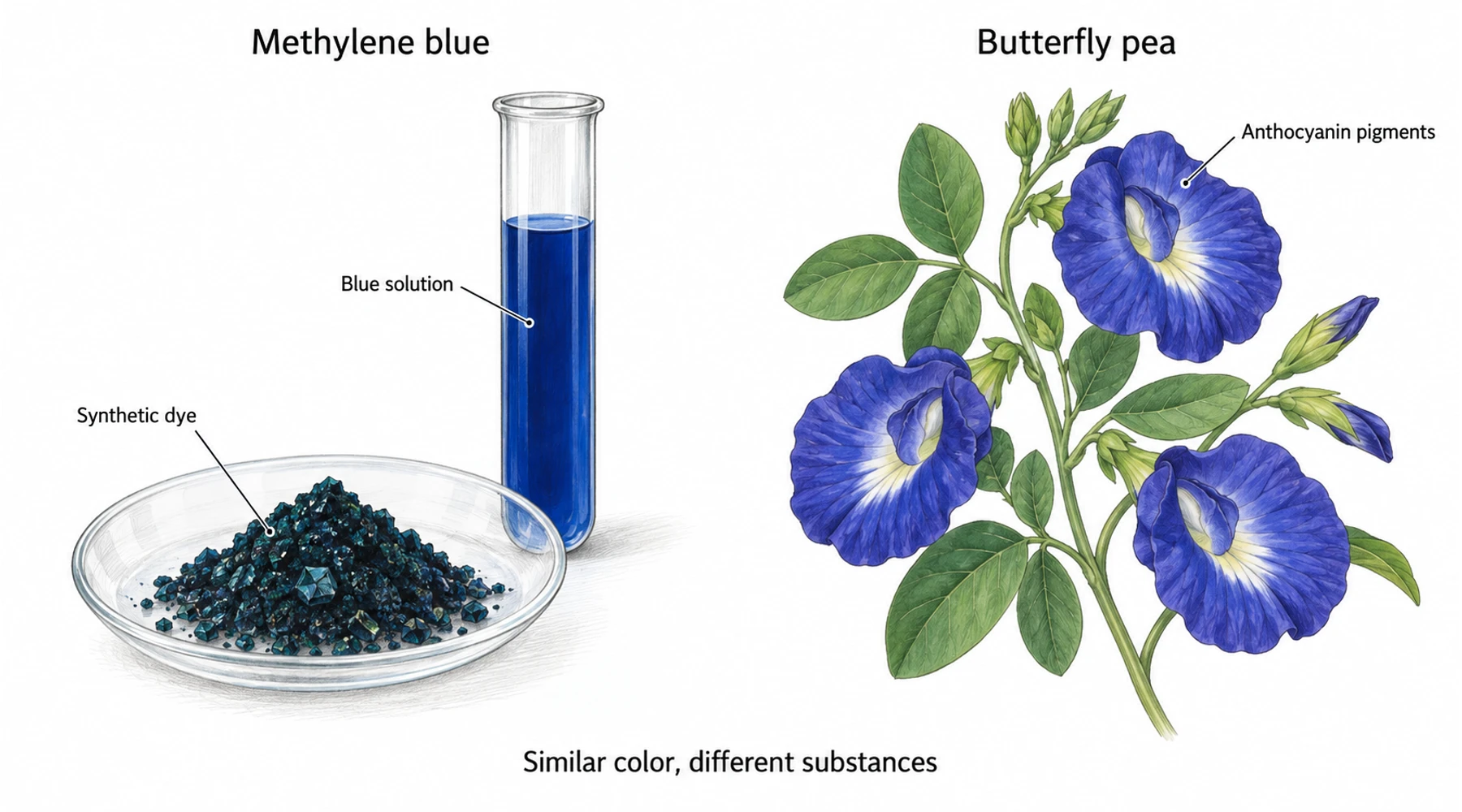
Methylene blue is a synthetic dye. It is an organic compound in the chemistry sense, but that does not mean it is organically farmed, plant-extracted, or certified organic. There are no established natural food sources of methylene blue. Blue flowers and food colorants contain other substances.
These distinctions matter when a product label uses words such as “natural,” “organic,” or “plant-based” to suggest that a bottle is suitable for consumption. Each word answers a different question, and none replaces evidence about the actual product.
Where methylene blue comes from
The IARC account of methylene blue's origins and production dates its initial synthesis to 1876, as an aniline-based textile dye. The same monograph explicitly identifies it as synthetic and not naturally occurring. Commercial manufacturing constructs the dye through chemical reactions; it does not harvest methylene blue from a blue plant.
That history does not establish how a particular supplier manufactures its current material. A general description of industrial chemistry cannot verify a seller's factory, feedstocks, purification steps, or test results. Those require documents tied to the supply chain. Our explanation of methylene blue manufacturing and purification separates the public chemistry from product-specific evidence.
For the basic identity and its different applications, start with what methylene blue is. An origin statement should describe the substance in the bottle, not simply evoke the history of a dye industry.
“Organic” has two different meanings
In chemistry, the term refers to a class of carbon-based compounds. The American Chemical Society's explanation of organic chemistry includes human-made substances within the field. Methylene blue has a carbon-containing molecular framework, so calling it an organic dye is chemically appropriate. Synthesis in a factory does not make an organic compound inorganic.
Agricultural certification asks a different question: was an eligible product produced and handled according to a defined standard? Under USDA organic labeling requirements, an “organic” product generally requires at least 95% organic content, with restrictions on the remainder. Water and salt are excluded from that calculation and cannot themselves be labeled organic.
This creates a useful test for dilute solutions. A seller cannot count the water as certified-organic content and use that arithmetic to justify an organic claim for the bottle. Likewise, an organic botanical ingredient in a blend does not establish that the methylene blue ingredient is certified organic. Check exactly what the certification covers.
USDA requirements are a United States example. For a label invoking another country's scheme, identify that scheme and certifier rather than transferring U.S. rules automatically.
Terminology comparison
| Term on a label | What it describes | What it does not establish |
|---|---|---|
| Organic compound or organic dye | Chemical classification | Agricultural certification, plant origin, purity, or suitability for ingestion |
| Synthetic methylene blue | Production through chemical synthesis | A particular manufacturer's quality or the amount of impurities |
| Natural or plant-derived | A claim about source that needs a named material and process | That the material is methylene blue or has its effects |
| Certified organic | Compliance within a named certification scheme and scope | Clinical effectiveness or permission for every proposed use |
| Food-grade or human-grade | A seller's wording that needs a precise specification and intended-use basis | That a chemical is a natural food constituent or interchangeable with a medicine |
Use the comparison of methylene blue labels and grades when the claim moves from origin to technical, reagent, aquarium, or pharmacopoeial terminology.
Are blue foods a source of methylene blue?
A blue color is an optical property, not a chemical identity test. Different molecules can absorb light in ways that give similar visible colors. Consequently, a photograph of a blue drink supplies no evidence that the drink contains methylene blue.
Butterfly pea is a specific example. The FDA's description of butterfly pea flower extract identifies anthocyanins, principally delphinidin derivatives, as its main coloring components. These plant pigments are chemically different from methylene blue.
“Blue spirulina” creates another possible confusion. The FDA's spirulina extract identity specification identifies phycocyanins as the principal coloring components of an extract from Arthrospira platensis. Spirulina is a cyanobacterial source, not a flowering plant and not a source of methylene blue. Calling two materials “blue antioxidants” would not make their chemistry, absorption, or effects interchangeable.
A report of dye residues or contamination in food would also answer a different question from natural food occurrence. Detection after external exposure does not turn a manufactured chemical into a nutrient normally supplied by that food. There is no basis for choosing foods to obtain a dietary amount of methylene blue.
Source-verification checklist
Use this checklist with the label and supporting documents open. You can also download the reusable checklist.
- Identify the ingredient. Record the full substance name, concentration, solvent, and other ingredients. Check whether “natural” describes the dye, a flavoring, or the overall brand. Our guide to methylene blue solution ingredients explains this distinction.
- Define the claim. Ask whether “organic” means chemical classification or certified agricultural production. A carbon-containing formula supports the first meaning only.
- Trace the claimed source. For a plant-origin claim, request the species, ingredient identity, and production description. A plant photograph or a blue extract is not identification evidence.
- Verify certification scope. Record the scheme, certifier, certificate identifier, named operation, and covered product or ingredient. A certificate for another ingredient or another business does not verify this claim.
- Evaluate the batch and intended use. Match the lot number to analytical documentation and read the stated specification and results. Assess whether the formulation and labeling fit the intended application. Use the buyer's comparison checklist for a broader product comparison.
Origin does not determine whether to take it
Purity, efficacy, and personal suitability are separate questions. A purity result concerns composition. Evidence of efficacy concerns a defined outcome in a defined setting. Personal suitability also depends on formulation, route, medical history, and interacting medicines.
For example, the prescribing information for intravenous ProvayBlue warns about serious serotonin syndrome with serotonergic drugs and opioids, and contraindicates use in G6PD deficiency because of hemolytic-anemia risk. These are properties relevant to the medicine and patient, not defects that an origin claim removes. A retail product's “natural” or “organic” wording is therefore no basis for deciding to ingest methylene blue. Discuss a proposed medical use with a clinician or pharmacist using the actual product label and medication list.