
Article
How methylene blue is manufactured and purified
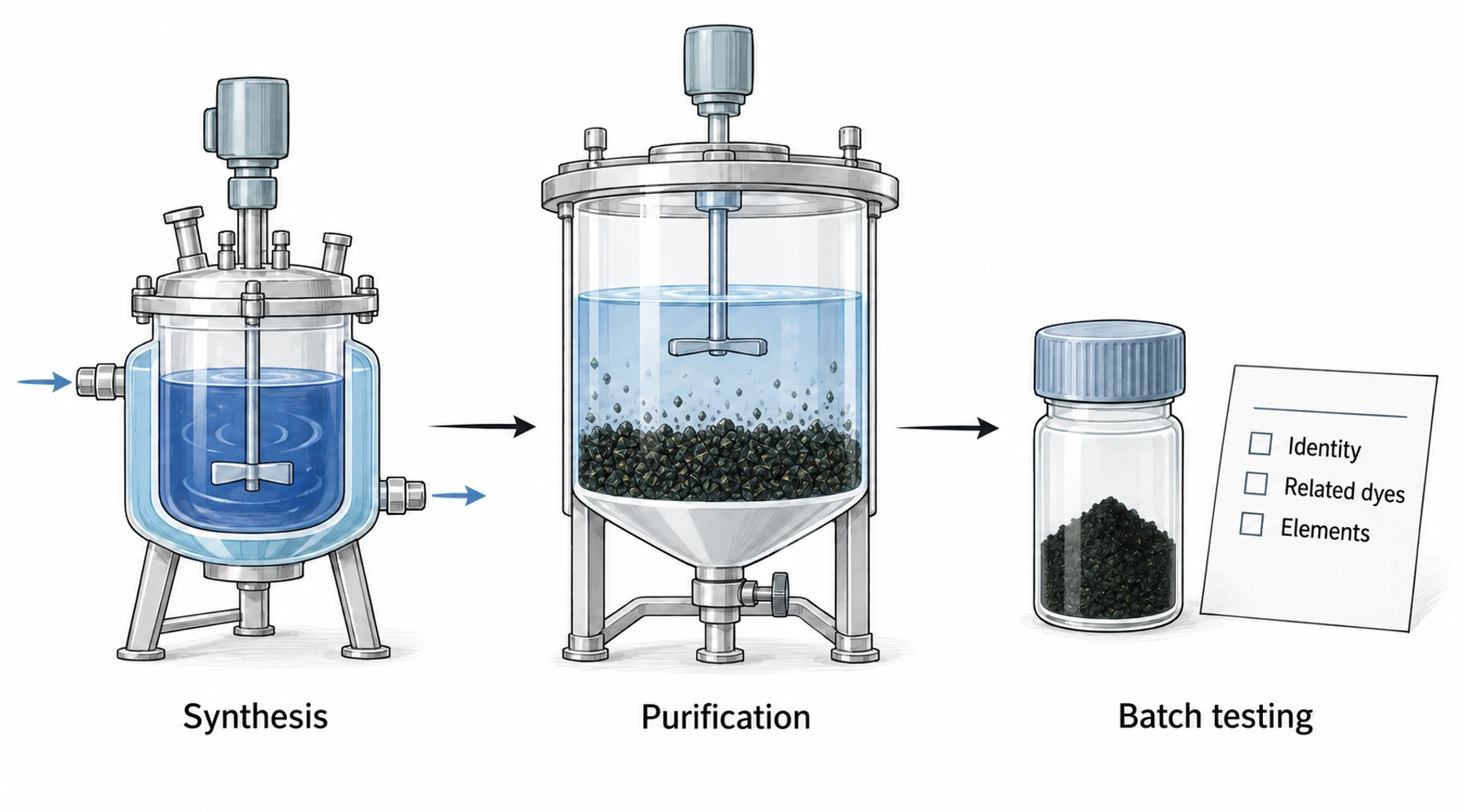
Methylene blue is made by chemical synthesis. Manufacturers construct the dye molecule, separate it from reaction residues, isolate the required material, and assess its quality. These are distinct tasks: making a blue compound does not establish that a batch meets a particular specification.
Public chemistry explains how this can be done. It does not identify the route used for a particular bottle. A patent describes an invention and its examples; a batch record describes what happened during actual production.
What is methylene blue made from?
The IARC account of commercial production describes a route using substituted aromatic amines, including N,N-dimethyl-p-phenylenediamine and N,N-dimethylaniline, with sodium thiosulfate and oxidizing reagents. The reactions build the sulfur-containing ring system of methylene blue. The finished material is commonly supplied as a chloride salt with water associated with the solid.
This is a transformation of starting chemicals into a new substance. An ingredient used during synthesis is not automatically an ingredient of the finished bottle. Conversely, calling it a starting material does not prove that its residues have been removed. Residual-content questions need analytical evidence.
The same IARC chapter describes dry methylene blue as dark green crystals or crystalline powder with bronze lustre, although its solutions are deep blue. Neither appearance establishes purity.
Published routes differ in what they introduce
The classical route joins aromatic building blocks and closes the central ring through a sequence of oxidation reactions. Its industrial variants differ in oxidants, intermediate handling and isolation.
For example, US4212971A describes a manganese-dioxide route designed to avoid dichromate in the oxidation sequence. Copper sulfate also participates in the disclosed process. This distinction matters for quality planning: avoiding a chromium reagent changes one potential source of contamination, while manganese and copper still require consideration. “Dichromate-free process” and “no elemental impurities” are different claims.
Some newer proposals start with an existing ring framework. WO2018167185A1 describes a phenothiazine-based preparation, using halogenation followed by reaction with dimethylamine to obtain the substituted dye. This illustrates a different synthetic strategy, not evidence that the route has replaced classical manufacture everywhere.
A purchaser usually cannot rank these routes from their names alone. The useful comparison is whether each controlled process repeatedly produces material meeting the intended specification, including its route-specific impurities.
Purification addresses different kinds of carryover
Related dyes are one challenge. Azure A, Azure B and Azure C have structures close to methylene blue. Separation can therefore be more demanding than removing an unrelated insoluble particle. A fine filter can retain particles while dissolved dye impurities pass through.
A second challenge is metal-containing residue. A third is process solvent remaining after isolation. A purification step that reduces one category may leave another largely unchanged.
Two published approaches illustrate the difference:
- Precipitation, extraction and crystallization. US12215234B2 describes removing metals by precipitation during solvent extraction, followed by further purification and isolation. The document also associates basic conditions with dye-impurity formation and discusses pH control and a separate crystallization approach for an organic impurity. This illustrates a process tradeoff: conditions useful for separation must also be assessed for unwanted chemical change. Its reported performance belongs to the disclosed examples, not to all commercially sold methylene blue.
- Purifying a temporarily reduced form. US20160200696A1 describes a stabilized protonated leucomethylene-blue complex. The process reduces methylene blue, purifies that intermediate, and oxidizes it back. The proposed advantage is that changing the chemical form makes separation from azures and metal contaminants easier. “Leuco” identifies the reduced form; it does not itself mean “pure.”
These approaches use different chemical properties to accomplish separation. Their existence explains why an adequate process description is more informative than the word “filtered,” but neither substitutes for results on the actual batch.
Process diagram: where quality questions arise
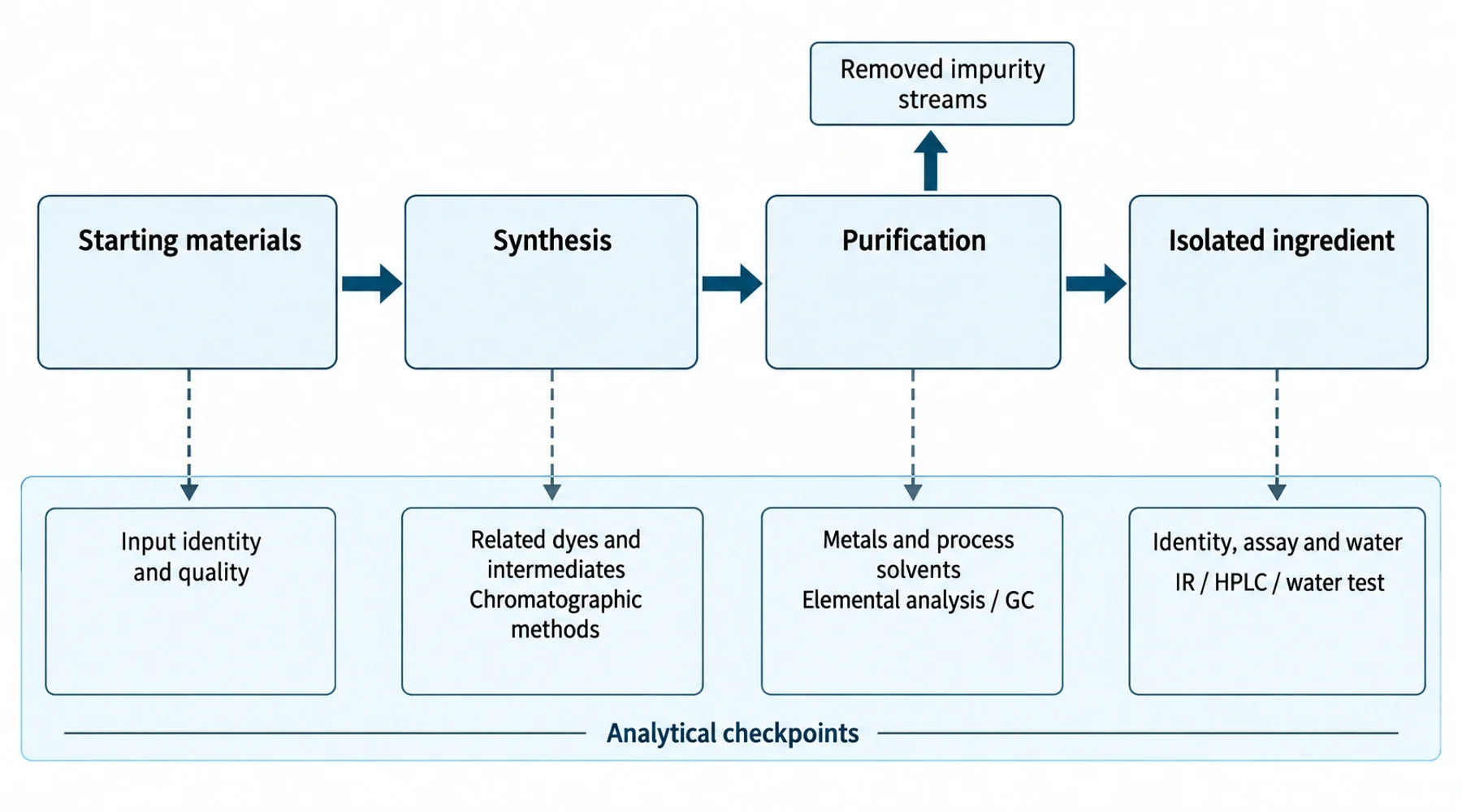
Conceptual synthesis of the published processes and quality principles discussed here. Solid arrows show material flow; dashed arrows associate stages with analytical questions. These are not prescribed sampling times, and tests may apply at several stages. Removed streams leave during purification; laboratory tests measure what remains.
The table connects those questions to useful evidence. HPLC means high-performance liquid chromatography; IR means infrared spectroscopy; GC means gas chromatography; ICP-MS means inductively coupled plasma mass spectrometry.
| Stage or concern | What can require control | Evidence that addresses it |
|---|---|---|
| Incoming chemicals | Wrong identity, variable quality or contaminants entering with inputs | Input specifications, identity checks and supplier qualification |
| Synthesis | Related dyes, remaining starting materials and intermediates | Suitable chromatographic methods with identified targets, sensitivity and acceptance limits |
| Metal-bearing reagents | Elemental residues carried through processing | Element-specific analysis, such as ICP-MS, covering the justified element panel |
| Solvent-based separation and drying | Residual process solvents | A solvent assessment and suitable residual-solvent testing, commonly GC |
| Isolated ingredient | Incorrect identity, content or water basis | Complementary identification, assay and an appropriate water or loss-on-drying test |
These methods answer different questions. USP's explanation of residual-solvent testing discusses when gas chromatography is needed; it is not a substitute for related-dye analysis. Elemental measurements likewise cannot identify azure dyes. A method must be suitable for the material being tested. The guide to methylene blue impurities and test methods explains these analytical distinctions in more detail.
Why the final percentage needs context
An assay measures the amount of a specified substance under a defined method and reporting basis. An impurity method measures a defined set of other compounds. Those results are related, but they are not interchangeable.
The ICH Q6A specification framework distinguishes identity, assay and impurity testing. It also addresses water testing for hygroscopic substances and hydrates. For a hydrated material, a result reported on a dried basis cannot be read as the percentage of the as-received powder without accounting for that basis.
Process history adds another layer. ICH Q7 guidance on active pharmaceutical ingredients calls for an impurity profile linked to the controlled production process and comparisons that can reveal changes in inputs or manufacturing. It also specifies batch identity, test limits and numerical results on certificates of analysis. These pharmaceutical guidance documents explain quality principles; they do not confer pharmaceutical status on a retail product.
What this establishes about Blupreme
Blupreme's published quality information describes records linking a bottle's product batch to a methylene blue ingredient batch and its certificate of analysis. That is a traceability claim. It does not disclose the ingredient manufacturer's synthetic route, purification sequence or factory operating conditions.
Accordingly, none of the patent routes above should be described as “how Blupreme makes methylene blue” without additional manufacturing documentation. An ingredient COA also cannot, by itself, establish finished-solution concentration, packaging performance or sterility. The distinction is explained in ingredient COA versus finished-product testing.
For a procurement decision, start with the actual lot and the required use. Request the matching report, examine the methods and limits, and ask how relevant process impurities are controlled. The methylene blue buyer's comparison checklist turns those questions into a consistent supplier comparison.