
Article
Can an organic acid test show whether you need methylene blue?
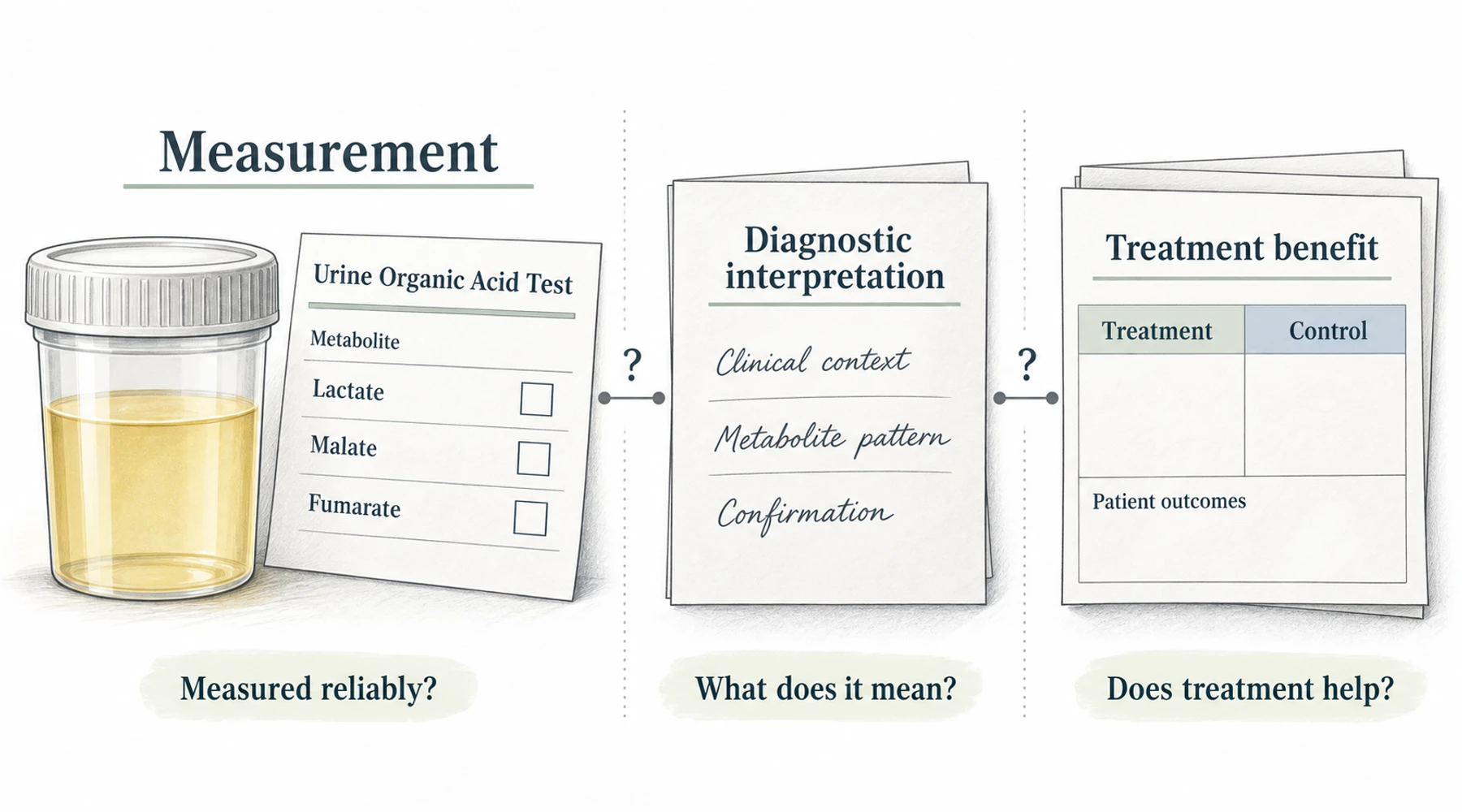
An organic acid test cannot, on its own, establish that you need methylene blue. Urinary organic acids are measurable metabolites with legitimate uses in investigating metabolic disease. But measuring a substance accurately, identifying the cause of an abnormal result, and predicting benefit from a drug are three separate tasks.
The sources examined for this guide did not establish a validated urine organic acid pattern that selects people for methylene blue treatment. A report can therefore contain a real abnormality while the treatment recommendation attached to it remains unsupported.
What an organic acid test measures
Organic acids include intermediates and breakdown products from metabolic pathways. A urine assay examines what reaches the collected specimen. It does not directly measure ATP production inside your muscles or electron transport inside your brain.
The Mayo Clinic Laboratories organic acid screen uses gas chromatography with mass spectrometry and provides a qualitative interpretation of abnormal organic acid levels for investigating inborn errors of metabolism. Mayo notes that interpretation depends on circumstances such as acute illness, supplements, and whether the body is building tissue or breaking down energy stores.
That clinical use does not validate every interpretation offered by every commercial panel. An assay marketed as an “OAT” may report different compounds, use different reference intervals, or attach additional claims about nutrients, microbes, or neurotransmitters. The exact method and intended use matter more than the abbreviation.
A flag is a comparison, not a diagnosis
Start with the full report: analyte name, specimen, units, reference interval, collection conditions, and the laboratory's interpretation. A concentration and a value expressed relative to urine creatinine are different quantities. Results should not be compared across reports without checking their reporting basis.
A reference interval describes a laboratory's comparison population under specified conditions. It is not automatically a treatment threshold. A mildly high result asks why the value differs; it does not identify the cause by itself. An “optimal” range narrower than the laboratory interval needs its own justification.
The FDA-NIH explanation of biomarker validation distinguishes analytical validation, whether a test measures its intended target, from clinical validation, whether the result supports the proposed clinical interpretation. Good laboratory measurement does not make every downstream claim valid.
For example, a high malate result might lead a clinician to examine the overall metabolite pattern, symptoms, and possible alternative explanations. Drawing a line from malate on a pathway diagram to an alleged need for methylene blue skips that investigation. For comparison, experimental mitochondrial measurements assess different endpoints under controlled conditions.
What the supplied mitochondrial study actually found
In Bruce Barshop's 2004 retrospective study, researchers examined 3,646 urine analyses, including 258 specimens from 67 patients with known mitochondrial oxidative disorders and 176 specimens from 21 patients with organic acidemias. These are specimen counts and patient counts, not interchangeable sample sizes.
Urine lactate and most Krebs-cycle intermediates were poor discriminators. Fumarate and malate were more informative, but at the study's chosen cutoffs they distinguished only about 25–30% of mitochondrial disease patients with a 5% false-positive rate. Those research cutoffs are not universal diagnostic thresholds for a contemporary panel.
This was a study of diagnostic correlations in referred samples. It did not give methylene blue, compare it with placebo, or test whether a urine pattern predicted improvement. It supports investigating the limits of metabolite interpretation, not using a result to choose a regimen.
Lactate needs its own context
Urinary lactate, blood lactate, and a blood lactate-to-pyruvate ratio are different observations. A urine lactate flag cannot substitute for correctly collected blood measurements.
The Mitochondrial Medicine Society consensus statement explains that blood lactate can rise because of collection artifacts or conditions other than primary mitochondrial disease. The lactate-to-pyruvate ratio is informative only when lactate is elevated. Normal lactate also does not reliably exclude mitochondrial disease.
The same statement places urine organic acids within a broader investigation that can include blood tests and genetic analysis. Confirmatory work depends on the suspected disorder and clinical findings. Repeating a questionable sample may resolve one uncertainty; confirming a disease mechanism may require a different test entirely. Neither step automatically predicts a response to methylene blue.
“Neurotransmitter markers” require a specified clinical use
Homovanillic acid, or HVA, is a dopamine metabolite. That biochemical relationship does not make a urine HVA result a direct measurement of brain dopamine or a prescription for a drug affecting monoamine metabolism.
The Mayo urine HVA test has defined uses, including evaluation of catecholamine-secreting tumors and selected inherited disorders of catecholamine metabolism. It also identifies medication-related effects on results. These are specific diagnostic settings, not validation of a general “low neurotransmitter” explanation for fatigue or mood symptoms.
Ask which disorder the reported marker is supposed to identify, how that interpretation was validated in comparable patients, and what would confirm it. A named pathway supplies a hypothesis. It does not establish the clinical meaning of an isolated low or high value.
Test-to-treatment evidence checklist
Use this table when assessing a test-based recommendation. Record the actual document or study supporting each answer. An unknown answer remains unknown; this is not a score that clears someone for treatment.
| Evidence layer | Concrete questions | What would support the claim? | What remains unproven? |
|---|---|---|---|
| Analytical validity | What exact analyte, method, units, and specimen were used? Were handling and interference checks satisfied? | Laboratory method documentation, quality controls, and precision at the reported level | The cause of the result or the usefulness of a drug |
| Reference interpretation | Is the interval appropriate for the person's age and reporting basis? Is the deviation reproducible when repetition is clinically appropriate? | The laboratory interval and contextual interpretation of the complete pattern | That every flag represents disease or requires correction |
| Diagnostic validity | Which diagnosis is proposed? How often does this finding occur with other conditions or without the disease? | Studies in the intended patient population plus appropriate confirmatory biochemical, genetic, or other testing | That the diagnosis predicts methylene blue benefit |
| Predictive validity | Did people with this test pattern benefit more from methylene blue versus a comparator than people without it? | A prespecified biomarker analysis with treatment and control comparisons | That an observational correlation identifies responders |
| Clinical benefit | Did test-guided care improve symptoms, function, or another meaningful outcome, with acceptable harms? | Controlled patient-outcome evidence for the actual treatment and testing strategy | That a lower metabolite value alone means better health |
The FDA-NIH definition of a predictive biomarker explains why treatment comparisons matter. Better outcomes among treated people with a marker can reflect their underlying prognosis. Establishing prediction generally requires comparing treatment with control across marker groups. Even a successful trial enrolling only marker-positive patients would not, by itself, prove that the marker is needed to select responders.
What to do with a recommendation
Bring the complete report and the cited study to the clinician evaluating the symptoms. Ask which part of the checklist the evidence actually satisfies. Use the online protocol verification guide to check whether a diagnostic paper has been presented as treatment evidence.
For ME/CFS, a useful outcome would need to address the illness and its functional consequences, including post-exertional malaise. A changed urine result or short-lived feeling of energy does not answer that question.
A urine panel also does not establish medication compatibility. The PROVAYBLUE prescribing information identifies serious serotonergic interactions and contraindicates use in G6PD deficiency. These issues require a separate clinical assessment, as outlined in questions to ask before considering methylene blue.
Tell the laboratory about any methylene blue exposure. Documented laboratory interference depends on the method; interference with a urine dipstick does not prove interference with every mass-spectrometry assay. The ordering clinician and laboratory should decide whether a result is interpretable and how any further collection should be arranged.