
Article
Methylene blue and sunscreen claims: UV research and its limits
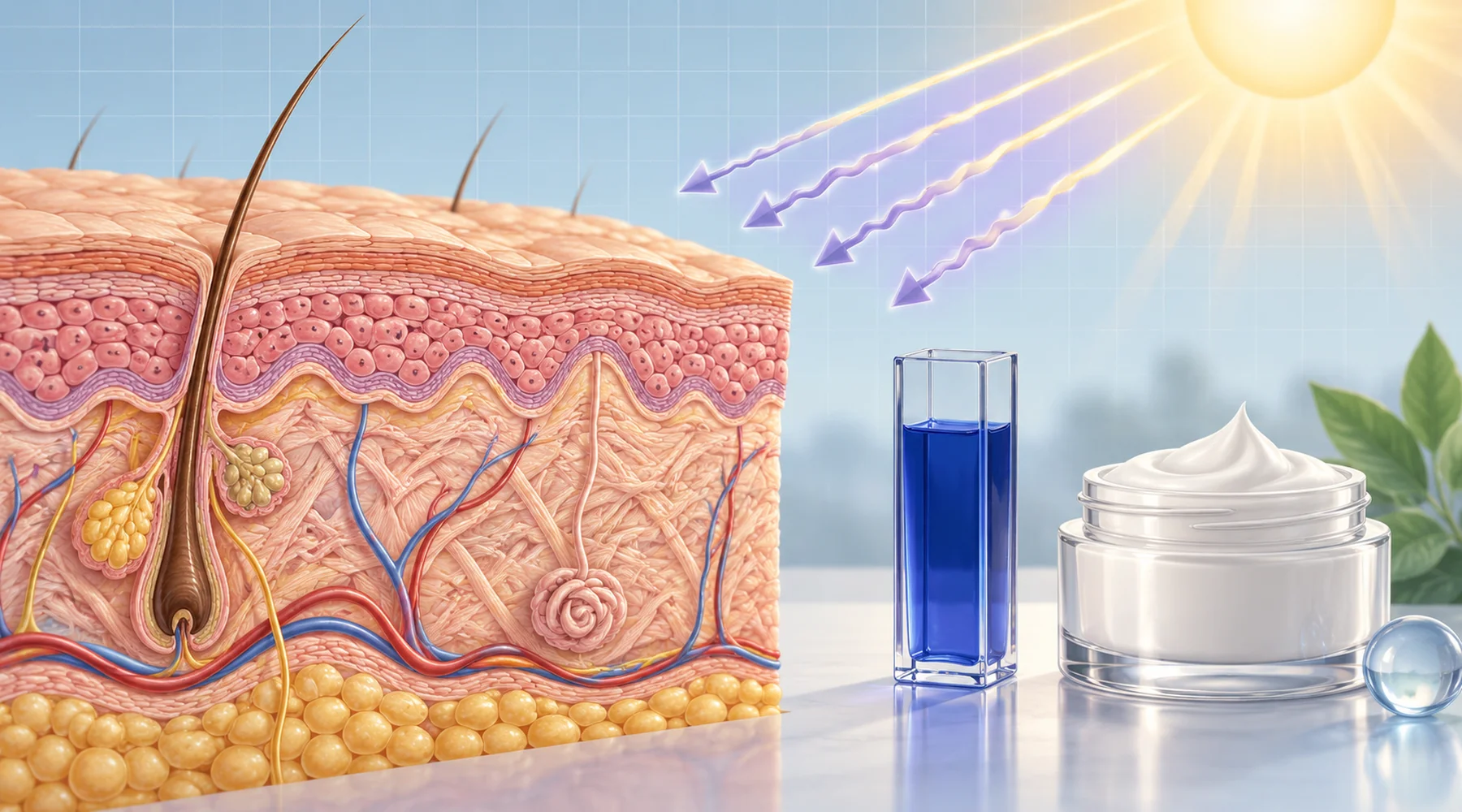
A social media post claims methylene blue works as sunscreen. It cites a real study in which the dye absorbed ultraviolet light and reduced injury in cultured skin cells. The study exists. The conclusion drawn from it does not follow.
The problem is a familiar one in health claims. A laboratory measurement gets treated as a product test. To read methylene blue sun exposure claims correctly, keep three questions separate: does the molecule absorb UV, does it protect living skin from sun, and is it an authorized sunscreen ingredient in a finished product. The 2021 research answers the first question in part, gestures at the second in cells only, and does not answer the third at all.
What the frequently cited study tested
The paper most often quoted is the 2021 study by Xiong and colleagues on ultraviolet protection potentials of methylene blue, listed on PubMed. The authors proposed methylene blue as a candidate sunscreen active, including as a possible alternative to oxybenzone. They did not claim they had validated a methylene blue sunblock for human use. Their discussion states that further safety work would be needed before seeking inclusion in a sunscreen monograph.
The experiments were preclinical throughout. No living human subjects participated, and no finished sunscreen was applied to human skin. Two authors were affiliated with Mblue Labs, and the university and the company had filed a joint patent application on methylene blue as a sunscreen active. A disclosed commercial interest does not invalidate data, but it is one more reason to read endpoints exactly.
Solution spectroscopy came first. The team compared methylene blue in saline with oxybenzone in solvent across 200 to 400 nanometers. Methylene blue absorbed more strongly below about 310 nanometers, while oxybenzone absorbed more strongly at longer wavelengths. That is a property of molecules dissolved in liquid. It is not a measurement of a cream spread as a film on skin.
Cell experiments came next. Normal human keratinocytes were pretreated with 100 nanomolar methylene blue for two weeks, then exposed to UVB peaking at 302 nanometers. Treated cultures showed a lower DNA damage response, measured by gamma-H2AX, plus better viability and less senescence staining. Parallel work in keratinocytes and four human fibroblast lines found reduced mitochondrial superoxide and increased proliferation. A supplementary comparison found that 100 nanomolar oxybenzone did not produce the same cellular benefit at that concentration. But a nanomolar solution bathing isolated cells tests how cells respond to injury, while a sunscreen film on skin intercepts light before it reaches cells. The two settings share the word protection but test different mechanisms.
The coral experiment was small and qualitative. Fragments of the soft coral Xenia umbellata sat in seawater with 1 micromolar methylene blue or 1 micromolar oxybenzone for about a week. The oxybenzone group deteriorated while the methylene blue group did not. That concerns short term fragment survival only. It is not a reef safety assessment, and it says nothing about sun protection for people.
One language detail deserves attention. The abstract mentions clearance of UVA induced cellular reactive oxygen species, but the methods describe a UVB irradiation protocol without a matching controlled UVA experiment. The conservative reading is that the study showed reduced injury after experimental UVB exposure in cultured cells plus antioxidant behavior. It did not directly demonstrate prevention of UVA induced ROS under a controlled UVA exposure.
Readers who want background on how the related skin aging experiments differ from human trials can compare this with the skincare formulation evidence, which separates cell culture, reconstructed skin, and finished product testing.
Evidence comparison: UV test type and what it can establish
This table is the core of the article. Use it to locate any methylene blue sunscreen claim. Each row names a test, states what a positive result can establish, and states what still requires a different test.
| Type of UV test | What it can establish | What it cannot establish |
|---|---|---|
| Solution absorbance spectrum, 200 to 400 nm | That the molecule absorbs UV photons in liquid at tested concentrations | That a cream protects human skin, or its SPF, UVA protection factor, or broad spectrum status |
| Cultured keratinocyte survival after UVB | That pretreated cells resist an experimental injury better under those conditions | That a topical film prevents sunburn or DNA damage in intact skin |
| Cellular ROS and proliferation measures | Antioxidant or redox behavior in that cell system | That sun induced oxidative injury is reduced in people, or that UVA was the cause without a controlled UVA exposure |
| Coral fragment observation over days | Short term comparative effects on those fragments | Reef safety in general, or any human efficacy outcome |
| Finished sunscreen tested on human skin or PMMA plates | Erythema protection, UVA protection factor, critical wavelength, and photostability of that formula | Nothing beyond the tested formula, applied amount, and exposure conditions |
The pattern across rows is consistent. Earlier rows test ingredients or cells. Only the last row tests sun protection. A methylene blue sunscreen claim needs the last row.
Photoprotection is not the opposite of photosensitization, but it is a different behavior
Methylene blue has two light related roles that sound contradictory and are both real. In some cell systems it behaves as a redox mediator with antioxidant effects. Under suitable illumination it behaves as a photosensitizer that generates reactive oxygen species, including singlet oxygen. Photodynamic therapy deliberately exploits the second behavior to damage target cells or microbes, as reviewed in photodynamic applications of methylene blue. This is also why methylene blue plus red light devices belong in a separate assessment, covered in our guide to combined light treatments.
The difference turns on conditions: wavelength, light dose, concentration, aggregation state, oxygen availability, and where the dye sits relative to living tissue. Red light around 630 to 670 nanometers is commonly used to activate methylene blue in photodynamic work. Sunlight contains UV, visible, and infrared bands together, so a topical film would face mixed illumination rather than a single laboratory wavelength.
A sunscreen filter should intercept harmful UV and dissipate the energy through comparatively harmless pathways while remaining stable. A photosensitizer uses absorbed photon energy to drive chemistry that creates reactive species. Absorbing UV is therefore necessary for a UV filter candidate but far from sufficient. The 2021 paper did not test whether a topical methylene blue film under sunlight generates singlet oxygen near viable skin, what photoproducts form, or how the oxidized and reduced forms behave. Anyone evaluating methylene blue sunblock claims should treat those questions as open until a finished formula is tested under sunlight like exposure.
Methylene blue is not an authorized sunscreen ingredient
Regulatory status is separate from laboratory promise. In the United States, sunscreen actives for over the counter products appear in OTC Monograph M020. Methylene blue is not listed there. In the European Union, UV filters used in cosmetics must appear in Annex VI of Regulation 1223/2009. Methylene blue is not an authorized Annex VI UV filter.
Approval elsewhere does not transfer. Intravenous methylene blue has approved drug uses, and the dye has diagnostic and procedural roles discussed in our overview of authorized and investigational uses. None of those makes it an approved sunscreen active. Sunscreen authorization concerns a specific ingredient, in a specific product type, at specific conditions of use.
What validated sun protection would require
A finished methylene blue product that claimed SPF or broad spectrum protection would need the standard sunscreen test battery, performed on that finished formula. SPF is measured in people: product applied at 2 milligrams per square centimeter, exposed with a 290 to 400 nanometer solar simulator, under methods such as ISO 24444 for in vivo SPF. The endpoint is erythema, mostly a UVB response. No cell experiment can substitute for it.
UVA protection needs its own measurement rather than inference from a solution spectrum. International practice uses in vivo UVA protection factor testing under ISO 24442, in vitro characterization under ISO 24443, or both. European guidance looks for UVA protection of at least one third of the labeled SPF.
Critical wavelength measures how far into UVA the protection extends, defined from the finished film absorbance with 370 nanometers as the threshold for a broad spectrum designation in the sunscreen monograph procedure. A dye dissolved in saline cannot supply this value. Photostability must also be challenged directly by pre irradiating the product film and measuring what protection remains. Until those tests are run on the actual cream, talk of a stable methylene blue sunscreen is speculation.
Human testing also captures what laboratory work misses: whether the film forms evenly, whether sweat removes it, whether staining makes correct application unlikely, and whether phototoxicity appears. Blue staining is not a minor detail here. Uneven visible color can signal uneven application, and uneven application reduces protection.
How to handle sun exposure claims in practice
Treat methylene blue as an interesting UV research candidate with no validated sunscreen product behind it. Do not substitute a solution, a lab finding, or a coral observation for a tested sunscreen. Do not mix dye into moisturizer or oil as a homemade sunscreen. This article gives no recipe because dilution, uniformity, stability, preservation, application amount, and photochemistry cannot be controlled at home, and the solution ingredients guide explains why a finished liquid is more than dye plus water. For actual sun protection, use shade, protective clothing, and a sunscreen whose label states tested SPF and, where applicable, broad spectrum or UVA protection.
For actual sun protection, use measures with direct evidence: shade, protective clothing, and a sunscreen whose label states tested SPF and, where applicable, broad spectrum or UVA protection. For methylene blue questions that involve swallowing the dye for sun protection, note that oral photoprotection is its own claim with its own required trials, and that systemic use carries the drug interaction and contraindication issues summarized in our safety and interaction reviews. Readers evaluating combined light protocols should keep sunscreen assessment apart from photodynamic therapy evidence, where light plus dye is meant to injure a target rather than shield skin.