
Article
Methylene blue for persistent pruritus ani: evidence and limitations
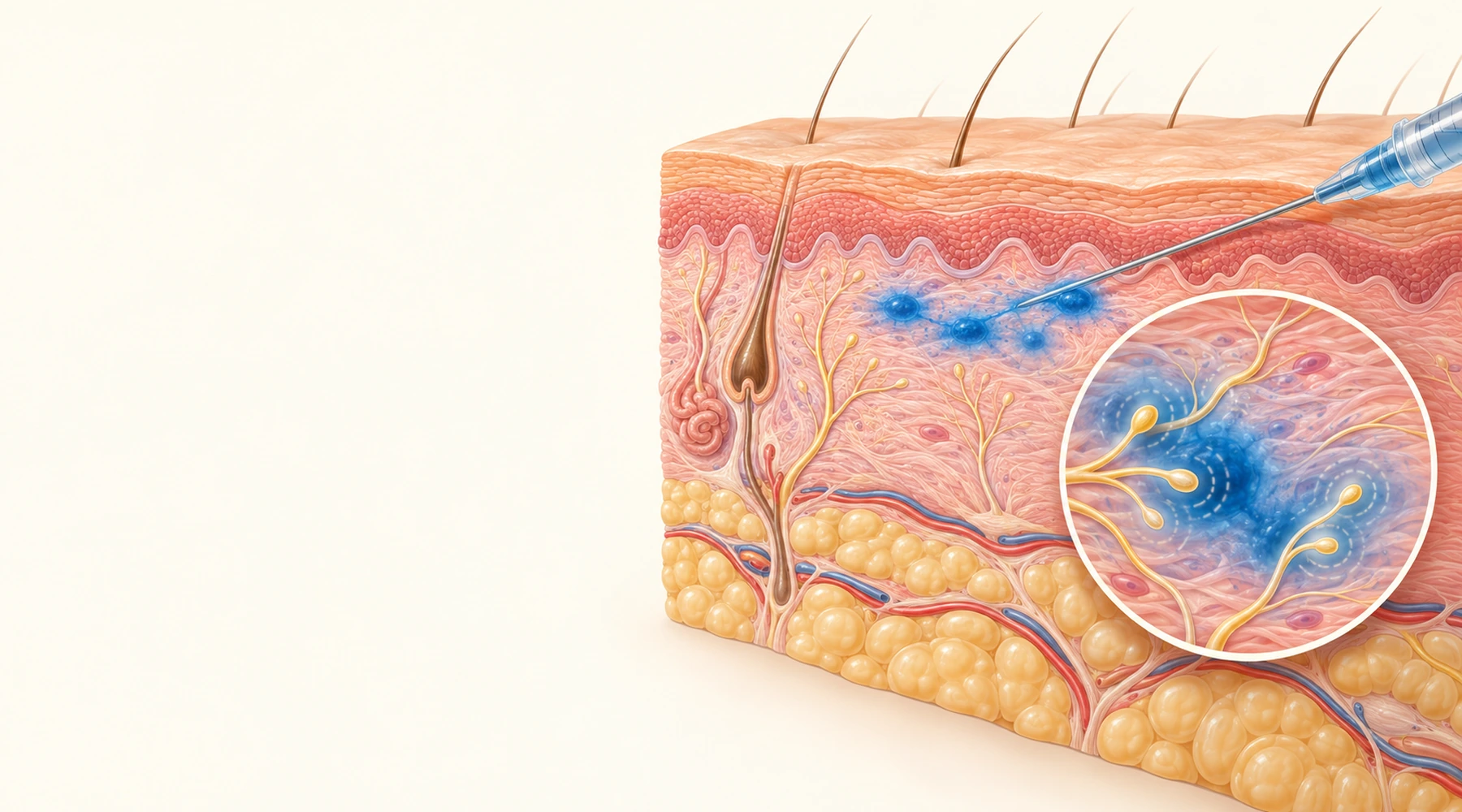
Consider a patient who has tried barrier creams, antifungals, steroid ointments, and hygiene changes for months, yet nightly anal itching continues. A colorectal surgeon mentions an injection of blue dye into the skin around the anus. Most readers picture a soothing liquid coating the skin, like another topical cream delivered by needle. The procedure under discussion works on a different concept. It injures small sensory nerve endings in the dermis to interrupt the itch scratch cycle, and the evidence behind it is a small set of uncontrolled surgical case series with uneven follow-up.
This article reviews that literature. It covers what the specialist procedure involves, what must be excluded before itching is called idiopathic, what two key references report, and where the evidence falls short. For background on the compound itself, see how methylene blue acts at the cellular level, and for the broader list of authorized and investigational medical uses.
A procedure, not a cream
Intradermal or immediately subcutaneous injection of methylene blue for refractory idiopathic pruritus ani is an invasive, clinician administered procedure. Published protocols place dilute methylene blue within the dermis of the affected perianal skin under sterile conditions, usually with local anesthesia or a regional block and the patient prone. The intended mechanism is chemical ablation of superficial sensory nerve endings. The American Society of Colon and Rectal Surgeons describes injection into and below the affected skin and warns that placement too close to the surface risks skin breakdown or ulceration.
Three distinctions matter. First, topical methylene blue applied to the skin surface is not the intervention these studies evaluated, and no comparable evidence shows it substitutes for the intradermal procedure. Second, self injection cannot be extrapolated from the published protocols. Depth control is the safety critical variable: too superficial risks ulceration and necrosis, too deep or nonsterile technique risks abscess and anatomic injury. Third, the commercial methylene blue injection sold in the United States is labeled for intravenous treatment of acquired methemoglobinemia, so perianal intradermal use is off label. Readers taking serotonergic medicines should also review the serotonin syndrome and drug interaction warnings, discussed further below.
Diagnose first: most itching has a cause
Pruritus ani describes a symptom, not a single disease. Guidelines classify secondary causes as anorectal, dermatologic, infectious, systemic, irritative, and psychogenic, and they recommend history, anorectal examination with anoscopy, and targeted testing before the label idiopathic is applied. The Italian Society of Colorectal Surgery practice parameters set out this workup, including swabs or scraping, laboratory tests, patch testing, and biopsy selected by findings.
Common explanations to exclude include hemorrhoids, fissure, fistula, skin tags, fecal seepage or incontinence, prolapse, and warts, alongside contact dermatitis from soaps, wipes, fragrances, and topical products, plus moisture and occult stool contamination. Dermatologic mimics include psoriasis, lichen sclerosus, and lichen simplex chronicus. Infections include Candida, dermatophytes, pinworm, scabies, and sexually transmitted causes. Systemic associations include diabetes, cholestatic liver disease, chronic renal disease, and thyroid disorders. Persistent, atypical, or ulcerated lesions warrant biopsy to exclude anal intraepithelial neoplasia or extramammary Paget disease. Only the very small group with persistent, intense symptoms despite this workup and conservative care is considered for injection, which is also the position of the ASCRS patient guidance.
What the 2023 meta-analysis found
The broadest synthesis is a 2023 single arm meta-analysis by Jia and colleagues, which pooled 7 studies and 225 patients. Resolution after one injection was 76.1 percent (95 percent CI 64.9 to 87.3), rising to 85.4 percent after a second injection. Reported remission was 75.3 percent at one year and 77.3 percent at three years, falling to 24.0 percent at five years.
Those numbers need careful reading. The pooled studies were uncontrolled series spanning 1979 to 2019 with heterogeneous techniques, concentrations, and endpoints, and statistical heterogeneity was high. The long term percentages do not come from one cohort followed for five years. Different small studies contributed at different time points, so the five year figure is fragile. Typical complications were temporary blue tattooing and perianal numbness, with reported events including cellulitis, hematoma, temporary fecal seepage, urinary retention, superficial abscess, and prolonged altered sensation. Notably, the historical skin necrosis series by Eusebio and colleagues (1990) was not among the seven pooled studies, so reassuring safety language in the meta-analysis does not mean necrosis has never occurred. Our methylene blue safety profile summary places these events in context.
What the largest single study found
The largest individual study is a 2019 retrospective review of a prospective database by Kim and colleagues. Of 362 patients presenting with anal itching, 259 improved with conservative treatment, leaving 103 with severe refractory symptoms treated by intradermal injection. The protocol mixed 5 mL of 1 percent methylene blue stock with 15 mL of 1 percent lidocaine, giving 20 mL of injectate at roughly 0.25 percent final concentration, delivered under saddle block anesthesia. This stock versus final concentration distinction recurs across the literature: papers that say 1 percent often describe the stock solution, not the diluted mixture actually injected.
At six weeks, 87 of 96 followed patients (90.6 percent) were classified as improved. Eight patients later received a repeat injection, with improvement in five. At three years, 53 of 62 patients available for long term assessment (85.5 percent) were improved, and among 53 initial responders, 4 (7.5 percent) had recurrence. Attrition qualifies these figures: only 62 of the original 103 contributed three year data. Blue tattooing persisted in 84 of 96 (87.5 percent) at six weeks, generally fading to small pinpoint areas by about four weeks. Hematoma occurred in 6 of 62 (9.7 percent) and resolved spontaneously. The authors reported no fecal seepage, cellulitis, necrosis, or abscess in their cohort.
Study quality and follow-up table
The table below is the central reference for this review. Concentrations marked with an asterisk are final mixture estimates, since several papers reported only the stock solution strength.
| Study | Design and patients | Injection protocol | Follow-up | Efficacy and recurrence | Adverse outcomes |
|---|---|---|---|---|---|
| Wolloch and Dintsman, 1979 | Case series, n=9 | About 10 to 15 mL of 1% solution, subcutaneous | 3 to 15 months | 8 of 9 improved after first injection; 9 of 9 after repeat | Fever for about one day, 1 of 9 |
| Eusebio, Graham, and Mody, 1990 | Case series, n=23 | Up to 30 mL of 0.5% solution, intracutaneous infiltration | Responders beyond 12 weeks, some to 9 years | 21 of 23 initial complete or partial response; recurrence 4 of 18 responders (22%) with longer follow-up | Full thickness skin necrosis, 3 of 23 (13%), requiring debridement |
| Farouk and Lee, 1997 | Prospective series, n=6 | 10 mL 1% stock plus anesthetic and saline, about 0.44% final* | Median 3 years, range 2 to 5 | 5 of 6 major initial improvement; cumulative recurrence about 20% at 1 year, 40% at 2 years, 60% at 3 years | Urinary retention, superficial abscess, transient incontinence, 1 of 6 each |
| Botterill and Sagar, 2002 | Prospective series, n=25 | 5 mL 1% stock plus lignocaine and hydrocortisone, about 0.25% final* | Median 11 months, range 2 to 25 | 16 of 25 symptom free after one injection; 22 of 25 (88%) after repeat | Temporary fecal seepage, 1 of 25, about 2 days |
| Mentes et al., 2004 | Prospective nonrandomized, n=30 | About 15 mL at 1% final, from 2% stock diluted about 1:1, intracutaneous plus superficial subcutaneous | 12 months for most; 5 to 24 months | 24 of 30 symptom free at 1 month; about 28 of 30 after retreatment; 23 of 30 at 12 months; recurrence about 5 of 28 (18%) | Self limited cellulitis, 2 of 30 (7%) |
| Sutherland, Faragher, and Frizelle, 2009 | Prospective single surgeon series, n=49 | 10 mL 1% stock plus bupivacaine with adrenaline and methylprednisolone, about 0.32% final* | Mainly 4 and 8 weeks | Improvement 47 of 49 (96%); complete resolution 28 of 49 after one injection, 32 of 49 (65%) after repeat | Altered continence 7 of 49 (14%), resolved within about 10 days to 6 weeks; distressing reduced sensation 2 of 49 (4%) |
| Samalavicius et al., 2012 | Prospective series, n=10 | Reported 15 mL of 1% solution, intradermal | Median 47 months, range 29 to 60 | 10 of 10 resolved by 4 weeks; recurrence 8 of 10 (80%) with long observation | Temporary numbness and tattooing; swelling up to about 2 months; no necrosis reported |
| Kim, Kim, and Lee, 2019 | Retrospective review of prospective database, n=103 treated | 5 mL 1% stock plus 15 mL 1% lidocaine, about 0.25% final* | 6 weeks (96 of 103) and 3 years (62 of 103) | 87 of 96 improved at 6 weeks (91%); 53 of 62 improved at 3 years (86%); recurrence 4 of 53 responders (8%) | Tattooing 84 of 96 at 6 weeks (88%); hematoma 6 of 62 (10%); no seepage, cellulitis, necrosis, or abscess |
The pattern across rows is consistent. Early response is usually high, while recurrence estimates depend heavily on how long patients are observed and how many remain in follow-up. Samalavicius reported 100 percent early resolution but 80 percent eventual recurrence at a median of 47 months; Kim reported under 8 percent recurrence at three years among responders who stayed in follow-up. Small samples, repeat injections, differing endpoints, and attrition make direct comparison unreliable.
Limitations a reader should keep
No randomized trial supports this procedure. Every efficacy estimate above comes from uncontrolled series or a retrospective cohort, so placebo response, regression to the mean, and concurrent hygiene measures cannot be separated from treatment effect. Protocols vary in plane of injection, volume, concentration reporting, anesthetic admixture, and steroid use, which means there is no standardized dose: compare final mixture concentrations, not stock labels. Series of 6 to 103 patients cannot establish the incidence of rare events such as hypersensitivity or systemic reactions, and follow-up for late recurrence is incomplete in most studies.
The necrosis history deserves plain statement. Three of 23 patients in the 1990 Eusebio series developed full thickness skin necrosis requiring debridement. Technique has since moved toward more dilute final mixtures and intradermal rather than deep placement, and later series report milder complications, but the historical event is part of the record and counsels against casual adoption.
Systemic drug warnings also apply in principle. Current methylene blue injection prescribing information carries a boxed warning for potentially fatal serotonin syndrome with serotonergic drugs and opioids, lists anaphylaxis reports, and contraindicates use in G6PD deficiency and severe thiazine dye hypersensitivity. These warnings derive mainly from systemic intravenous use, and systemic exposure after perianal injection is poorly quantified, so they cannot be assumed irrelevant. Disclose all antidepressants, opioids, and G6PD status before any methylene blue procedure.
Who might discuss it with a clinician
The candidate is narrow: idiopathic itching that persists after secondary causes were sought and conservative measures failed, severe enough that tattooing, numbness, and a small risk of infection or continence disturbance are acceptable trade-offs. Bring a symptom timeline, prior treatments with dates, test reports including anoscopy and any biopsy, and a full medicine list. Useful prompts are collected in our questions to ask a clinician about methylene blue. Do not pursue injection from a practitioner who skips the diagnostic workup, and never attempt self injection.