
Article
Methylene blue and postoperative cognition: human trials and animal mechanisms
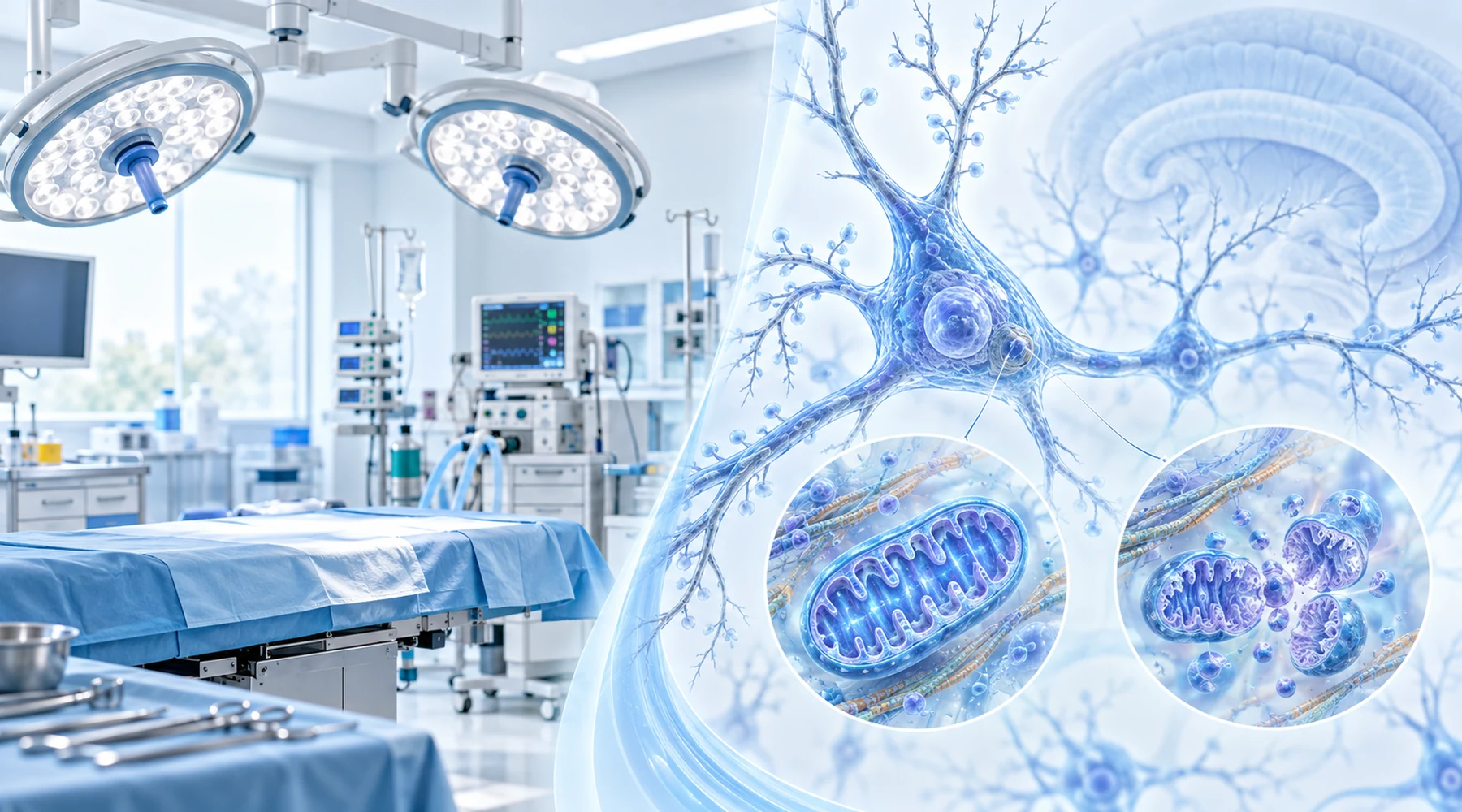
Older adults sometimes come out of major surgery thinking less clearly than before. Families notice it. Clinicians measure it. The question is whether methylene blue, given around the time of anesthesia, protects the brain. Two kinds of evidence speak to that question, and they answer different parts of it. A human perioperative trial reports what happened to patients. An aged mouse model proposes how protection might work inside neurons. Neither stands in for the other.
The first step is to separate two outcomes that are often blurred together.
Delirium and measured cognitive decline are different concepts
Postoperative delirium is an acute, fluctuating disturbance of attention and awareness. A patient is lucid one hour and confused the next. Hospitals detect it with bedside instruments such as the 3D-CAM, usually more than once a day, because a single check can miss it.
Postoperative cognitive dysfunction is something else. It is a measured drop on formal tests compared with the patient's own preoperative baseline, covering memory, attention, and executive function. Testing happens days or weeks later. A patient can have one without the other.
This distinction matters because the two outcomes are measured with different tools, at different times, by different assessors. When a trial reports both, read them as two separate claims. Background on this discipline of reading trial literature is covered in how to read methylene blue research.
What the human trial did
The main human evidence comes from an open-label randomized trial at Huashan Hospital, published in the Journal of Clinical Anesthesia in 2021. It enrolled 248 patients aged 60 to 80 undergoing elective major noncardiac surgery that excluded neurosurgery, including thoracic, orthopedic, urologic, and major abdominal procedures. Half received methylene blue 2 mg/kg intravenously, diluted to 50 mL and infused within 60 minutes immediately after anesthetic induction. Half received 50 mL of saline on the same schedule.
Delirium was the primary endpoint. Assessors screened with the 3D-CAM twice daily, at least six hours apart, on postoperative days 1 through 5 or until discharge, and characterized positive screens with the Memorial Delirium Assessment Scale. Confusion in the recovery room was recorded separately as emergence delirium. Cognition was the secondary endpoint: a formal test battery on the day before surgery and again around postoperative day 7, with decline defined as deterioration greater than one standard deviation in at least two tests. That is early decline, now usually called delayed neurocognitive recovery. At three months the investigators used a telephone screen, the TICS-m, but there was no preoperative TICS-m baseline for comparison.
The early results favored methylene blue. Delirium occurred in 9 of 124 methylene blue patients (7.3 percent) against 30 of 124 controls (24.2 percent), an adjusted odds ratio of 0.24 with a 95 percent confidence interval of 0.11 to 0.53. Early cognitive decline occurred in 20 of 124 (16.1 percent) against 49 of 122 (40.2 percent). Emergence delirium in the recovery room was similar between groups, roughly 18 versus 23 percent. At three months, telephone scores were nearly identical (medians 34.5 and 34.0) with no statistical separation.
Those numbers need their limitations alongside them. The trial was explicitly open label. The anesthesiologists knew the allocation, and methylene blue turns urine blue-green for three to five days, which can reveal the group to patients and assessors. It was a single center. Cognitive follow-up with proper baseline testing lasted about a week; the three-month telephone screen cannot show change from baseline because no baseline telephone score exists. Tabulated events such as nausea, vomiting, and dizziness were similar between groups, and no patient had reported serotonin syndrome or clinically significant hemolytic anemia. Fever was more common with methylene blue (16 of 124 versus 3 of 124). Abnormal liver function appeared in both arms and tracked hepatectomy cases.
What the aged mouse model adds
A separate study in 18-month-old mice asks a mechanism question, not a clinical one. Forty-five male C57BL/6J mice were divided into three groups of fifteen: oxygen only, 3 percent sevoflurane for two hours, or the same sevoflurane exposure preceded two hours earlier by a single 5 mg/kg intraperitoneal injection of methylene blue. Learning and memory were tested with the Morris water maze, and hippocampal tissue was examined for mitochondrial shape and for proteins governing mitochondrial fission.
Sevoflurane raised the protease SENP3, stripped a small modifier protein (SUMO2/3) from the fission regulator Drp1, fragmented mitochondria, and worsened maze performance. Methylene blue pretreatment reversed each link in that chain: less deSUMOylation of Drp1, less fragmentation, better memory scores. The authors present Drp1 SUMOylation status as a switch connecting anesthetic exposure to mitochondrial and cognitive harm.
That is a concrete, testable pathway, and it makes the human signal biologically less surprising. But note everything the model is not. These were aged but otherwise healthy mice given anesthesia alone, with no surgery and no comorbidity. The drug was injected into the abdomen two hours before exposure, a pretreatment design unlike the clinical infusion after induction. Tissue proof in mouse hippocampus does not establish that the same pathway explains the human result.
The two studies side by side
| Question | Human open-label trial | Aged mouse model |
|---|---|---|
| Population | 248 surgical patients, 60 to 80 years, one hospital | 45 aged male mice, three groups of 15 |
| Exposure | Major surgery under general anesthesia | Sevoflurane alone, no surgery |
| Methylene blue regimen | 2 mg/kg IV over 60 minutes after induction | 5 mg/kg intraperitoneal, 2 hours before anesthesia |
| Delirium endpoint | 3D-CAM twice daily, days 1 to 5; reduced with methylene blue | Not measured; mice cannot report this concept |
| Cognition endpoint | Test battery decline at day 7; reduced with methylene blue; no separation at 3 months by phone screen | Morris water maze; pretreatment preserved memory |
| Mechanism endpoint | Not tested in tissue | Hippocampal SENP3, Drp1 SUMOylation, mitochondrial shape |
| What it establishes | An early clinical signal with blinding and single-center limits | A mitochondrial pathway consistent with protection |
A second, larger protocol sharpens the picture of where the field is heading. The registered pancreatic surgery trial NCT04529265 planned 314 patients aged 55 to 80, double masking of participants and outcome assessors, and two intraoperative doses totaling 3 mg/kg, with delirium during hospitalization as the primary endpoint and day-7 cognition, inflammatory markers, and longer oncologic follow-up as secondaries. The registry record shows completion in December 2024, and results have since appeared in the Journal of Clinical Anesthesia in 2026. That blinded replication is the study to watch before upgrading the open-label finding into a settled claim.
Safety does not transfer from operating room to home
Every cognitive result above comes from supervised intravenous use during surgery. That setting includes anesthesiologists, monitors, resuscitation drugs, and screening for interacting medicines. None of it transfers to oral use at home.
Two cautions are specific. Methylene blue inhibits monoamine oxidase, so combining it with serotonergic antidepressants can precipitate serotonin syndrome, a risk the injectable prescribing information carries as a boxed warning; interacting medicines are detailed in methylene blue drug interactions. Patients with G6PD deficiency risk hemolysis. The blue discoloration of urine and skin, harmless in itself, is also the reason future trials must work harder on blinding than the open-label study did. General safety principles for handling and sourcing are summarized in methylene blue safety basics.
Bottom line
One open-label trial in older surgical patients reports substantially less delirium and less early measured decline after a single intraoperative IV dose, with no cognitive separation at three months and the blinding weaknesses its own authors disclose. An aged mouse anesthesia model supplies a coherent mitochondrial account of how such protection could occur. Treat those as two separate statements: a clinical signal awaiting blinded replication, and a mechanism awaiting human confirmation. Readers tracking memory outcomes in aging more broadly may also want methylene blue and memory in aging.