
Article
Methylene blue in large-animal nitrate and nitrite poisoning
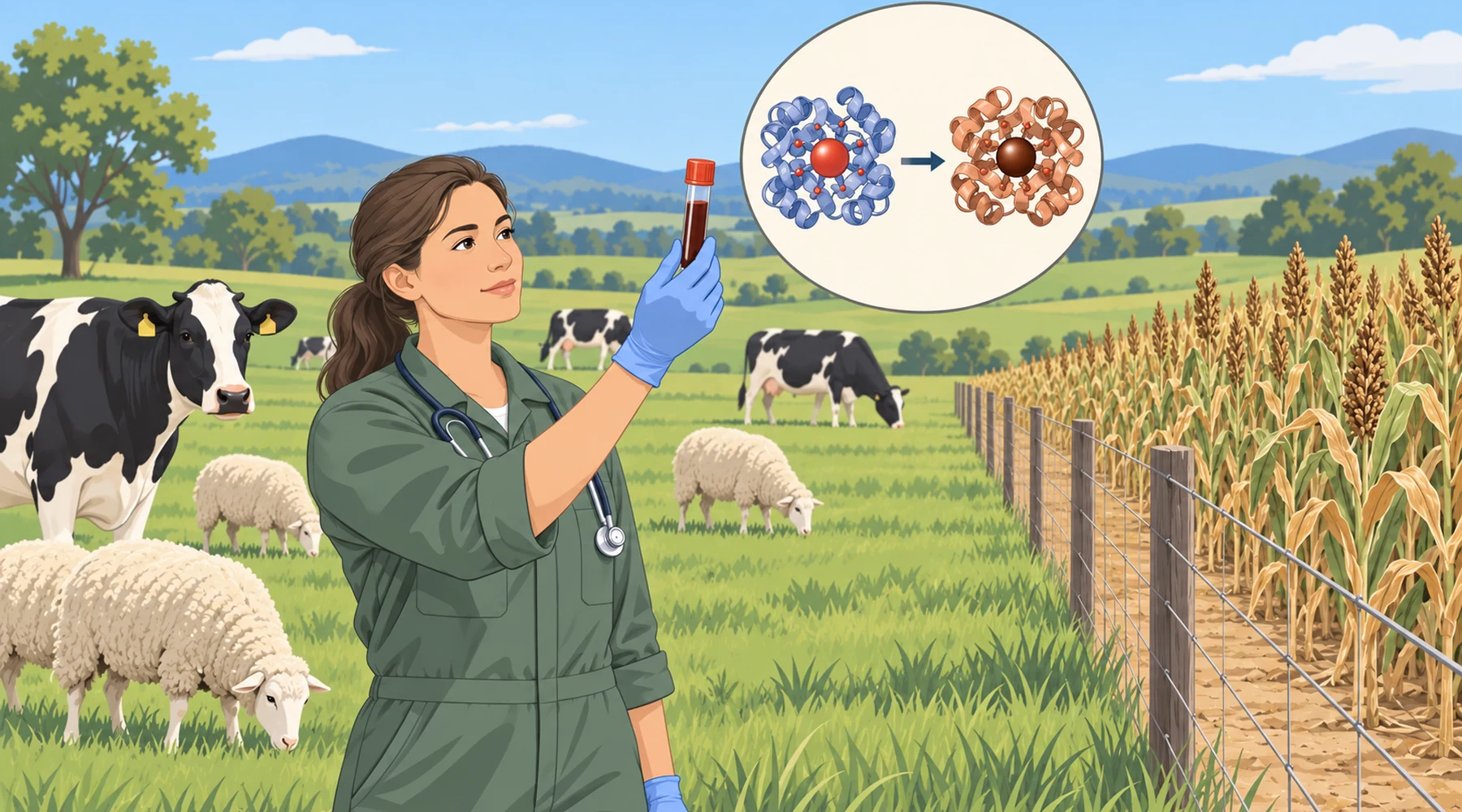
A herd moves onto drought-stressed sorghum in the afternoon. By evening several cows lag behind, breathing fast, with dark membranes and brown blood at venipuncture. Horses on the neighboring pasture look unaffected. The difference is not luck. It follows from where nitrate changes into nitrite, and that location decides both the diagnosis and the antidote plan.
The central point is simple: nitrate is mostly a precursor, nitrite is the poison, and methylene blue for cattle with nitrate exposure treats the nitrite effect on hemoglobin. Everything else in this article follows from those three steps.
Nitrate becomes nitrite inside the animal
Forage nitrate itself is a weak oxidant. Rumen microbes reduce it in two stages, first nitrate to nitrite, then nitrite onward to ammonia. When a large nitrate load arrives at once, the first step outruns the second. Nitrite accumulates, crosses into blood, and oxidizes the iron in hemoglobin from its oxygen-carrying ferrous state to the ferric state. The product is methemoglobin, which cannot transport oxygen.
The MSD Veterinary Manual review of nitrate and nitrite poisoning estimates nitrite to be roughly ten times more toxic than nitrate and describes the same sequence. Typical sources are nitrate-accumulating forages such as oats, millet, ryegrass, corn, sunflower, and sorghums, plus weeds like pigweed, lambsquarter, kochia, and Johnson grass, fertilizer ingestion, and runoff-contaminated ponds or shallow wells. Drought, heavy nitrogen fertilization, and arrested growth after cloudy or cool weather raise forage nitrate.
Methemoglobin percentage tracks severity only loosely, but the associations help triage. MSD places early signs such as tachycardia, weakness, tremor, and ataxia near 30 to 40 percent methemoglobin, marked dyspnea with brown or cyanotic membranes above about 50 percent, and fatal outcomes commonly at 80 percent or more. Chocolate-brown blood that stays brown in air is characteristic yet not pathognomonic, and methemoglobin reverts quickly enough that delayed samples understate the peak. For confirmation MSD prefers plasma nitrate testing before death and ocular fluid afterward, with forage and water analysis alongside. Values above about 20 ppm nitrate or 0.5 ppm nitrite in suitable biological samples generally indicate excessive exposure.
How methylene blue reverses the block
Under normal conditions most methemoglobin is reduced back by the NADH and cytochrome b5 reductase system. Methylene blue recruits a second, normally minor pathway. Cellular NADPH, generated through the pentose phosphate pathway, passes electrons through NADPH-dependent reductase to methylene blue, converting it to leucomethylene blue, which then reduces ferric iron back to ferrous hemoglobin. A StatPearls review of the mechanism lays out this carrier role.
The same chemistry creates the main caution. Methylene blue is a redox drug, not a pure antioxidant. At high concentrations it acts as an oxidant itself, recreating methemoglobin and injuring red cells. That is why a poor response should prompt the veterinarian to reconsider the diagnosis, ongoing ruminal absorption, and red cell status rather than simply repeating larger amounts. The general hospital logic, including diagnosis by co-oximetry and supervised injection, is described in methylene blue for methemoglobinemia.
Species and exposure comparison
This table is the decision aid. Each row combines exposure route, conversion site, and what methylene blue can and cannot do.
| Species group | Where nitrite forms | Typical exposure | Methylene blue context |
|---|---|---|---|
| Cattle | Rumen, efficiently | High-nitrate forage, fertilizer, contaminated water | Primary antidote candidates; reference range 4 to 15 mg/kg slow IV in ruminants, with repetition tied to severity and continued absorption |
| Sheep and goats | Rumen, efficiently | Same forage and water sources; sheep often described as somewhat less susceptible than cattle | Same ruminant framework; published reports span low single mg/kg field doses to 15 mg/kg experimental exposures, so sheep are not automatically low dose |
| Horses | Cecum and colon, less extensive nitrate reduction | Preformed nitrite remains hazardous; forage nitrate generally less potent than in cattle | Equine red cells respond poorly to methylene blue in classic in vitro work, and the drug can cause oxidative Heinz body hemolysis in horses; ruminant protocols do not transfer |
| Dogs and cats | Gut conversion minor relative to dose | Oxidant drugs and chemicals rather than pasture nitrate | Cats are exceptionally prone to oxidative Heinz body injury; a federal rule, 21 CFR 500.27, grew out of fatal feline hemolysis from oral methylene blue urinary products |
| Aquarium and pond fish | Gill uptake of waterborne nitrite, called brown blood disease | Nitrite spikes in new or overloaded systems | Bath concentration in mg per liter, not IV mg per kg; chloride competition and water correction lead, as covered in nitrite poisoning in aquarium fish |
Ruminants: cattle, sheep, and goats
Cattle are the species most frequently affected, and extension references commonly rank them as the most susceptible livestock group. Sheep and goats are clearly susceptible but often described as somewhat less affected, possibly because they handle nitrate loads faster. Treat that ranking as a useful tendency, not a settled biochemical constant.
Reproductive loss deserves separate attention. Cows that survive prolonged severe methemoglobinemia can abort or deliver stillborn calves roughly 5 to 14 days later, consistent with fetal hypoxia. A normal calf the next morning does not prove a mild exposure, and an abortion a week later does not prove a second exposure.
Published methylene blue cattle doses disagree because they come from different kinds of evidence. The current MSD passage gives slow intravenous 4 to 15 mg/kg or more from a 1 to 2 percent solution, with dose and repetition set by severity and continued absorption, and it states explicitly that only ruminants safely tolerate the higher amounts. Around that reference sit small experiments and field reports: an older cow experiment found 1 mg/kg adequate under its conditions, sheep pharmacology work evaluated 15 mg/kg intravenously, goat experiments tested 1 to 4 mg/kg with the 4 mg/kg groups performing best, and field reports describe recoveries near 4 mg/kg as well as an outlier cow case near 20 mg/kg. The 1984 sheep disposition study illustrates the category well: it supports tolerability reasoning, not a label.
For methylene blue methemoglobinemia sheep veterinary decisions, the practical reading is that no single number covers every case. Continuing ruminal generation means a recovering animal can relapse as more nitrite absorbs, which is why MSD ties repetition to ongoing exposure rather than a fixed schedule. Supportive care runs alongside: minimal-stress handling to limit oxygen demand, removal from the suspect feed and water, safe replacement feed, and attention to perfusion. Parenteral methylene blue is locally irritating, so secure venous access and slow intravenous delivery matter, and staining of tissues, urine, and sensors should be expected. Veterinary dye and spray limits put the broader species constraints in context.
Horses are a separate case
Horses ferment fiber in the hindgut rather than a rumen. Cecal microbes can reduce nitrate, but substantially less conversion occurs than in cattle, so adult horses are generally less susceptible to forage nitrate. Preformed nitrite bypasses that protection and stays dangerous.
The antidote logic also changes. In a classic comparative study of red cell methemoglobin regulation, methylene blue enhanced reduction in human cells but not in horse cells (equine erythrocyte study). Equine toxicology references separately describe methylene blue itself as a cause of oxidative Heinz body and eccentrocyte hemolysis and caution against it in oxidative disorders such as red maple poisoning. Neither point proves the drug can never help an individual horse, but together they block the common error of scaling a cattle protocol down by weight. A horse with suspected nitrite methemoglobinemia needs its own diagnosis, oxidant identification, and risk assessment, not a ruminant dose chart.
Pets and aquarium species show why weight scaling fails
Cats concentrate the warning. Feline hemoglobin is unusually prone to oxidative denaturation, and high or repeated methylene blue exposure produces Heinz bodies and hemolysis instead of cure. Dogs are less fragile than cats but still listed among sensitive species in comparative work. Pet oxidant exposures also differ in kind, since drugs, chemicals, and ingestion events dominate rather than pasture nitrate.
Fish show a different geometry entirely. Nitrite enters across the gills, so the lever is water chemistry, especially chloride competition and nitrite removal, before any drug. Methylene blue for fish is dosed as a bath concentration with species, duration, temperature, and biofilter effects attached, a system explained in methylene blue bath and tank treatment. A bath mg per liter value cannot be converted into an intravenous mg per kg value for a calf, and a calf protocol cannot be diluted into a tank.
Food-producing animals add a regulatory decision
There is no ordinary FDA-approved cattle, sheep, or goat methylene blue antidote label. FDA lists methylene blue for these species as a bulk substance nomination for food-animal antidotes that is currently under review (FDA compounding page), which is a queue position, not an approval and not a withdrawal time.
In the United States, use therefore runs through the veterinarian under extra-label provisions. The Animal Medicinal Drug Use Clarification Act requires a valid veterinarian-client-patient relationship, and for food animals a scientifically supported extended withdrawal interval with identification and residue safeguards. A modern residue study in eight healthy cattle given 6 mg/kg compounded methylene blue intravenously calculated study-derived intervals of 5 days for milk and 6 days for meat (cattle pharmacokinetics and withdrawal study). Those numbers belong to that study design. They are not an FDA-approved withdrawal period, and current residue advice for a treated animal should come through the attending veterinarian and resources such as FARAD.
European rules are stricter at the substance level. Pharmacologically active substances for food-producing species generally need a maximum residue limit entry or equivalent classification under the EU residue framework (EMA residue guidance), and EU assessments have discussed methylene blue among substances not registered for food-animal use. Describe it as not authorized for routine food-animal use in the EU rather than inventing a prohibition category. Horses with food-chain status need the same check before any cascade use.
A short decision sequence for the attending veterinarian
Confirm methemoglobinemia and look for the oxidant together: brown blood plus membranes, tachycardia, and dyspnea point toward it, while plasma or ocular fluid nitrate, forage, and water testing point to the source. Remove exposure first, because methylene blue given into continuing ruminal absorption treats the symptom while the rumen keeps manufacturing the cause. Choose the species framework before the amount: the ruminant reference range for methylene blue horses cannot borrow, cats need the strongest oxidative caution, and fish need water correction with bath logic from aquaculture uses and restrictions. Give slowly by vein with secure access, watch for relapse and hemolysis, and set milk and meat status in writing under local residue rules before the animal reenters the food chain.