
Article
Methylene blue for ifosfamide encephalopathy: what the case reports show, and what they do not
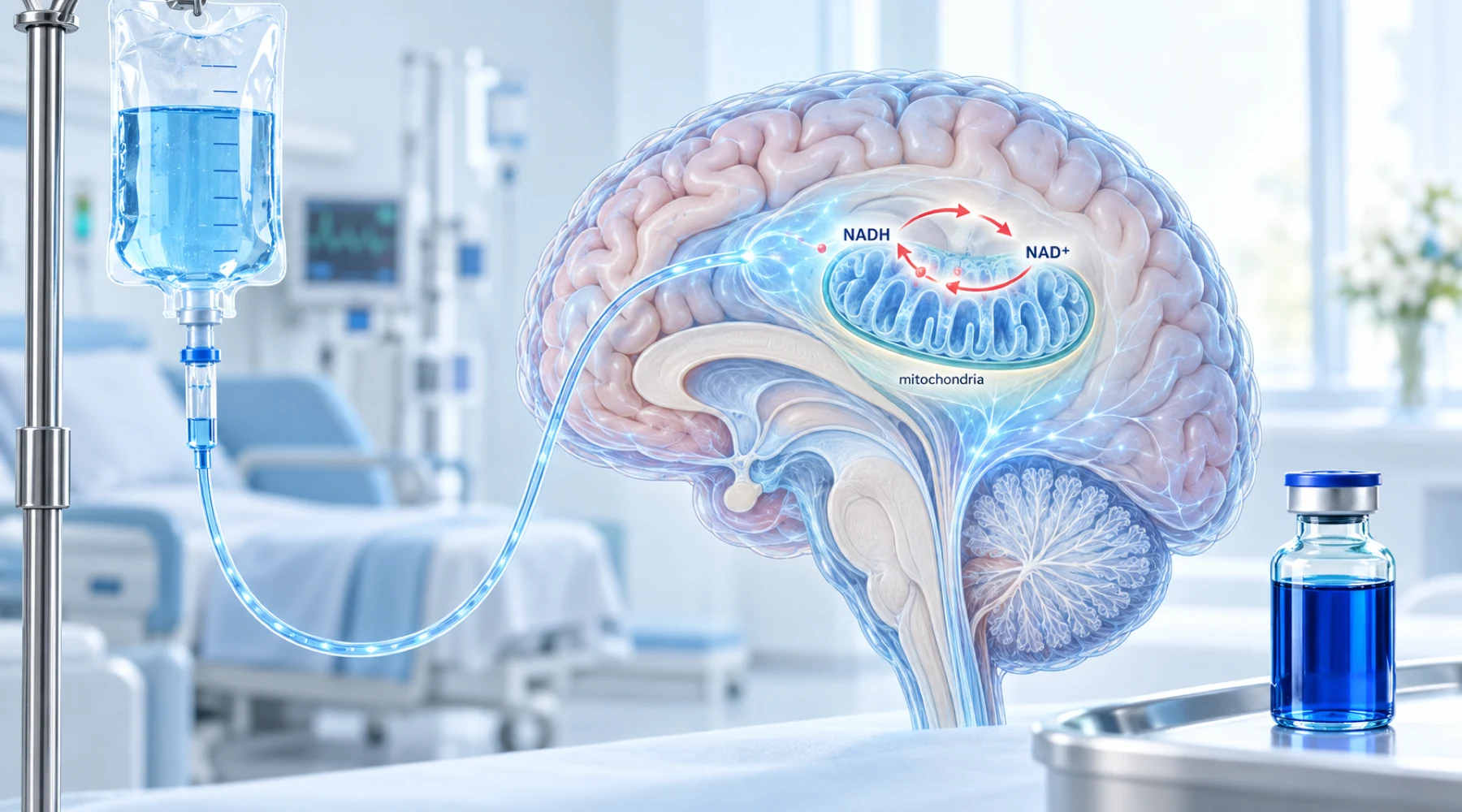
Ifosfamide is a workhorse alkylating drug in oncology, used for sarcoma, lymphoma, cervical cancer, and lung cancer among others. In a minority of patients it produces something alarming: hours to days after the infusion starts, the patient becomes confused, agitated, drowsy, sometimes frankly psychotic or unresponsive. Scans are usually normal. Then, in most cases, the picture clears within a few days once the drug is stopped. Oncologists call this ifosfamide-induced encephalopathy, and its unpredictability is the reason a 1990s report of a blue dye reversing it is still discussed on wards today.
The question this article answers is narrow. Does methylene blue treat or prevent that encephalopathy, and how strong is the evidence? The short answer is that the rescue stories are striking but the evidence is weak, and the prevention story is weaker still. That distinction matters because this is a hospital decision made under pressure, not a supplement decision made at home.
What the encephalopathy looks like
Symptoms typically begin during or shortly after ifosfamide infusion: disorientation, restlessness, hallucinations, somnolence, occasionally seizures or coma. The EEG often shows diffuse slowing. Risk rises with higher doses, rapid infusion, poor kidney function, low albumin, prior brain disease, and concurrent sedating drugs. Most episodes resolve with supportive care alone in one to three days, though severe or prolonged cases occur and rechallenge with ifosfamide can trigger a repeat episode.
That natural history is the concept you need before reading any methylene blue report. A drug given on day two of confusion followed by recovery on day three may have done nothing at all. Every claim below has to be weighed against spontaneous recovery.
Where the methylene blue idea came from
In 1994 a Bern group reported urinary findings in ifosfamide patients that resembled a rare inherited disorder of mitochondrial electron transfer, with excess glutaric acid and sarcosine, and described rapid reversal of encephalopathy after methylene blue in a short Lancet report. The follow-up mechanistic review proposed not one mechanism but three acting together.
First, ifosfamide breaks down in the liver into large amounts of chloroethylamine, which conjugates with cysteine to form a sulfur-containing cyclic compound called thialysine ketimine. That compound inhibits flavoproteins in the mitochondrial respiratory chain, blocking normal NADH oxidation. Methylene blue, as an alternative electron acceptor, can substitute for the blocked step, a rationale borrowed from its older use in certain forms of glutaric aciduria.
Second, the blocked redox chain plus excess aldehyde load from ifosfamide metabolism drives down the NAD to NADH ratio, which impairs aldehyde clearance and glucose production. Methylene blue re-oxidizes NADH toward NAD, restoring part of that balance. The same redox shuttling behavior underlies most of its other proposed cellular effects, and the general principle of how methylene blue shuttles electrons is worth understanding separately from this specific clinical use.
Third, methylene blue inhibits amine oxidase enzymes that would otherwise convert chloroethylamine into chloroacetaldehyde, a directly neurotoxic and nephrotoxic metabolite found free in plasma of ifosfamide patients. Less chloroacetaldehyde means less downstream injury, including less disruption of fatty acid oxidation demonstrated in isolated mitochondria.
The mechanism is plausible and unusually detailed. Plausible is not proven, but it explains why oncologists took the early cases seriously.
The rescue reports: fast, but uncontrolled
The most cited case remains a 1995 report of a 68-year-old woman with cervical cancer who became confused and agitated after 5 g per square meter of ifosfamide over 24 hours. Her CT was normal and her EEG showed diffuse slowing. She received 50 mg of methylene blue intravenously over five minutes and was described as awake and coherent within ten minutes. Ten minutes is far faster than the natural course, which is why this single case carried so much weight.
Later series are less dramatic. In a retrospective series of 52 ifosfamide patients, 12 developed grade 2 or worse encephalopathy, eight of whom received methylene blue at 50 mg intravenously six times daily. Four recovered fully within 24 hours including one severe case within about an hour, two more by 48 hours, and two by 72 hours. But all four untreated patients also recovered within 48 hours, as the authors themselves reported. A pediatric series of 15 cases found demonstrable benefit in only one of five treated children. Two adult cases published in 2018 and treated with 50 mg every four hours began improving only after 12 to 16 hours and returned to baseline after two to three days, indistinguishable from supportive care timelines.
A 2020 literature review counted 38 published methylene blue treated patients with about three quarters described as favorable responders. That figure sounds reassuring until you remember that rapid recoveries get written up and slow ones often do not. Publication bias makes case report collections look better than the underlying reality.
Evidence table: keep the designs apart
The table below is the core of this review. Case reports can only suggest; series without controls can only describe; and for this question there are no randomized efficacy trials.
| Evidence tier | Study | Design and patients | Methylene blue regimen | What happened |
|---|---|---|---|---|
| Case report | Kupfer et al., Lancet 1994 | Index treatment case plus one prophylaxis case; biochemical finding of glutaric aciduria-like pattern | Treatment 50 mg IV; prophylaxis oral | Rapid reversal reported; second patient had no recurrence on rechallenge |
| Case report | Zulian et al., N Engl J Med 1995 | 68-year-old woman, cervical cancer, confusion after ifosfamide 5 g/m2 over 24 h | 50 mg IV over 5 min, 1 percent solution | Awake and coherent within 10 min |
| Case series, retrospective with untreated comparison | Pelgrims et al., Br J Cancer 2000 | 52 ifosfamide patients; 12 with grade 2 or worse encephalopathy; 8 treated, 4 not | Treatment 50 mg IV six times daily; prophylaxis 50 mg four times daily in 3 patients | Treated: 4 of 8 recovered within 24 h, all within 72 h. Untreated: all 4 recovered within 48 h |
| Case series | Turner et al., Clin Oncol 2003 | 4 acute cases, 2 later given prophylaxis | Often 50 mg orally three times daily | Marked improvement within 24 h reported; milder course on rechallenge with prophylaxis |
| Case series, pediatric | Dufour et al., Arch Pediatr 2006 | 15 pediatric encephalopathy cases | Treatment 50 mg IV every 4 h; prophylaxis every 6 h | Benefit judged present in 1 of 5 treated; 2 of 2 prophylaxis cases without recurrence |
| Pharmacokinetic study, no efficacy control | Aeschlimann et al., Drug Metab Dispos 1998 | 9 lung cancer patients on ifosfamide, mesna, etoposide | 50 mg orally three times daily from evening before chemotherapy | Tolerated; no material change in ifosfamide activation; neuroprotection claimed but uncontrolled |
| Retrospective, prophylaxis focus | Sweiss et al., Drug Safety 2008 | 19 high-dose ifosfamide patients; 8 with encephalopathy; 5 rechallenged with prophylaxis | Prophylactic methylene blue, regimens varied | All 5 prophylaxed rechallenges developed encephalopathy again |
| Retrospective cycles comparison | Richards et al., J Oncol Pharm Pract 2011 | 166 cycles with prophylactic methylene blue, thiamine, or albumin versus none | Heterogeneous prophylaxis | Encephalopathy in 21.1 percent of prophylaxis cycles versus 8.4 percent without; confounding by indication likely |
| Retrospective series | MD Anderson pediatric and young adult series, 2025 | 24 encephalopathy patients; 20 received methylene blue | Most often 50 mg IV every 6 h, median 5 doses | 19 of 20 recovered over 24 to 120 h with no untreated comparison; 3 of 5 prophylaxed rechallenges recurred |
Read down the outcome column and the pattern is consistent: dramatic early anecdotes, then progressively slower and more mixed results as sample sizes grow and comparisons appear. That is the signature of an intervention whose true effect, if any, is modest.
Prophylaxis does not hold up
The prevention claim deserves its own verdict because it drives real prescribing. After the early Bern experience with oral ifosfamide plus 50 mg three times daily and no observed neurotoxicity, several centers tried methylene blue prophylaxis on rechallenge. The results scatter. Some rechallenged patients had milder episodes or none; in other series every prophylaxed rechallenge still developed encephalopathy, and one retrospective comparison found more encephalopathy in prophylaxed cycles than in unprophylaxed ones, almost certainly because the highest risk patients were selected for prophylaxis.
Guideline writers have noticed. The joint neurotoxicity guideline from European oncology and neurology societies concluded that controlled trials are absent and methylene blue cannot be recommended for prevention or treatment on current evidence. Prescribing information and some institutional protocols take a softer line, saying it may be considered for moderate or severe encephalopathy. Both positions describe the same data; they differ only in how much weight to give anecdotes when no better option exists.
Specialist context a non-oncologist should know
Three practical points frame every bedside decision. First, methylene blue is off label here, given intravenously in hospital, typically 50 mg every four to eight hours until symptoms resolve. It is not a home remedy and this article is not a dosing guide.
Second, methylene blue is a monoamine oxidase A inhibitor with a boxed warning for serotonin syndrome when combined with serotonergic antidepressants and certain opioids, and serotonin syndrome has been reported specifically during treatment of ifosfamide encephalopathy. It is also contraindicated in glucose-6-phosphate dehydrogenase deficiency because of hemolysis risk. The safety and interaction profile and the broader question of whether methylene blue use is safe in a given patient belong in the decision before any blue vial is opened.
Third, stopping ifosfamide, hydration, correcting electrolytes and co-medications, and excluding other causes of confusion remain the foundation. Methylene blue, where used, is added to that foundation, not substituted for it. Learning how to read a methylene blue study helps here: ask whether the report had a control group, how encephalopathy was graded, what else changed at the same time, and whether the recovery time differs from the known one to three day natural course.
Bottom line
Methylene blue for ifosfamide encephalopathy rests on a coherent mitochondrial mechanism, a handful of rapid and genuinely impressive rescue anecdotes, and a larger body of series in which treated and untreated patients recover on similar timelines. As rescue therapy for severe or prolonged encephalopathy, some oncologists consider it reasonable given the lack of alternatives. As routine prophylaxis, the evidence does not support it. Anyone encountering this question, whether patient, caregiver, or clinician, should treat it as a specialist, inpatient, case by case judgment, and read the fast recoveries as hypothesis rather than proof.