
Article
Methylene blue and inflammatory bowel disease: research versus diagnostic staining
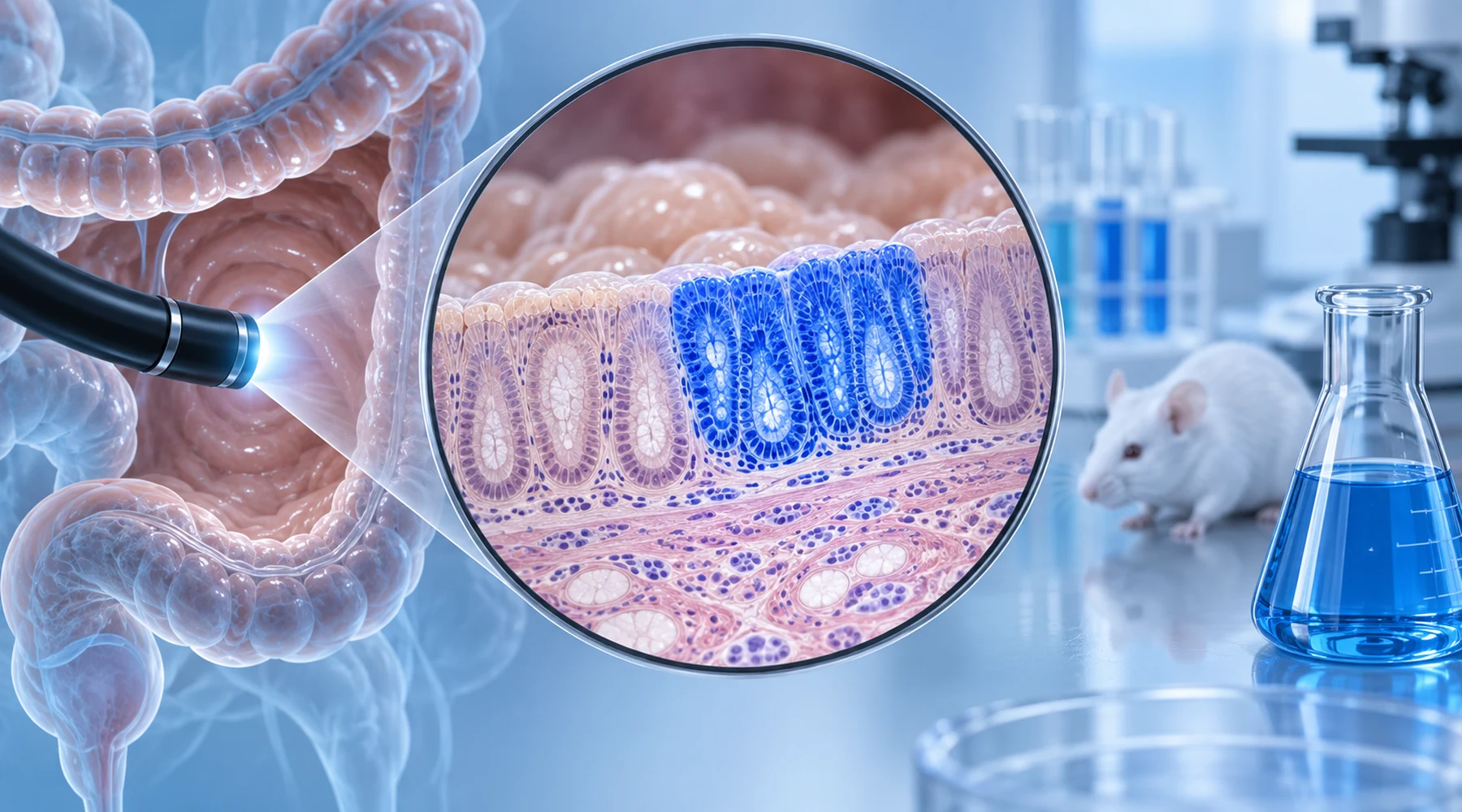
Two procedures share a blue molecule and almost nothing else. In one, researchers give methylene blue to rats with chemically injured colons and measure whether inflammation falls. In the other, an endoscopist sprays dilute blue dye onto the bowel lining of a person with ulcerative colitis or Crohn's colitis to see suspicious patches more clearly. The first asks whether the compound changes disease. The second asks whether the color reveals it. Readers searching for methylene blue ulcerative colitis evidence need both stories kept apart, because merging them turns a visibility aid into an imaginary therapy.
The experiment that tried to change inflammation
The therapeutic attempt is a 2015 rat study by Dinc and colleagues, published as methylene blue inhibits the inflammatory process of acetic acid induced colitis. It was a randomized preclinical experiment, not a patient trial. Eighty male Sprague-Dawley rats were split into four groups of twenty: healthy controls, healthy animals given dye, untreated colitis, and treated colitis. Colitis was induced with acetic acid, and animals in the treated groups received 2 mL of 1% methylene blue solution. Three days later the team examined an 8 cm segment of distal colon.
Endpoints covered several layers of injury: visible and microscopic damage scores, intestinal permeability, neutrophil activity through myeloperoxidase, lipid peroxidation through malondialdehyde, the antioxidant enzymes superoxide dismutase and catalase, the cytokines TNF-alpha, IL-1beta and IL-6, and nitric oxide pathway readouts including total nitrite/nitrate and nitric oxide synthase activity.
Acetic acid produced the expected injury, and against that background the dye treated colitic rats showed less macroscopic and microscopic damage, better permeability, lower myeloperoxidase and malondialdehyde, restored superoxide dismutase and catalase, and lower cytokines, nitrite/nitrate and synthase activity. The authors proposed inhibition of excessive nitric oxide production as the central mechanism, with reduced oxidative and nitrosative stress contributing. That is a coherent hypothesis for this model, and the broader inflammation evidence review places it among other laboratory findings rather than clinical proof.
What the study did not do matters more. It ran three days, used males only, tested one fixed regimen with no dose response, included no standard IBD drug as comparator, and measured tissue and biochemical surrogates rather than remission, relapse, or any patient outcome. As of September 2026 there is no published human trial testing methylene blue as a treatment for ulcerative colitis or methylene blue for Crohn's disease with therapeutic endpoints. The rat result is a starting point for research, not a basis for personal dosing decisions.
Why a chemical burn is a weak stand-in for IBD
Acetic acid colitis is an injury model, not a disease model in the human sense. A chemical solution burns the distal colonic mucosa, neutrophils rush in, ulcers form, and the animal is examined within days. Human ulcerative colitis is a chronic relapsing immune mediated condition shaped by genetics, microbiota, and adaptive and innate immunity, with flares and remissions over years. The model reproduces some distal colon morphology and inflammatory readouts while missing initiation, persistence, and relapse almost entirely.
For Crohn's disease the mismatch grows. The acetic acid lesion sits in the distal colon and stays mucosal to submucosal. Crohn's can strike any segment of the gastrointestinal tract in discontinuous skip lesions, runs transmural through the bowel wall, and remodels tissue into strictures and fistulas. Questions about methylene blue and Crohn's disease therefore cannot be answered by a three day distal colon burn in rats. Related animal work on microbial communities belongs in its own context, discussed in the gut microbiome mouse study guide.
The practical rule is simple. When a claim cites an induced colitis model, ask which chemical, which species and sex, how long the experiment ran, whether a standard therapy served as comparator, and whether endpoints were tissue markers or clinical outcomes. A model that answers how inflamed a rat colon looked on day three cannot answer whether a person stays in remission at month twelve.
The study that only looked
The second paper belongs to a different concept. Marion and colleagues ran a prospective dysplasia surveillance study in 102 people with longstanding colitis, 79 with ulcerative colitis and 23 with Crohn's colitis, reported as chromoendoscopy targeted biopsies are superior to standard surveillance. Each patient served as their own control during a single examination with two passes of the colonoscope. The team compared conventional random biopsies, targeted biopsies of abnormalities seen under ordinary white light, and targeted biopsies after pancolonic spray of 0.01% methylene blue. A single gastrointestinal pathologist read the specimens blinded.
Dye assisted targeting found dysplasia in 17 patients against 3 for random biopsy, a statistically significant difference, and against 9 for white light targeting alone, a numerical gain that missed conventional significance. Combined targeted approaches found dysplasia in 20 patients versus 3 with random sampling. No adverse events were reported.
Nothing here tested therapy. The dye was a topical contrast agent that made pit pattern abnormalities easier to see and biopsy. It did not measure symptoms, disease activity, cytokine levels, remission, or relapse, and it cannot be cited as human evidence that methylene blue treats IBD. Detection is the endpoint, and detection belongs with the gastrointestinal endoscopy and chromoendoscopy guide, which explains vital staining, the oral Lumeblue tablet formulation, and why finding lesions is not treating them.
Intervention versus visualization: evidence table
| Dinc 2015: experimental intervention | Marion 2008: diagnostic visualization | |
|---|---|---|
| Role of the dye | Candidate anti inflammatory agent | Topical contrast stain |
| Question asked | Does methylene blue reduce colitis injury in rats | Does dye spray improve dysplasia detection in people |
| Subjects | 80 male rats, acute acetic acid colitis, 3 day endpoint | 102 surveillance patients, 79 ulcerative colitis and 23 Crohn's colitis |
| Regimen | 2 mL of 1% solution, single fixed regimen | 0.01% spray during colonoscopy, suctioned after uptake |
| Endpoints | Damage scores, permeability, MPO, MDA, SOD, catalase, cytokines, NOS activity | Patients with histologically confirmed dysplasia per biopsy method |
| Headline result | Treated colitic rats improved across histologic and biochemical markers | Dye targeting found dysplasia in 17 vs 3 random, P 0.001; 17 vs 9 white light targeting, P 0.057 |
| What it does not show | No human efficacy, no remission data, no dosing guidance | No treatment effect on inflammation, symptoms, or disease course |
How to read the next IBD claim
Treat every claim as a small classification task. First, identify the role: is the dye given to alter biology or applied to inspect tissue. Second, identify the disease: ulcerative colitis confined to the colon is not Crohn's disease with its skip lesions and transmural complications, and a result in one does not transfer to the other. Third, identify the level: a chemically induced rat model, a human detection study, and a human treatment trial answer different questions and cannot substitute for each other. Fourth, inspect the endpoints: tissue markers and detection counts are surrogates, while remission, relapse, hospitalization, and surgery are the outcomes patients feel. A claim that passes all four checks earns attention. One that borrows the detection numbers from Marion to support a treatment decision fails the first check and should be set aside.
What to take away
Keep two boxes and never let their contents mix. Box one holds a short rat experiment in which methylene blue reduced markers of chemically induced colonic injury, with the nitric oxide pathway as the leading mechanistic suspect and every translational limit of acute models attached. Box two holds a human surveillance study in which blue dye helped endoscopists find dysplasia worth biopsying, with zero information about treating bowel disease. For orientation across authorized and experimental applications, see the overview of methylene blue in medicine. The collected methylene blue research record catalogues the studies behind these distinctions.