
Article
Methylene blue and inflammation: what the evidence measures
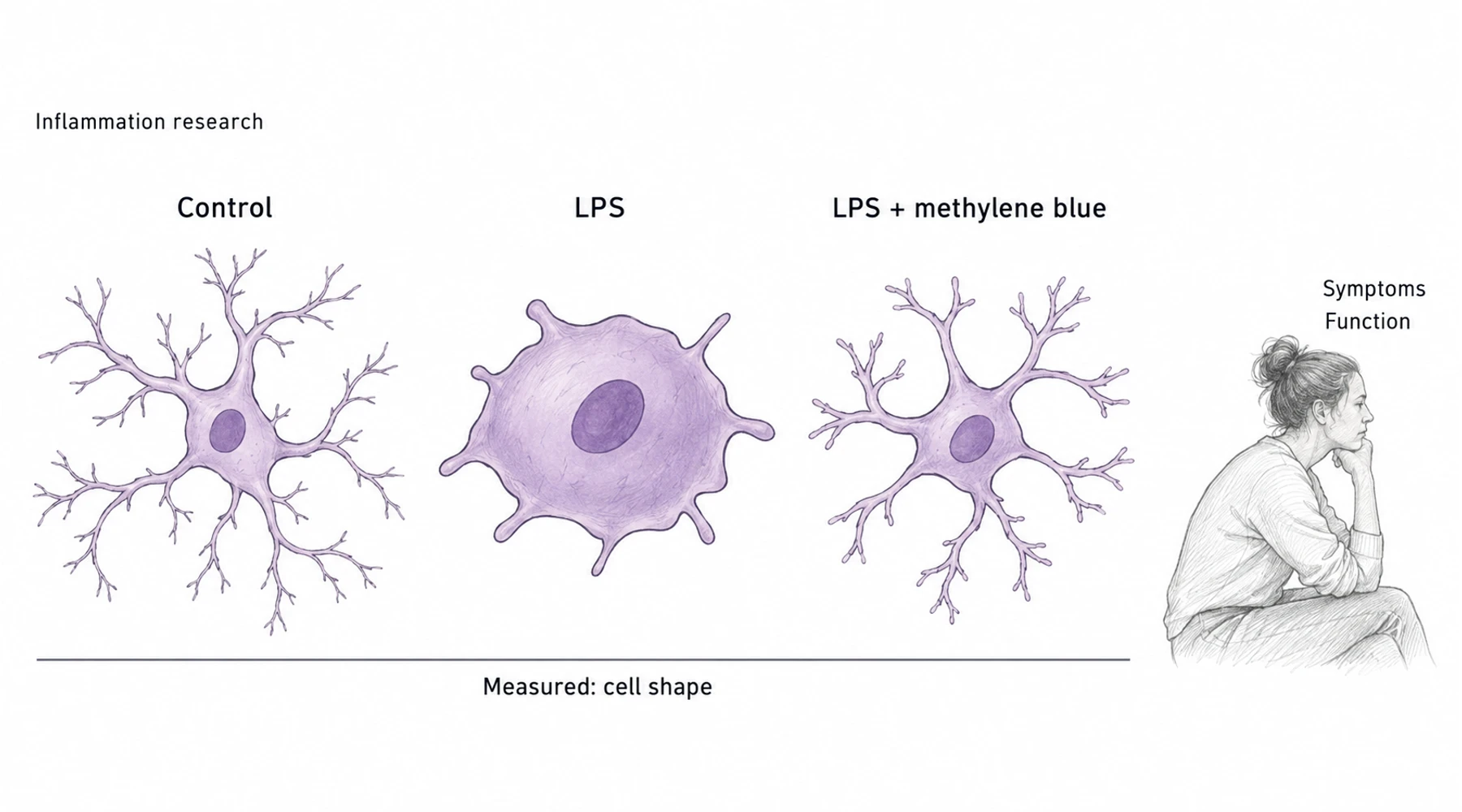
Methylene blue can reduce particular inflammatory signals under experimental conditions. That does not establish it as a general treatment for inflammation in people. The studies reviewed here support biological activity, with some animal benefits and limited, highly specific human findings. They do not establish that taking methylene blue improves everyday symptoms attributed to “chronic inflammation.”
The useful question is more precise: which inflammatory process changed, in which model, and did the change improve an outcome that matters to the patient? A cytokine concentration, the outline of a cell, and the duration of intensive-care treatment answer different questions. Our broader review of methylene blue benefits in human research places these findings alongside other proposed health uses.
What counts as an anti-inflammatory result?
Inflammation coordinates responses to infection and injury. It can contribute to damage, but some inflammatory activity also supports defense and repair. “Less inflammation” is therefore incomplete without a location, trigger, time point, and outcome.
A cytokine is a signaling protein. Researchers may measure how much of it appears in culture fluid or blood. They may instead measure the expression of an inflammatory enzyme, the activation state of a signaling protein, or changes in an immune cell's shape. These measurements can reveal a drug effect without showing that pain, fatigue, cognition, or disease activity improves.
Lipopolysaccharide, usually shortened to LPS, is a bacterial component used to provoke an inflammatory response. Several methylene blue studies use this controlled trigger. An LPS challenge is useful for testing a mechanism, but it does not reproduce every feature of a chronic human illness. The same limitation applies when a drug is given alongside the trigger: preventing an experimentally induced change is different from reversing established disease.
Evidence matrix: model, trigger, endpoint, relevance
This matrix summarizes selected primary studies. Each row preserves the distinction between what investigators measured and what a reader might hope the finding means.
| Study and model | Inflammatory trigger or setting | Measured endpoint and finding | Clinical relevance |
|---|---|---|---|
| Huang and colleagues, 2015: mouse macrophages and mice | LPS and/or interferon-gamma in cultured cells; endotoxemia in mice | Reduced expression of inducible nitric oxide synthase, or iNOS | Supports an effect on an inflammatory enzyme; does not measure human symptoms |
| Ahn and colleagues, 2017: macrophages and human THP-1 cells | Experimental activation of several inflammasomes | Reduced IL-1β release and inflammasome-related activity | Mechanistic evidence; a human cell line is not a patient trial |
| Ahn and colleagues, 2017: mice | LPS challenge; separate Listeria challenge | Improved survival after LPS and lower peritoneal IL-1β in experimental conditions | Includes an animal outcome beyond a biomarker; does not demonstrate improved survival in people |
| Li and Ying, 2023: mice | Repeated LPS injections over three days | Lower serum IL-6, less STAT3 activation in brain and skin, and less weight loss | Shows signaling and a whole-animal response; no human symptom or disease-remission measurement |
| Aburel and colleagues: human cardiovascular fat samples | Tissue collected during surgery from 25 patients with heart failure; laboratory incubation, including a serotonin challenge | Lower monoamine oxidase expression and oxidative-stress readouts | Human tissue relevance, but oxidative stress is not interchangeable with inflammation, and patients were not treated in this experiment |
| Stelmashook and colleagues, 2026: rat cortical glial cultures | LPS exposure for 24 hours | With methylene blue, microglia had more processes and a smaller cell-body profile than with LPS alone | A morphological result, without evidence of improved memory, behavior, or human symptoms |
| Memis and colleagues, 2002: 30 patients with severe sepsis | Six-hour intravenous infusion versus saline in a randomized trial | No significant effect on measured plasma cytokine levels | Direct human testing did not confirm cytokine lowering under that protocol |
| Ibarra-Estrada and colleagues, 2023: 91 analyzed patients with septic shock | Intravenous methylene blue versus placebo, added to intensive-care treatment | Shorter vasopressor duration; cytokines were not measured | A specific clinical finding whose mechanism was not established by inflammatory-marker testing |
Three distinctions that change the interpretation
Lower signaling is not automatically better function
The 2015 iNOS study investigated how methylene blue reduced production of an enzyme involved in nitric oxide biology. This helps explain a possible action of the drug. It does not establish that reducing that enzyme would benefit every person with an inflammatory condition.
Likewise, the 2023 mouse study connected changes in blood IL-6 with changes in tissue signaling. Its weight-loss result adds useful whole-animal information. Nevertheless, weight during an acute challenge is not equivalent to cognition, quality of life, or sustained control of chronic disease. The more detailed account of inflammasomes, IL-6, and STAT3 explains the pathways without substituting them for health outcomes.
A cell's appearance is one measurement
Microglia are immune cells in the central nervous system. Their branching processes and cell bodies can change with their environment. In the 2026 culture study, methylene blue changed the appearance of LPS-exposed cells toward the control pattern.
The cover illustrates this comparison schematically. It is not a microscope image or a quantitative reproduction of the experiment. More branching does not independently prove that a cell protects neurons, clears pathogens effectively, or improves brain function. Those claims need additional measurements. The review of microglia, astrocytes, and inflammation examines that context in more detail.
Human tissue is not a treated human
The cardiovascular-fat study used samples from people, making it relevant to human biology. Researchers exposed those samples to methylene blue outside the body for 24 hours. This arrangement can establish a response in the sampled tissue, but it bypasses absorption, distribution, metabolism, and interactions between organs.
It also measured oxidative stress and monoamine oxidase expression. Those processes can interact with inflammation, yet a reduction in reactive oxygen species is not itself proof of reduced inflammatory disease. The distinction is central to reading cell, animal, tissue, and clinical research.
What the clinical studies do and do not show
Sepsis provides a direct test of the idea that methylene blue must lower inflammatory cytokines in people. The small randomized severe-sepsis trial did not find a significant cytokine effect. That does not prove no effect is possible with any regimen or condition. It does show why positive cell findings cannot be treated as universal human results.
In the 2023 septic-shock trial, median time to stopping vasopressors was 69 hours with methylene blue and 94 hours with placebo. These medicines support blood pressure. Mortality was not significantly different, and the study was too small to settle that outcome. The authors explicitly reported that they did not measure cytokines to confirm a mechanism. A circulatory benefit in intensive care therefore cannot establish treatment of general inflammation, or justify transferring the regimen to home use.
What would support a broader health claim?
A convincing claim needs a defined patient population, a suitable comparator, a reproducible formulation and route, and an outcome such as symptoms, function, disease activity, or complications. The follow-up must be long enough to evaluate the proposed benefit and its harms. A favorable biomarker can support that evidence; it cannot replace it.
Claims about MCAS and histamine intolerance require their own disease-specific evidence. General cytokine studies cannot establish that methylene blue controls mast-cell symptoms.
There is also a practical cost to assuming an experimental effect is a safe treatment. The current US prescribing information for intravenous ProvayBlue lists acquired methemoglobinemia as its indication, warns about serious serotonin syndrome with serotonergic drugs and opioids, and contraindicates use in G6PD deficiency because of hemolytic-anemia risk. An anti-inflammatory hypothesis does not remove these pharmacological effects.
For readers assessing a product claim, ask for the patient study behind the promised outcome. If the evidence ends at a cytokine, tissue sample, or cell photograph, the claimed clinical benefit remains unestablished.