
Article
Methylene blue for MCAS and histamine intolerance: what the evidence shows
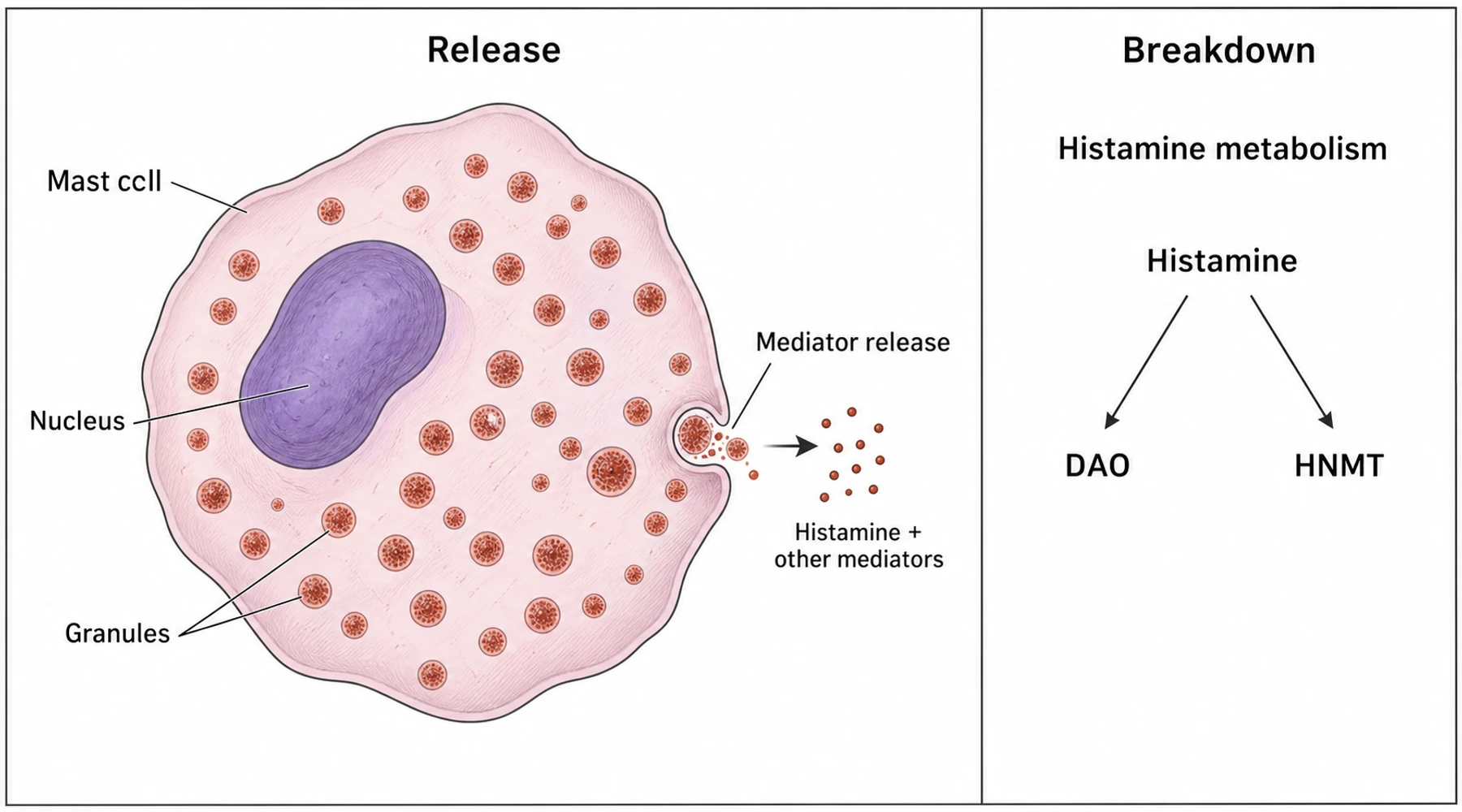
Methylene blue is not an established treatment for mast cell activation syndrome (MCAS) or histamine intolerance. The literature located for this article did not provide controlled patient trials demonstrating sustained benefit for either condition. The available findings include laboratory experiments and a perioperative case report, which answer narrower questions.
The distinction matters because “reduces inflammation,” “stabilizes mast cells,” and “clears histamine” describe different effects. Evidence for one cannot simply be transferred to the others.
Three terms that should stay separate
MCAS concerns recurrent systemic episodes of mast-cell mediator release. Histamine is one mediator, but mast cells also produce other signaling substances. The American Academy of Allergy, Asthma & Immunology explains MCAS evaluation through a combination of characteristic attacks, an increase in relevant mediators during symptoms compared with baseline, and response to treatment directed at those mediators. A collection of symptoms alone does not establish the diagnosis.
Immediate IgE-mediated allergy involves an immune response to a particular allergen. Allergen binding to IgE on mast cells can trigger mediator release. This familiar allergy pathway can involve mast cells without making every allergic person someone with idiopathic MCAS. “Allergy” also encompasses mechanisms beyond this immediate pathway.
Histamine intolerance is commonly used for suspected adverse reactions to histamine in food. It is not interchangeable with food allergy or MCAS. A 2021 multi-society guideline on ingested histamine describes limited, contradictory evidence connecting intake with reproducible symptoms and warns that serum diamine oxidase measurements cannot establish the diagnosis. The term expresses a proposed explanation for symptoms; a food reaction does not by itself prove deficient histamine breakdown.
What the mast-cell experiments actually measured
The direct experimental findings do not support a simple account in which methylene blue reliably prevents mast-cell release.
In Kimura and colleagues' 1999 rat microcirculation study, researchers observed mast cells beside small mesenteric veins using intravital microscopy. Applying methylene blue locally by superfusion at 50 micromolar elicited degranulation. Leukocytes also adhered more to the vessel lining and rolled more slowly. Ketotifen pretreatment inhibited the degranulation response. This was an animal preparation examining nitric-oxide-related signaling, not oral treatment of people with MCAS.
A 2001 study of human basophils and rat peritoneal mast cells measured histamine release directly. Methylene blue did not alter basal or immunologically stimulated release from the human basophils under the conditions tested. Basophils are related immune cells, not interchangeable with tissue mast cells.
Another experiment using the rat RBL-2H3 cell line found no effect of methylene blue on basal or L-arginine-induced histamine release. A cell line, isolated cells, and mast cells within a living microvascular preparation differ in their surrounding signals and experimental exposures. Neither a null result nor a degranulation result in these models predicts every human response. Together, they make a blanket “mast-cell stabilizer” claim difficult to justify.
General inflammatory measurements sit further from the clinical question. A change in a cytokine or signaling protein would not establish reduced mast-cell degranulation unless that was measured. Even a demonstrated reduction in mediator release would still need patient evidence to establish fewer attacks or better daily functioning. The distinction between inflammatory signals and health outcomes applies here.
A hospital case answers a different question
The 2017 pulmonary-embolectomy case report describes a patient with a possible mast-cell disorder who developed postoperative vasodilatory shock. The patient received H1 and H2 antagonists, steroids, and methylene blue, with improved hemodynamics.
That is a clinical observation, but the outcome was recovery of circulation in a complex surgical setting. Several treatments were given, there was no comparison group, and the diagnosis was uncertain. The report cannot isolate methylene blue's contribution, show that it stopped mediator release, or establish that repeated use improves chronic food reactions. Improving the downstream blood-pressure consequences of an episode and preventing the episode are separate treatment objectives.
Condition-and-endpoint comparison
Use this comparison to identify what a proposed benefit would actually require. The evidence requirements below are an original synthesis of the diagnostic and experimental distinctions above, not a validated diagnostic tool.
| Proposed effect | Relevant condition or process | Evidence that would support it | What would remain unproven |
|---|---|---|---|
| Prevents mast-cell activation | Mast-cell mediator release in a defined model | Controlled measurements of degranulation and relevant mediators, with viable-cell controls | Benefit for people with confirmed MCAS |
| Controls MCAS | Clinically characterized recurrent systemic episodes | Controlled patient outcomes such as episode frequency, severity, functioning, and adverse effects, with suitable mediator assessment | That benefit comes from faster histamine breakdown |
| Improves food-related histamine reactions | Reproducible symptoms associated with ingested histamine after other explanations are assessed | Blinded, supervised comparison of symptoms under standardized conditions | An underlying DAO deficiency or a benefit for IgE-mediated allergy |
| Accelerates histamine clearance | Histamine metabolism | Validated measurements of histamine handling under controlled exposure, with enzyme-specific evidence | Fewer symptoms or fewer mast-cell attacks |
| Improves shock or general inflammation | Circulatory failure or a specified inflammatory pathway | Hemodynamic outcomes or the actual inflammatory endpoint, with an appropriate comparator | Prevention of allergy, MCAS episodes, or food intolerance |
Histamine breakdown is not MAO inhibition
Histamine has two principal metabolic routes involving diamine oxidase (DAO) and histamine N-methyltransferase (HNMT). These are different enzymes from monoamine oxidase A (MAO-A). The cover separates mediator release from these breakdown routes; its enzyme labels identify pathways, not products made from histamine.
Ramsay and colleagues demonstrated methylene blue's inhibition of MAO-A, a finding relevant to serotonin toxicity. Inhibiting MAO-A is not evidence that DAO or HNMT activity increases, and it does not demonstrate faster histamine clearance. Similar enzyme names do not establish a shared therapeutic effect.
There is also an easily missed research distinction. A 2020 DAO assay study involving 22 patients and 22 controls generated methylene blue as the colored product of a laboratory reaction used to estimate enzyme activity. Participants were not being treated with methylene blue. Finding both terms in a paper therefore does not necessarily identify treatment research.
Why symptom changes cannot confirm the mechanism
The forum discussion that prompted this question includes reports of better digestion and less urinary urgency after methylene blue. Those reports describe perceived changes. They do not measure histamine concentration, establish MCAS, or demonstrate that bladder tissue became resistant to histamine.
Symptoms can fluctuate while diet, caffeine, hydration, medicines, and other exposures change. An observation can be accurate without its proposed explanation being correct. Urinary urgency also needs its own assessment: bladder symptoms and confirmed urinary infection are different findings. Symptom relief alone cannot identify either infection or mast-cell activity as the cause.
Hypersensitivity remains relevant
Methylene blue itself can cause hypersensitivity. The PROVAYBLUE intravenous prescribing information describes anaphylaxis and contraindicates use after severe hypersensitivity to a methylene-blue-class product. It also warns about serotonin syndrome with interacting medicines and contraindicates use in G6PD deficiency. This label establishes important hazards; it does not quantify every risk for an unstudied oral product.
The evidence does not justify substituting methylene blue for prescribed antihistamines or other established care. Breathing difficulty, throat swelling, or collapse warrants emergency medical help, not an experiment with a dye. For a planned clinical discussion, bring the exact claim, product, current medicines, and symptom history using these questions to ask about methylene blue. The practical question is which diagnosis and outcome the proposed treatment is meant to address, and whether evidence exists for that specific use.