
Article
Methylene blue for betta fish: answering common treatment questions
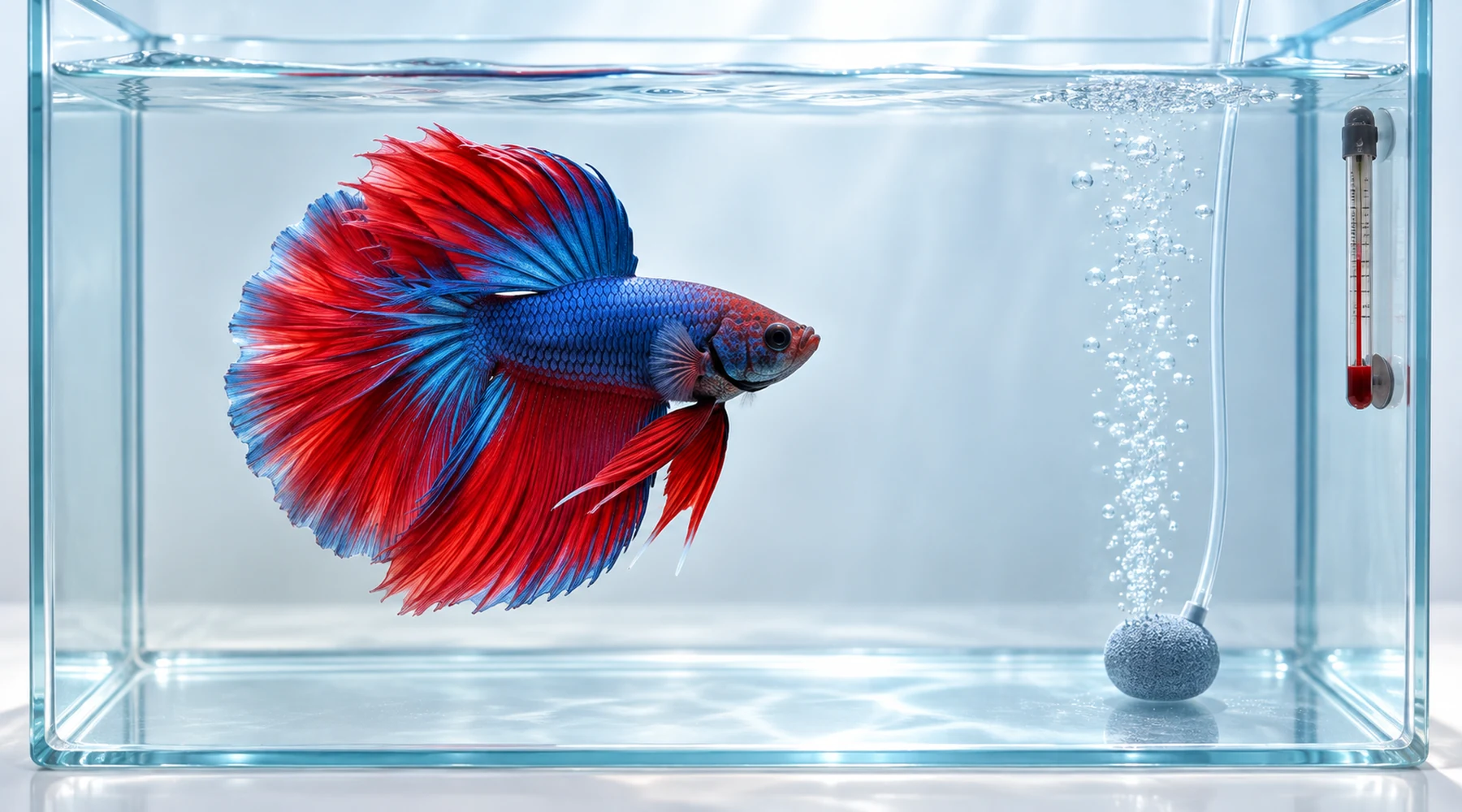
A betta keeper sees frayed fins, reaches for a blue bottle, and asks the wrong first question. The question is usually "how much," when it should be "for what, in which water, measured how." Bettas concentrate every common aquarium treatment mistake into one small tank: tiny water volumes that magnify measuring error, a fish that breathes surface air, and a symptom, ragged fins, that names no single disease.
This FAQ answers the betta-specific questions. It assumes you have already worked through the general aquarium treatment decision tree, and it leaves two topics to their own pages: general evidence on fin rot and fungal disease, and general bath-versus-tank methods.
Does methylene blue treat betta fin rot?
Not as a general claim. Read the label first. Kordon's methylene blue product information describes a 2.303% aqueous product indicated for fungal control on fish eggs and superficial fungal infections, with secondary uses against some external protozoans and assistance in known nitrite or cyanide poisoning. The same label excludes bacterial infections, flukes, Oodinium, and more severe fungal disease from its indications.
That exclusion decides most fin rot cases. Fin rot in bettas is most often bacterial, driven by organisms such as Aeromonas or Pseudomonas or by columnaris, with fungus arriving secondarily on already damaged tissue. A cottony edge on a fin can therefore be a fungal infection sitting on top of a bacterial problem the dye is not indicated for. Treating the visible white growth while the underlying bacterial infection continues is the classic failure mode: the water turns blue, the keeper feels action was taken, and the fins keep receding.
So the honest answer is conditional. If an aquatic veterinarian diagnoses a superficial fungal infection on your betta, methylene blue sits inside its labeled uses. If the diagnosis is bacterial fin rot, it does not, and you need a different plan. The evidence behind that boundary, including what methylene blue has and has not been shown to do against ich, fin rot, and fungal disease, is reviewed in the fin rot and fungal disease evidence guide. Do not import a conclusion from that page as a dose; bring a diagnosis to it instead.
Can I treat my betta in its own tank?
Prefer a separate bare treatment container. Three properties of the home tank argue against dosing it directly, and all three come from the product label rather than from folklore.
First, the manufacturer cautions against use in systems relying on biological filtration. Nitrifying bacteria process the ammonia your betta keeps producing during treatment, and a treatment that disturbs them trades one problem for another. Second, the label warns of interference with plant growth and notes removal by activated carbon plus absorption by porous materials, which makes the actual exposure in a decorated, filtered tank unpredictable. Third, aquarium silicone can stain permanently, a cosmetic but irreversible cost worth knowing before you pour.
The alternative is a bare hospital container with known water volume, a heater, gentle aeration, and nothing porous in it. That setup also protects the display tank from exposure. But isolation alone does not create safe water. The hospital container has no established biofilter, so ammonia can rise fast in a small volume, and UF/IFAS guidance on chemicals in recirculating systems recommends isolating affected fish for treatment while explaining that chemical effects depend on exposure and system conditions. Monitor the treatment water, control temperature, and keep treatment equipment separate. Compatibility details for filters, plants, shrimp, and marine systems are collected in the tank and livestock compatibility guide.
My betta lives in a small tank. How do I avoid overdosing?
Small volumes turn small measuring errors into large concentration errors. A miscounted drop in a 2 liter hospital container changes the concentration several times more than the same miscounted drop in a 40 liter tank. Bettas are often kept, and therefore treated, in exactly these small volumes.
The defense is procedural. Write down four things before preparing treatment water: the exact product name, its active concentration from the bottle, the measured treatment-water volume in the units the label uses, and the intended method. The percentage on a bottle describes the stock solution, not the treatment; the directions describe how much of that stock enters a specified amount of water. A short dip and a longer exposure are different concentration-plus-time pairs, so never combine the concentration from one protocol with the duration from another. The bath versus tank treatment guide explains why these pairs cannot be interchanged and works through the label protocols.
Measure water volume rather than trusting a tank's nominal size. Substrate, decor, and a lowered waterline all subtract from the advertised capacity, and in a small container each missing half liter is a large fraction. Use metric measures and a syringe or graduated pipette for the stock, not drops squeezed from the bottle, and prepare the full treatment volume before the fish enters it.
Does the labyrinth organ change anything about treatment?
Yes, in one practical way. Bettas are labyrinth fish: they rise to breathe atmospheric air through a dedicated organ as well as extracting oxygen from water through their gills, so husbandry guidance recommends unobstructed surface access. A treatment container must therefore leave the surface accessible at all times, with warm humid air above it rather than a tight cold lid.
This matters twice over. First, any protocol that suggests covering treatment water closely, or that fills the container to the brim, conflicts with how the fish breathes. Leave an air gap and a lid that breathes. Keep the treatment water at the same warm stable temperature the fish is used to; veterinary guidance recommends 76 to 81F for betta tanks, normally maintained with a heater. Second, surface breathing does not protect against bad water. Ammonia and nitrite injure gills and stress the fish regardless of air access, which is why the hospital container still needs monitoring even though its occupant can gulp air. If you see persistent gasping, lethargy, or rubbing, treat those as signals of an unsolved water or disease problem, not as requests for more dye.
What should I check before using methylene blue at all?
Check the environment before naming the disease. The UF/IFAS fish health management guide recommends checking water quality first when fish appear sick, with dissolved oxygen, ammonia, nitrite, and pH as the minimum outbreak screen. A clear-looking betta tank can still hold harmful ammonia, which is colorless and odorless at concentrations that injure fish, and interpreting total ammonia requires temperature and pH, as UF/IFAS explains for ammonia in aquaculture systems.
Run the same decision sequence as for any aquarium fish: confirm water quality and equipment, match the diagnosed problem to the product's actual indications, confirm the exact product and readable instructions, verify the treatment container can meet the label's compatibility conditions, measure the true water volume, and define an observation and completion plan with an escalation path. Ulcers, persistent respiratory distress, or continuing deaths warrant prompt assessment by an aquatic veterinarian or fish health specialist rather than another round of dye.
Should every new betta get a preventive dip?
No routine justifies it. Blue shipping water is not evidence that every new arrival benefits from a bath. In experiments reported by the University of Florida Tropical Aquaculture Laboratory, methylene blue used as a prophylactic bath did not improve the measured appearance or behavior of fish. A separate transport trial with velvet swordtails found better immediate appearance with treatment, but appearances converged after a week. Different exposures, different observations, no universal shipping recommendation.
For a new betta, quarantine and observation outperform prophylaxis. UF/IFAS guidance for responsible aquarium ownership places quarantine, suitable filtration, nutrition, and water quality inside routine disease prevention. Watch the fish, test the water, and reserve medication for an identified need inside that plan.
The short version
State the diagnosed problem, confirm it sits inside the product's labeled indications, and treat in a measured bare container with surface access and a monitoring plan. Fin rot without a diagnosis is not an indication. A small tank without a measured volume is not a dose. And a blue tank without an observation plan is not a treatment.