
Article
Methylene blue for ich, fin rot, and fungal disease: comparing the evidence
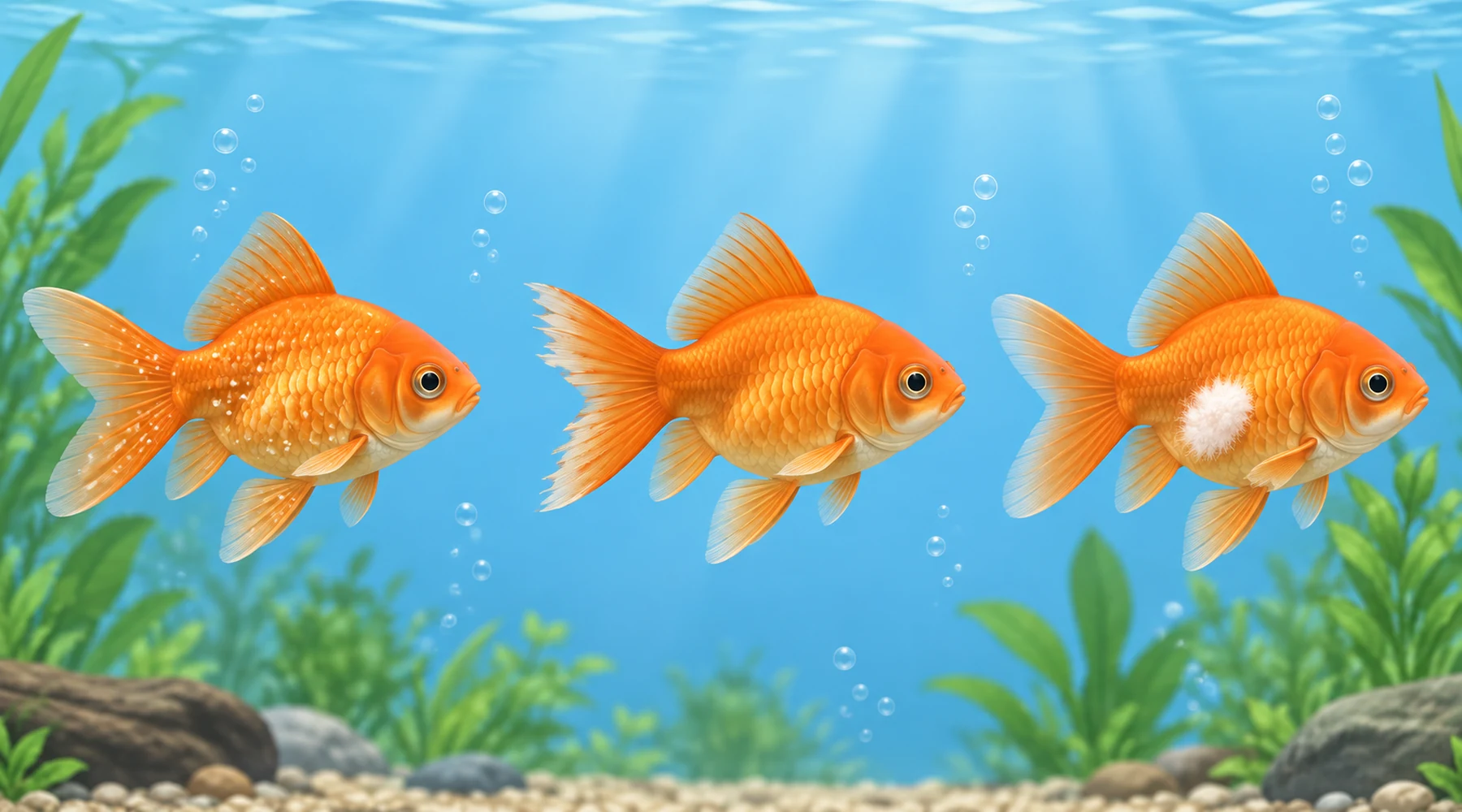
A fish shows white spots. The water turns blue. The spots become hard to see, and the owner concludes the treatment worked. Days later the fish is worse. Nothing about the dye changed the parasite. Only the view changed.
That mistake repeats because several diseases share one visual vocabulary: white dots, pale patches, ragged fins, cottony tufts. Search results still present the dye as one answer to every lesion. The organisms disagree. A ciliate protozoan, a water mold, a Gram-negative bacterium, a dinoflagellate, and a flatworm share little except damaged skin, fins, or gills. A dye with real but narrow effects cannot cover all five. The useful order is diagnosis first, then pathogen and life stage, then drug, then product label. Everything below follows that order.
Where the evidence is strongest: eggs and water mold
The best supported aquarium use of methylene blue is protection of fish eggs against water mold, chiefly Saprolegnia and Achlya. These are oomycetes, water molds rather than true fungi, and they colonize dead or damaged eggs and wounds before spreading to neighbors. Controlled work found 3 mg/L improved hatching in angelfish and black-skirt tetra, while zebrafish did not benefit, so the dose response is species dependent rather than universal. The broader context is summarized in a recent review of ornamental fish disease treatments.
Superficial cottony lesions on adult fish sit one step down in evidence. Methylene blue has genuine anti water mold activity on exposed surfaces, and general aquarium guidance on methylene blue for aquarium fish places egg and surface use at the center. Hatchery practice extends the same logic, as described in methylene blue for fish eggs and hatchery use. But a cottony tuft is often secondary. It grows where a wound, a parasite bite, poor water quality, or a bacterial lesion opened the surface first. Treating the tuft while ignoring the breach underneath produces recurrence.
Freshwater ich: partial, stage dependent help
Freshwater white spot disease is caused by Ichthyophthirius multifiliis, a ciliate that burrows into skin, fins, and gills. Mature feeding stages are large, roughly half a millimeter to a millimeter, so the classic sign reads as discrete salt grains. University extension material on freshwater ich biology and treatment principles describes the life cycle and stresses microscopy of skin or gill samples over guessing from spots alone.
Methylene blue has some antiprotozoal activity here, and manufacturer labels include Ichthyophthirius among secondary uses. A recent review notes partial success when methylene blue was combined with salt in heavily infected catfish, yet a penetration study found the dye could not kill feeding trophonts encysted within the skin. That pair of findings defines the ceiling: plausible action against exposed free stages, weak action against the protected feeding stage buried in epithelium. Treatment must therefore span the life cycle rather than ending when spots fade from view. Standard extension guidance leans on formalin, copper, and salinity based strategies rather than methylene blue monotherapy.
Marine white spot is a different organism, Cryptocaryon irritans, and the evidence gets thinner. Older chemical lists mention methylene blue with variable success, but current extension guidance on marine white spot diagnosis and treatment centers copper, hyposalinity, chloroquine, and formalin protocols, with copper held at a monitored free ion concentration for weeks. A methylene blue bath is not equivalent to clearing Cryptocaryon from a system.
Fin rot: a torn fin is not automatically an infection
Fin rot is a syndrome, not one pathogen. Opportunistic Gram-negative bacteria, including Pseudomonas and Aeromonas species, invade fins already damaged by poor water quality, aggression, or handling. Veterinary guidance on bacterial diseases of fish lists exactly these predisposing factors and recommends culture with susceptibility testing when antimicrobial therapy is warranted.
Methylene blue is not an antibiotic for established fin rot in any convincing trial. One frequently misread goldfish study exposed fish to methylene blue for weeks before a bacterial challenge and found altered immunity and later survival. That is preconditioning biology, not a cure trial for rotting fins. A fresh clean tear that stabilizes after water correction and removal of the nipping tankmate was mechanical damage. Progressive recession with discoloration, inflammation, ulceration, or tissue loss points toward infection and needs diagnosis and targeted therapy.
The comparison table
| Condition | Organism or cause | Evidence for methylene blue | What to use or add instead |
|---|---|---|---|
| Egg fungus, external water mold | Saprolegnia, Achlya (oomycetes) | Moderate for eggs; low to moderate for superficial lesions. Strongest use case in this article. | Fix the underlying wound or water problem; follow egg protocols in methylene blue for fish eggs and hatchery use. |
| Freshwater ich | Ichthyophthirius multifiliis (ciliate) | Low to moderate; stage dependent; combination and label evidence only. | Life cycle coverage; formalin, copper, or salinity strategies per extension guidance. |
| Marine ich | Cryptocaryon irritans (marine ciliate) | Low; legacy mentions only. | Copper, hyposalinity, or chloroquine under monitored protocols. |
| Freshwater velvet | Piscinoodinium (dinoflagellate) | Low; historical reports of immersion treatment. | Copper based protocols have stronger support. |
| Marine velvet | Amyloodinium ocellatum (marine dinoflagellate) | Insufficient as first line therapy. | Formalin, hydrogen peroxide, freshwater dips, copper, or chloroquine per Virginia Tech guidance on marine velvet. |
| Skin and gill flukes | Gyrodactylus, Dactylogyrus (monogenean flatworms) | Insufficient; antiprotozoal action does not transfer to flatworms. | Praziquantel is the treatment of choice for ornamental monogeneans per extension guidance on fish monogeneans. |
| Columnaris | Flavobacterium columnare (bacterium) | Insufficient; do not present as a columnaris treatment. | Wet mount diagnosis; targeted antimicrobial decisions, not dye baths. |
| Dropsy | A sign: fluid accumulation from renal, cardiac, septicemic, or other causes | No evidence for treating dropsy as such. | Diagnose the underlying disease; antibiotics only when bacterial disease is implicated. |
| Swim bladder signs | A sign: buoyancy disorder with many causes | No evidence for generic swim bladder treatment; one toxicologic exception below. | Water quality first, then anatomic, dietary, infectious, and environmental differentials. |
Telling them apart before medicating
Four presentations get confused most often. Size helps. Ich spots are discrete raised grains visible individually. Velvet is a fine dusting or gold brown sheen, much smaller per particle, and marine velvet trophonts average only a fraction of ich size. Water mold is three dimensional: cottony threads standing off the surface. Columnaris forms yellowish white filamentous or slimy patches that look deceptively fungal but smear as bacterial mats on a wet mount.
Location and behavior add information. Ich favors skin, fins, and gills, and marine ich can hide in gills with no visible spots at all. Velvet hits gills hard, so rapid breathing with flashing puts velvet high on the list. Water mold picks wounds and dead eggs first, so its presence asks what injured the surface. Columnaris attacks skin, gills, and fins and can erode tissue quickly.
The discriminator that settles most arguments is microscopy: a skin, fin, or gill wet mount showing ciliates, dinoflagellate trophonts, branching water mold structures, or the filamentous bacterial aggregates of columnaris. Before any of that, check ammonia, nitrite, temperature, pH, and dissolved oxygen, plus salinity in marine systems. Poor water quality both mimics disease and invites the secondary infections that the dye then gets blamed for failing to cure.
Five cases where the dye is the wrong answer
Velvet belongs to copper, not to blue water. Historical immersion reports exist for freshwater velvet, but the evidence is old and thin, and copper carries substantially stronger support. For marine velvet, current expert guidance discusses formalin, peroxide, dips, copper, and chloroquine, with repeat treatment because the encysted stage resists.
Flukes need an anthelmintic. Monogeneans are multicellular flatworms, and nothing about methylene blue antiprotozoal activity transfers to them. Extension guidance names praziquantel, commonly as a prolonged bath in the low single digit mg/L range under appropriate veterinary and regulatory conditions, as the treatment of choice for ornamental fish.
Columnaris needs bacteriology, not dye. Flavobacterium columnare is a Gram-negative bacterium capable of rapid tissue destruction, especially in gills. A surface antiseptic effect does not equal cure of a progressive bacterial infection, and established antimicrobial indications for columnaris in aquaculture belong to drugs chosen on diagnosis and susceptibility rather than dosed casually at home.
Dropsy is not a disease to match with a drug. The pinecone appearance describes fluid accumulation with many possible roots: organ failure, systemic infection, cardiac disease, severe integument damage. A veterinary explainer of why dropsy has no single cure makes the point directly. Treating the swelling without identifying the failed system wastes the window for effective action.
Swim bladder signs are the same category error with one instructive exception. Abnormal buoyancy can come from anatomy, diet, constipation, trauma, infection, organ compression, or water chemistry. Methylene blue treats none of those directly. The exception is nitrite toxicity: nitrite oxidizes hemoglobin to methemoglobin, which cannot carry oxygen, and affected fish can swim abnormally. Trout erythrocyte work shows a methylene blue assisted pathway for methemoglobin reduction in fish blood, and experimental steelhead work found low methylene blue concentrations reduced acute nitrite toxicity. That treats the poisoning, as explained in methylene blue and nitrite poisoning in fish, not a damaged swim bladder.
What the labels actually claim
Product labels differ more than marketing summaries suggest, and the strictest label is the most informative. The Kordon methylene blue label names superficial fungal infection, egg fungus, secondary use against some external protozoa including Ichthyophthirius, and support in cyanide and nitrite poisoning, then explicitly states the product is not indicated for Oodinium, bacterial infections, flukes, or moderate to severe fungal infection. Those exclusions rule out exactly the overuses this article warns against.
The Fritz methylene blue information sheet is similarly narrow: prevention and protection against superficial fungal infection, egg protection, secondary protozoan use including freshwater ich, with both a low prolonged concentration and a brief high concentration dip protocol. The NT Labs methylene blue page claims more broadly, including bacterial presentations such as rotting fins and ulcers. Those broader claims are manufacturer claims, and the independent evidence does not establish methylene blue as reliable therapy for bacterial fin rot or columnaris, so the narrower labels track the literature better.
Combination products add a further trap. Formulations that list methylene blue beside acriflavine, ethacridine, methyl orange, or other antiparasitics may carry white spot or velvet indications that belong to the mixture, not to methylene blue alone. Reading the active ingredient list prevents crediting the dye for work done by its companions.
Using it without wrecking the tank
Methylene blue belongs in a bare hospital or treatment tank, not in a mature display. The Kordon label warns that it interferes with nitrifying filter bacteria and plant growth, absorbs into rock, coral, and wood, stains silicone, and is removed by activated carbon. Other manufacturers give the same cautions: remove carbon during treatment, expect plant and invertebrate sensitivity, and prefer quarantine bath use. Published dosing patterns are label examples, not universal prescriptions, and stock concentrations vary by brand: prolonged low exposure around 3 mg/L for several days, egg treatment near 3 mg/L through hatch, very brief high dips near 50 mg/L for seconds. Long exposures are not harmless; multi week exposure at 2 mg/L produced adverse growth and blood effects in goldfish.
The decision rule that survives all of this is short. Identify the organism or admit the sign is undifferentiated. Match the drug to that organism: dye for eggs and exposed water mold, life cycle aware protocols for ich, copper for velvet, praziquantel for flukes, diagnosis driven antimicrobials for columnaris, workup of the failing system for dropsy and buoyancy. Use methylene blue where its evidence sits, in a hospital tank, on the label, with water quality corrected first.