
Article
Liposomal methylene blue: delivery research and consumer claims
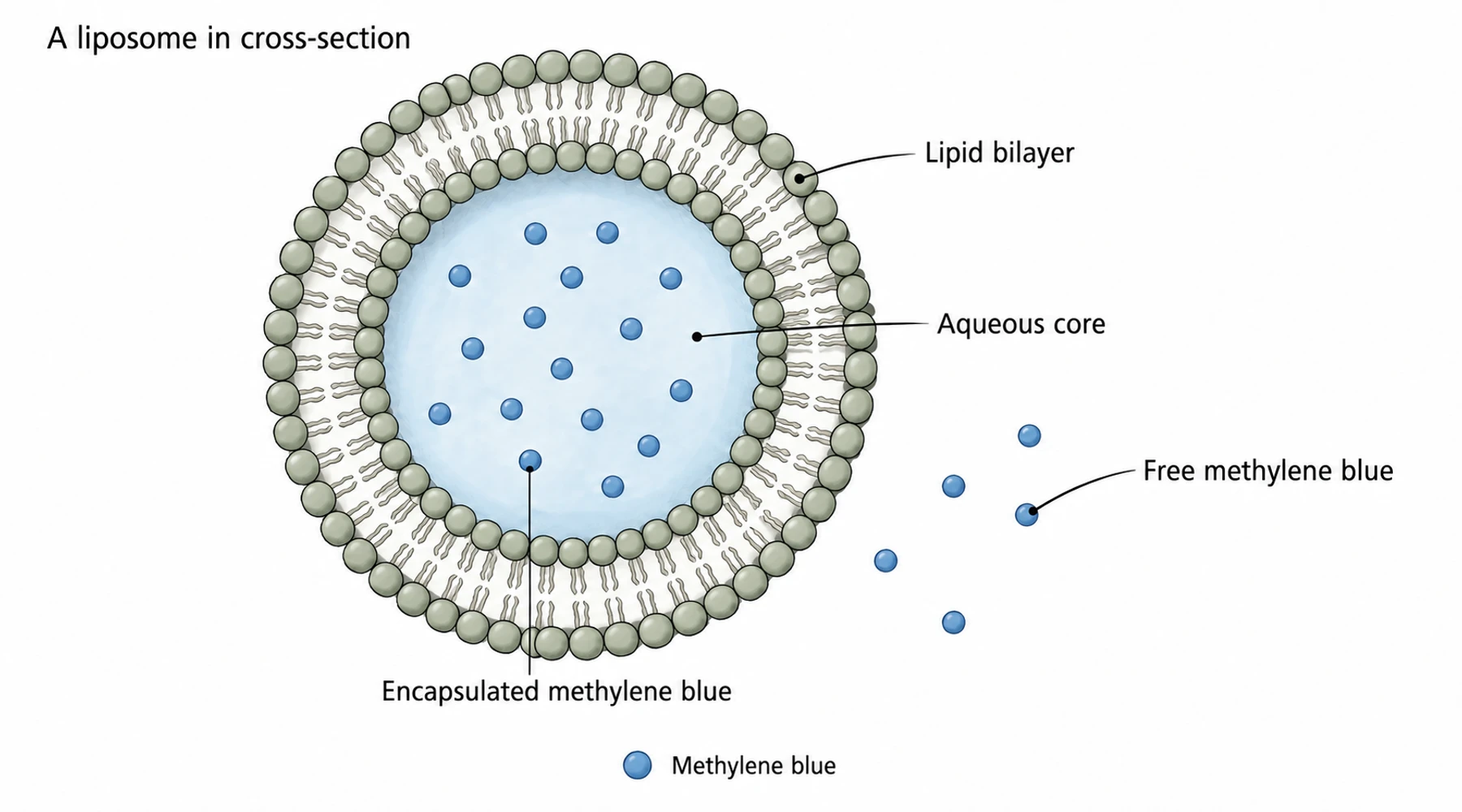
“Liposomal” describes a delivery structure. It does not, by itself, establish better absorption, improved brain delivery, or a health benefit. For methylene blue, published carrier research includes laboratory photodynamic experiments and a small topical clinical study. Those findings belong to the particular formulation, route, and endpoint tested.
The useful buying question is therefore specific: what evidence connects this finished product to the advantage claimed on its label? A study showing stronger light-activated effects against a biofilm cannot answer how much methylene blue enters a person's circulation after swallowing an unrelated liquid.
What a liposome contains
A liposome is a small vesicle whose membrane consists of a lipid bilayer, sometimes with additional concentric bilayers. Water occupies the central compartment. Drug molecules can associate with different parts of the structure according to their chemistry and the preparation method. Some drug may also remain outside the vesicles.
The cover illustrates a simplified single-bilayer carrier, with symbolic methylene blue dots inside and outside. It represents compartments, not the measured loading or molecular distribution of a commercial product.
Lecithin on an ingredient list is insufficient evidence that stable drug-loaded liposomes are present. A manufacturer needs to establish the structure and quantify the drug it carries. The FDA's liposome drug-product guidance distinguishes liposomes from nonvesicular drug-lipid complexes and treats manufacturing characterization and human pharmacokinetics as separate questions. This is guidance for drug applications, not an approval seal for products using the word “liposomal.”
Other carriers are different systems. Cyclodextrins are ring-shaped carbohydrates used in drug complexation; polymer nanoparticles use a polymer-based carrier. Neither becomes a liposome because it is small or contains methylene blue.
Five measurements behind a meaningful formulation claim
The National Cancer Institute's liposomal characterization protocol separates composition, physical structure, and drug content. A useful product dossier should make the following distinctions clear:
- Size and size distribution. An average diameter conceals how widely particles vary. A polydispersity index helps describe that variation. Size measurements alone do not establish the presence of a lipid bilayer.
- Carrier composition and morphology. Lipid identity, proportions, and structural imaging help distinguish vesicles from other aggregates. A supplier's ingredient list cannot replace measurements of the finished preparation.
- Total, free, and encapsulated methylene blue. Total concentration answers how much dye is present. Encapsulation efficiency describes a fraction associated with the loading process. Drug loading describes drug content relative to carrier material; the report must state its calculation basis.
- Release and leakage. Researchers need to measure whether the drug leaves the carrier, how quickly, and under which test conditions. A release result in one buffer is not a measurement of human absorption.
- Stability over time. Particle aggregation, drug leakage, and chemical degradation are separate failure modes. Results need a stated temperature, light exposure, container, and duration relevant to the product's storage claim.
A concrete example shows why this matters. In a 2019 liposome study using breast cancer cells, particle size remained near 160 nanometers during 14 days of monitoring. A separate release experiment found that approximately 95% of the methylene blue left the liposomes within eight hours. Stable particle diameter and sustained drug retention are different properties. Neither measurement was a human oral absorption result.
Delivery-system comparison: measurements versus outcomes
This comparison separates the carrier question from the biological question. The measurement column identifies relevant tests, not a claim that every listed study completed every test.
| Delivery system | Formulation measurements that matter | Endpoint actually examined in the cited research | What it cannot establish for an oral retail product |
|---|---|---|---|
| Aqueous methylene blue without a liposomal carrier | Identity, concentration, impurities, chemical stability | Human plasma exposure after oral and intravenous administration | The absorption of a different product or a clinical benefit from its use |
| Methylene blue in lipid-bilayer vesicles | Size distribution, lipid composition, free and encapsulated drug, release, storage stability | Cell uptake, light-activated cell effects, or fungal biofilm endpoints in laboratory studies | Superior gastrointestinal absorption or improved cognition |
| Liposomal methylene blue in topical hydrogel | Vesicle properties, gel release, skin localization | Acne lesion counts and clinical assessments in a small topical photodynamic trial | Benefits from swallowing liposomes, or efficacy without the light-treatment protocol |
| Methylene blue with beta-cyclodextrin | Complex/carrier identity, drug association, concentration, stability | Viable microbial counts in a laboratory oral biofilm with red-light activation | Liposome performance, systemic absorption, or treatment of an infection in a person |
| Methylene blue in polycaprolactone nanoparticles | Polymer composition, size, loading, release, surface properties | Skin penetration and cancer-cell phototoxicity in a topical delivery investigation involving ultrasound | Clinical cancer treatment efficacy or oral liposome bioavailability |
The polymer example comes from research combining polycaprolactone nanoparticles with sonophoresis, an ultrasound-assisted delivery approach. It illustrates why both carrier material and the accompanying intervention matter.
What the methylene blue studies actually show
In the liposomal Candida auris study published online in December 2025, researchers compared positively and negatively charged carriers with free methylene blue. Liposomal preparations improved delivery within laboratory biofilms and light-activated antibiofilm effects. However, the minimum fungicidal concentration against free-floating fungal cells was equivalent to that of free dye. The apparent advantage depended on the microbial setting and endpoint.
The same paper reported encapsulation efficiencies of approximately 11% and 14% for the two formulations. Their measured physical properties were maintained for 30 days under refrigerated, dark storage, with instability observed later. These are useful development findings, not specifications that can be assigned to a bottle from another manufacturer.
The 2021 beta-cyclodextrin study used a multispecies oral biofilm grown in microplates for 24 hours. Treatment paired the methylene blue carrier with red laser or LED illumination and assessed viable microorganism counts. Here “oral biofilm” means microorganisms associated with the mouth. It does not mean the preparation was swallowed or its oral bioavailability measured. The distinction is central to interpreting light-activated biofilm research.
Human carrier evidence is not entirely absent. A small randomized, investigator-blinded acne study treated 13 patients using liposomal methylene blue hydrogel with photodynamic therapy. It reported improvements in lesion counts and clinical assessments after two treatment sessions, with follow-up extending to 12 weeks. Separate formulation work examined release and targeting in mouse skin. The small patient sample, topical route, and light-dependent intervention limit what this study can establish. It is not a comparison of swallowed liposomal and ordinary methylene blue.
What would support a better-absorption claim?
An oral claim needs a human study of the relevant finished formulation, an appropriate comparator, comparable methylene blue amounts, and defined sampling and analytical methods. Exposure measures such as the area under the concentration-time curve describe drug exposure over time. A higher peak alone does not establish greater total absorption or a better clinical result.
Ordinary aqueous methylene blue already has human absorption data. A phase I crossover study in 16 healthy volunteers reported mean absolute bioavailability of 72.3%, with substantial variation, for the aqueous formulation tested. This finding neither establishes a universal absorption percentage nor ranks it against liposomal products. It does undermine an assumption that methylene blue necessarily requires a liposome to be absorbed.
The primary studies located for this article did not provide a human head-to-head oral trial establishing superior absorption of a retail liposomal methylene blue formulation. That is a limit of the evidence identified, not proof that no such study could exist. Route-specific absorption and distribution also require separate interpretation from clinical benefit.
How to evaluate a liposomal or compounded label
Ask for evidence on the exact product: its methylene blue concentration, carrier characterization, batch testing, storage stability, and any human comparison supporting the advertised advantage. A certificate measuring dye purity alone cannot verify encapsulation or absorption. Blupreme sells methylene blue; this article does not identify a preferred liposomal brand. Apply the same buyer comparison checklist to every seller.
“Compounded liposomal methylene blue” adds a preparation context, not proof of superior delivery. In the United States, compounded drugs are not FDA-approved. A pharmacist or prescriber should be able to explain the formulation's purpose and the evidence behind its intended route. Encapsulation should not be treated as a way to bypass methylene blue's established safety considerations.
When comparing solution with powder or capsules and tablets with liquid drops, keep convenience, documented content, and clinical performance separate. Pay for a demonstrated property, rather than assuming that a carrier name supplies the missing evidence.