
Article
Paul Ehrlich and methylene blue: how a dye helped shape drug discovery
Paul Ehrlich's contribution to medicine was not a drug. It was an argument about how to look at one.
In 1878 he submitted a doctoral thesis whose opening section was titled "The Chemical Conception of Staining." Its argument was that staining a tissue section and dyeing a piece of cloth follow the same logic. In both, colour attaches because of a chemical affinity between the dye and the material, not because the tissue is absorbent, or greasy, or shaped to trap a pigment. Ehrlich had grown up watching his cousin, the pathologist Karl Weigert, prepare stained sections, and what held his attention was not the pictures but the fact that the dye chose where to go.
The claim sounds modest. It is not. If a dye binds to a tissue for chemical reasons, then the pattern of staining is a report on the chemistry of that tissue. A stained slide stops being an illustration and becomes a measurement.
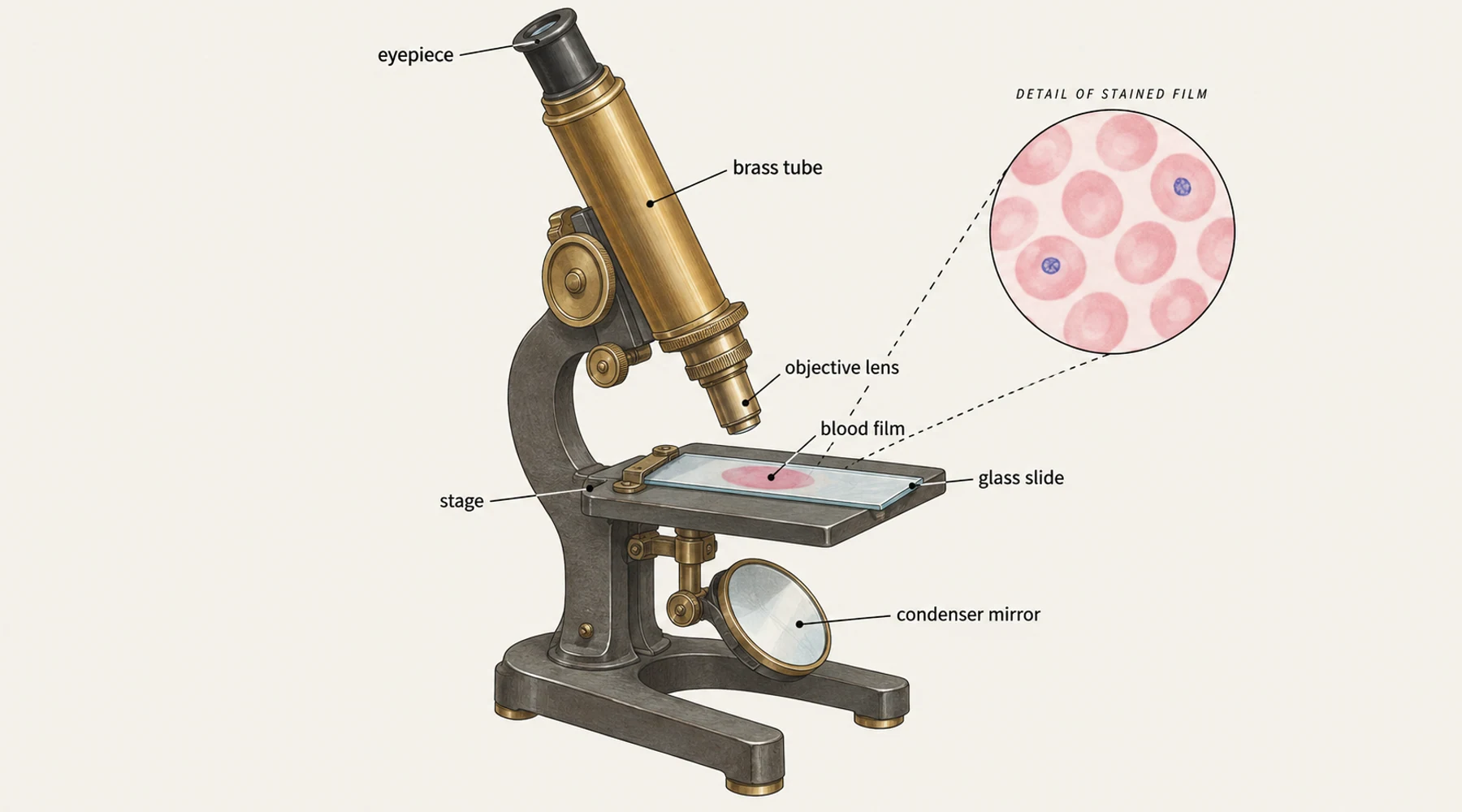
He built on that immediately. In 1880 he combined methylene blue with acid fuchsin and called the mixture a neutral stain, a neutralen Farbkörper, which separated the different kinds of white blood cell where the single dyes then in use could not. Two years later he presented a methyl violet method for staining tubercle bacilli, and Koch adopted the procedure in his own work.
The theory that later gave these practices a common foundation is a separate matter, and its date is routinely flattened. Ehrlich's side-chain theory, the idea that a substance acts on a cell because the two are chemically compatible, belongs to the 1890s, not to the dye years. What the earlier work supplied was the antecedent conviction: selectivity is chemical, and therefore selectivity can be searched for rather than stumbled upon.
The experiment that made the dye into a map
In 1885 Ehrlich published a monograph on the oxygen requirements of the organism, subtitled a colour-analytical study. Its method was to inject dyes whose colour depends on oxidation state, then compare how different organs reduced or preserved them. The dye was being used as an instrument, in the way a thermometer is used: it reported on conditions inside tissue that could not be surveyed directly. Ehrlich's own statement of the aim was to determine, with the help of particular dyes, the reducing power of living organs.
The methylene-blue result came in 1886, in a paper on the dye's reaction with living nervous substance, read to a medical society the previous December. Methylene blue was introduced into the circulation of a living animal, and thin slices of tissue were then removed and exposed to air so that accumulated colourless dye oxidised back to blue and showed where it had collected. Nerve cells and nerve fibres took the colour, and took it selectively enough that the technique became a standard method for showing nervous tissue. The compound was no longer only a colouring matter applied to a dead section on a bench. It was a marker that distributed itself inside a living body, and the distribution could be read.
The property underneath both experiments deserves stating plainly, because everything else in this story depends on it. Methylene blue is reversible. Its reduced form, leucomethylene blue, is colourless, and on contact with oxygen it returns to the blue cation. A glucose solution of the dye in a sealed jar is colourless; open the jar and it turns blue. Ehrlich is reported to have shown the point directly by treating stained sections with iron chloride as well as air and watching the colour return. A dye that changes colour with the redox state of its surroundings is a probe for those surroundings.
So two properties sat next to each other. A dye could distinguish one tissue from another. And a dye could be switched on and off by a change in oxidation state.
Read backwards, the second property is the beginning of chemotherapy. If a compound binds to one kind of tissue and not another, then the same compound might reach one kind of organism and not another. Ehrlich stated the inference directly: if a pathogen could be stained selectively, the staining might indicate a specific harm to that pathogen. A dye might therefore be usable as a drug, aimed at an invader rather than at the patient.
The first test in a patient was not for malaria. In 1890, with the psychiatrist Arthur Leppmann, Ehrlich reported that methylene blue relieved pain in neuralgic and rheumatic conditions of muscle, joints and tendons. The two men discussed whether the drug might act on mental illness and decided not to try it. An Italian physician, Pietro Bodoni of Genoa, went ahead anyway. His 1899 paper is titled for a sedative action in various forms of psychosis: he described calming in fourteen agitated patients, and noted that other Genoa doctors were already using the dye for the same purpose. Sedation is not an effect on the illness, and the distinction is one this history keeps producing.
The malaria work came in 1891, with the pathologist Paul Guttmann, at the Moabit hospital in Berlin. Methylene blue was given to two patients, and the report appeared in the Berliner klinische Wochenschrift of 28 September 1891. In the first case the patient took 0.5 g of the dye at once on the evening of 29 June; the attack that had been expected did not fully arrive, and the only complaint recorded afterwards was mild strangury with blue urine. Fever attacks disappeared over the first days, and the parasites were gone from the blood by the eighth day at the latest. The authors' own summary was that their expectations had been completely fulfilled. Two uncontrolled cases are not a demonstration. The fuller account of methylene blue and malaria, including the modern trials, belongs on its own page, and the interesting question here is narrower: how much of Ehrlich's reasoning survived contact with the parasite.
Where the reasoning held and where it failed
Not much of the mechanism survived, at least not in the form Ehrlich proposed. The tidy version, in which a flat tricyclic cation slides between the base pairs of parasite DNA, does not stand up against Plasmodium. Methylene blue is reduced so readily by an infected red cell that it never arrives at the parasite as a planar cation at all, and the intercalation story that fits the acridine dyes does not fit this one.
What the evidence does support is untidier. Methylene blue inhibits the parasite's glutathione reductase at concentrations a patient can reach. It blocks the conversion of haem into haemozoin, the inert pigment the parasite builds to avoid being poisoned by its own digestion of haemoglobin, about as effectively as chloroquine and far more effectively than quinine. Its redox cycling also generates reactive oxygen species in a cell already producing them. Which of these is the real mechanism, or whether all contribute, is still not settled.
There is a further complication, and it should shape how any historical claim about this compound gets read. Commercial methylene blue of that period was not one substance. Samples contained azure B, the mono-demethylated congener, and older solutions accumulated more of it. Azure B is a metachromatic dye with different targets: it stains double-stranded DNA deep blue and RNA green. A mixture of two dyes with different destinations, in proportions nobody recorded, cannot support a clean statement about what the methylene blue in it did.
The dye itself never displaced quinine. The method did better. Ehrlich's student Wilhelm Roehl, working for the dye and drug combine IG Farben, kept pushing dye derivatives as tropical medicines and supplied the missing tool: the canary, infected with a bird malaria, as a routine screen for candidate compounds. Werner Schulemann then altered the side chain, and the resulting phenothiazinium salt cured the experimental infection. It still turned patients blue.
The durable output turned out to be neither the dye nor the ring system but the side chain. Adding a dialkylaminoalkylamino group changed how the molecule behaved, and the fragment survived every later redesign. Keep that group and swap the phenothiazinium ring for an acridine, and the result is quinacrine. Swap in a quinoline, and the result is chloroquine. Pamaquine, primaquine and amodiaquine, all still in the antimalarial catalogue, carry the same group. The compound that failed as a treatment supplied the piece that succeeded.
The connection to the antipsychotics runs through the ring rather than through the drug. Elucidating the structure of methylene blue is what led Heinrich August Bernthsen to the parent phenothiazine nucleus in 1883, and that scaffold, substituted in different ways, is what chemists at Rhône-Poulenc were working on in the 1940s while hunting for antihistamines. One of those compounds was synthesised around the end of 1950 and tested by the surgeon Henri Laborit, who noticed that it left patients calm and indifferent. Its first published psychiatric use, in a patient with mania, came in January 1952. The first antipsychotic is not a descendant of Ehrlich's antimalarial so much as a distant relative of the dye he started with.
Three habits this episode is worth keeping
- "First synthetic drug used in medicine" describes a category, and the qualifications are larger than the phrase suggests. The phrase has become a fixture; a much-cited review by Schirmer and colleagues in Neurobiology of Aging calls methylene blue the very first fully synthetic drug used in medicine. Chloral hydrate was introduced as a synthetic sedative in 1869, more than twenty years earlier. The 1891 paper itself supplies part of the answer, because its authors name the synthetic antipyretics that had already failed against malaria, among them quinoline, antipyrine and antifebrin. Ehrlich's own arsenical for syphilis came later still. The defensible version of the claim is about method rather than priority: methylene blue is among the earliest synthetic compounds chosen to act against a specific organism on the basis of a chemical theory of selectivity.
- Selective distribution is not selective benefit. Ehrlich's 1886 result was that the dye goes to nerve tissue. Where a compound goes and what it does on arrival are two different measurements, and the first is much easier to make. That gap is where most claims about methylene blue and the brain have lived ever since.
- Purity belongs to the evidence, not to the marketing. The historical record is ambiguous for exactly this reason. Small structural differences change where this compound goes, which is why a certificate of analysis has to be tied to a specific lot rather than offered as a statement that a product is tested. A seller claiming conformance to the pharmacopoeial monograph while testing only heavy metals is claiming more than the report supports. Blupreme sources methylene blue from a pharmaceutical manufacturer and tests the full specification the monograph sets out: identity, purity, organic impurities, residual solvents, elemental impurities, residue on ignition, microbial limits and bacterial endotoxins. The report is published alongside the product, and the USP grade methylene blue page explains those limits and why the azure B result is the first one to look for.
A dated source trail
| Date | What was done | Where it is recorded |
|---|---|---|
| 1878 | A doctoral thesis argues that staining and textile dyeing follow the same logic of chemical affinity | Ehrlich, thesis, Leipzig, 1878; its first part is titled "The Chemical Conception of Staining" |
| 1880 | Methylene blue with acid fuchsin, a "neutral stain", separates the white blood cell types | Krafts, Hempelmann and Skórska-Stania, Parasitol Res 111:1-6, 2012 |
| 1882 | A methyl violet method for staining tubercle bacilli is presented to the Berlin Medical Society, and published the following year | Ehrlich, Berliner klinische Wochenschrift 20:13, 1883 |
| 1885 | A colour-analytical monograph uses redox dyes to compare the reducing power of organs | Ehrlich, Das Sauerstoff-Bedürfniss des Organismus, Berlin, 1885 |
| 1886 | Methylene blue injected into a living animal marks nervous tissue selectively | Ehrlich, "Ueber die Methylenblaureaction der lebenden Nervensubstanz", Deutsche Medizinische Wochenschrift 12(4):49-52, 1886 |
| 1888 | Methylene blue with eosin stains the malaria parasite in blood films | Chęciński, Centralblatt für Bakteriologie und Parasitenkunde 3(15):457-460, 1888 |
| 1890 | Methylene blue is reported to relieve neuralgic and rheumatic pain | Ehrlich and Leppmann, Deutsche Medizinische Wochenschrift 16(23):493-494, 1890 |
| 1891 | Methylene blue is given to two patients with malaria at the Moabit hospital, Berlin | Guttmann and Ehrlich, "Ueber die Wirkung des Methylenblau bei Malaria", Berliner klinische Wochenschrift 28(39):953-956 |
| 1897 | The side-chain theory is set out in its mature form, in a paper on diphtheria serum | Ehrlich, Klinisches Jahrbuch 6:299-326, 1897 |
| 1899 | A sedative action of methylene blue is reported in various forms of psychosis | Bodoni, Clinica Medica Italiana 24:217-222, 1899 |
| 1926 | The infected canary becomes a routine antimalarial screen | Roehl, Deutsche Medizinische Wochenschrift 52, 1926 |
| 1932 | A side-chain substitution cures the experimental infection | Schulemann, Proc R Soc Med 25:897-905, 1932 |
| 1934 | An acridine ring is replaced by a quinoline, producing chloroquine | Krafts and colleagues, 2012, drawing on Bayer archive material |
| 1950 | A substituted phenothiazine, later named chlorpromazine, is synthesised at Rhône-Poulenc; published 1952 | Charpentier and colleagues, Comptes rendus de l'Académie des Sciences 235:59-60, 1952 |
| 1952 | The first published psychiatric use of chlorpromazine | Delay, Deniker and Harl, Annales médico-psychologiques 110:112-117, 1952 |
The dated sequence of milestones, including the dye chemistry that came before Ehrlich and the grades and specifications that came after him, is set out separately in the history of methylene blue, and the compound's own identity is covered in what methylene blue is.
The plates behind this account, reproduced in the 2012 review by Krafts, Hempelmann and Skórska-Stania, are not equivalent, and one example shows why. The 1891 plate is the primary record of the trial; the 1910 portrait beside it dates a reputation and nothing else. Pages from Andersag's 1934 notebook are the direct trace of the quinoline substitution, in the chemist's own hand.
The honest summary of Ehrlich's dye experiments is that he got the selectivity and he got the target, and he missed the mechanism. Methylene blue does concentrate in nervous tissue and does harm the malaria parasite. It does not do the second because of the first, and the chemical reason he offered for both was wrong. What he demonstrated beyond dispute was more lasting than a correct mechanism: a compound can be chosen rather than found, and chosen on evidence gathered before anyone gives it to a patient.